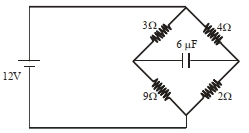
In the circuit shown, the energy stored in the capacitor is $n\,\mu J$. The value of $n$ is ..............
JEE MAIN 2023, Diffcult
Download our app for free and get started
$I _1=\frac{12}{3+9}=1\,A$
$I _2=\frac{12}{4+2}=2\,A$
$V_A-V_C=3 I_1=3\,V$
$V_A-V_D=2 \times 4=8\,V$
Subtracting eq.$(1)$ from eq.$(2)$
$V _{ C }- V _{ D }=5 V \Rightarrow V =5\,V$
$U =\frac{1}{2} CV ^2=\frac{1}{2} \times 6 \times 5^2=75\,\mu J$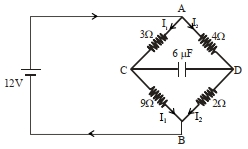

Download our appand get started for free
Experience the future of education. Simply download our apps or reach out to us for more information. Let's shape the future of learning together!No signup needed.*
Similar Questions
- 1View SolutionThe mechanism of the heat produced in a conductor when an electric current flows through it, can be explained on the basis of
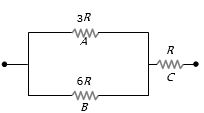
- 2The three resistances $A, B$ and $C$ have values $3R, 6R$ and $R$ respectively. When some potential difference is applied across the network, the thermal powers dissipated by $A, B$ and $C$ are in the ratioView Solution
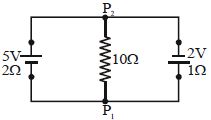
- 3A $5\, V$ battery with internal resistance $2\, \Omega$ and a $2\,V$ battery internal resistance $1\, \Omega$ are connected to a $10\, \Omega$ resistor as shown in the figure. The current in the $10\, \Omega$ resistor is :-View Solution
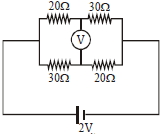
- 4The reading of an ideal voltmer in the circuit shown is.....$V$View Solution
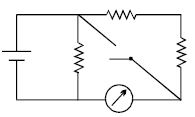
- 5In the circuit shown, the reading of the Ammeter is doubled after the switch is closed. Each resistor has a resistance $ = 1\,\Omega $ and the ideal cell has an $e.m.f. = 10\, V$. Then, the Ammeter has a coil resistance equal to ................ $\Omega$View Solution
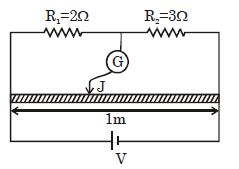
- 6In a meter bridge experiment, initially the jockey is at null point. Now resistance $R_1$ $\&$ $R_2$ is interchanged. Shift in the position of jockey is ................ $cm$View Solution
- 7Two sources of equal $emf$ are connected to an external resistance $R$. The internal resistances of the two sources are ${R_1}$ and ${R_2}\,({R_2} > {R_1})$. If the potential difference across the source having internal resistance ${R_2}$ is zero, thenView Solution
- 8A fuse wire with radius $1\, mm$ blows at $1.5\, amp$. The radius of the fuse wire of the same material to blow at $3\,A$ will beView Solution
- 9When the power delivered by a $100\,volt$ battery is $40\,watts$ the equivalent resistance of the circuit is ........... $ohms$View Solution
- 10A potentiometer having the potential gradient of $2\, mV/cm$ is used to measure the difference of potential across a resistance of $10 \,\Omega$. If a length of $50\, cm$ of the potentiometer wire is required to get the null point, the current passing through the $10 \,\Omega$ resistor is (in $mA$)View Solution