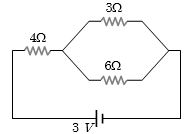
The potential drop across the $3$ $\Omega$ resistor is ............... $V$
Medium
Download our app for free and get started
Equivalent resistance $R = 4 + \frac{{3 \times 6}}{{3 + 6}} = 6\,\Omega $ and main current $i = \frac{E}{R} = \frac{3}{6} = 0.5\,A$
Now potential difference across the combination of $3$ $\Omega$ and $6$ $\Omega$, $V = 0.5 \times \left( {\frac{{3 \times 6}}{{3 + 6}}} \right) = 1\,Volt$
The same potential difference, also develops across $3$ $\Omega$ resistance.

Download our appand get started for free
Experience the future of education. Simply download our apps or reach out to us for more information. Let's shape the future of learning together!No signup needed.*
Similar Questions
- 1$A$ total charge $Q$ flows across a resistor $R$ during a time interval $= T$ in such a way that the current vs. time graph for $0 \rightarrow T$ is like the loop of a sin curve in the range $0 \rightarrow \pi$ . The total heat generated in the resistor isView Solution
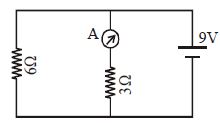
- 2In the figure shown, if the internal resistance of the battery is $1\, ohm$, the reading of the ammeter will be ............... $A$View Solution
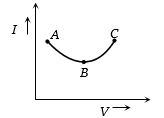
- 3View SolutionResistance as shown in figure is negative at
- 4A wire of length $5\,m$ and radius $1\,mm$ has a resistance of $1\, ohm$. What length of the wire of the same material at the same temperature and of radius $2\,mm$ will also have a resistance of $1\, ohm$ .............. $m$View Solution
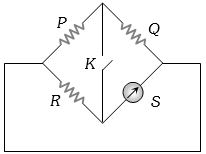
- 5In the following Wheatstone bridge $P/Q = R/S$. If key $K$ is closed, then the galvanometer will show deflectionView Solution
- 6Carbon resistor has resistance specified by three bands having colour red, yellow and black. If this resistor is cut into two pieces of equal length then the new colour code of each one will be (Neglect tolerance of $4^{th}$ band)View Solution
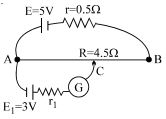
- 7In the given potentiometer circuit length of the wire $AB$ is $3\, m$ and resistance is $R = 4.5 \, \Omega$ . The length $AC$ for no deflection in galvanometer isView Solution
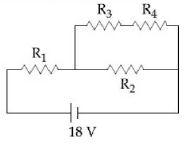
- 8In the given circuit the internal resistance of the $18\,V$ cell is negligible. If $R_1 = 400 \,\Omega ,\,R_3 = 100\,\Omega $ and $R_4 = 500\,\Omega $ and the reading of an ideal voltmeter across $R_4$ is $5\,V,$ then the value of $R_2$ will be ........... $\Omega$View Solution
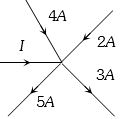
- 9In the given current distribution what is the value of $I$ .............. $A$View Solution
- 10$4$ bulbs marked $40\, W$, $250\, V$ are connected in series with $250\, V$ mains. The total power is ............. $W$View Solution