Question
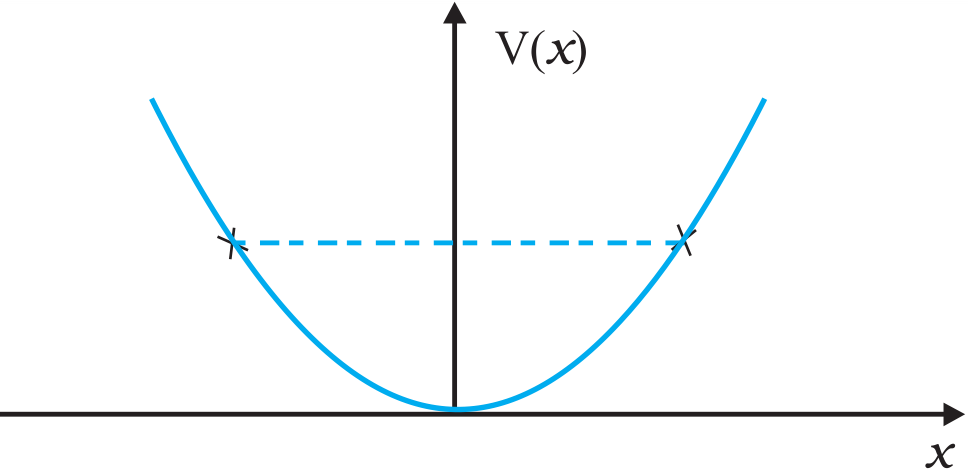
The potential energy function for a particle executing linear simple harmonic motion is given by $\text{V(x)} = \frac{\text{kx}^2}{2},$ where k is the force constant of the oscillator. For $k = 0.5Nm^{-1}$, the graph of V(x) versus x is shown in Show that a particle of total energy $1J$ moving under this potential must ‘turn back’ when it reaches $\text{x} =\pm 2\text{m}.$
Answer

Given, Potential energy for a particle executing linear simple harmonic motion is, $\text{V(x)}=\frac{1}{2}\text{kx}^2$ Where, $\text{k}=\frac{1}{2}\text{N/m}$

Total energy of particle E = 1J
Since at extreme position total energy is potential energy, $\therefore\text{V}=\frac{1}{2}\text{kx}^2=1\text{J}$ $\Rightarrow\text{x}=\pm\sqrt{\frac{2}{\text{k}}}=\pm\sqrt{4}$ $\Rightarrow\text{x}=\pm2\text{m}$ Hence the results.

Need a full question paper?

Generate a complete, print-ready paper with questions like this in minutes — across 16+ boards, with answer keys.

Start Generating Free

Similar questions

A uniform square plate of mass 2.0kg and edge 10cm rotates about one of its diagonals under the action of a constant torque of 0.10N-m. Calculate the angular momentum and the kinetic energy of the plate at the end of the fifth second after the start.
An adult weighing 600N raises the centre of gravity of his body by 0.25m while taking each step of 1m length in jogging. If he jogs for 6km, calculate the energy utilised by him in jogging assuming that there is no energy loss due to friction of ground and air. Assuming that the body of the adult is capable of converting 10% of energy intake in the form of food, calculate the energy equivalents of food that would be required to compensate energy utilised for jogging.
A metre stick is held vertically with one end on a rough horizontal floor. It is gently allowed to fall on the floor. Assuming that the end at the floor does not slip, find the angular speed of the rod when it hits the floor.
A laboratory in sky of mass $2 \times 10^3kg$ is raised from a circular orbit of radius $2R$ to a circular orbit of radius $3R$. What is the approximate work done?
A person standing on a platform finds that a train moving with velocity $0.6c$ takes one second to pass by him. Find:
  1. The length of the train as seen by the person and.
  2. The rest length of the train.
The efficiency of a Carnot engine is $1 / 2$. If the sink tem perature is reduced by $100^{\circ} C$, then engine efficiency becomes $2 / 3$. Find
i. sink temperature
ii. source temperature
iii. Explain, why a Carnot engine cannot have $100 \%$ efficiency?
A simple pendulum of length (l) is pulled aside to make an angle $\theta$ with the vertical. Find the magnitude of the torque of the weight (w) of the bob about the point of suspension. When is the torque zero?
A capacitor of capacitance $100\mu\text{F}$ is connected to a battery of 20 volts for a long time and then disconnected from it. It is now connected across a long solenoid having 4000 turns per metre. It is found that the potential difference across the capacitor drops to 90% of its maximum value in 2.0 seconds. Estimate the average magnetic field produced at the centre of the solenofd during this period.
A source of sound is coming towards a stationary observer with a constant velocity. Deduce the formula for the apparent frequency heard by observer.
A wave pulse is travelling on a string with a speed $v$ towards the positive $X-$axis. The shape of the string at $t = 0$ is given by $\text{g(x)}=\text{A}\sin\big(\frac{\text{x}}{\text{a}}\big),$ where $A$ and $a$ are constants.
  1. What are the dimensions ot $A$ and $a$ ?
  2. Write the equation of the wave for a general time $t,$ if the wave speed is $v.$