Question 13 Marks
Which of the following potential energy curves in cannot possibly describe the elastic collision of two billiard balls? Here r is the distance between centres of the balls.
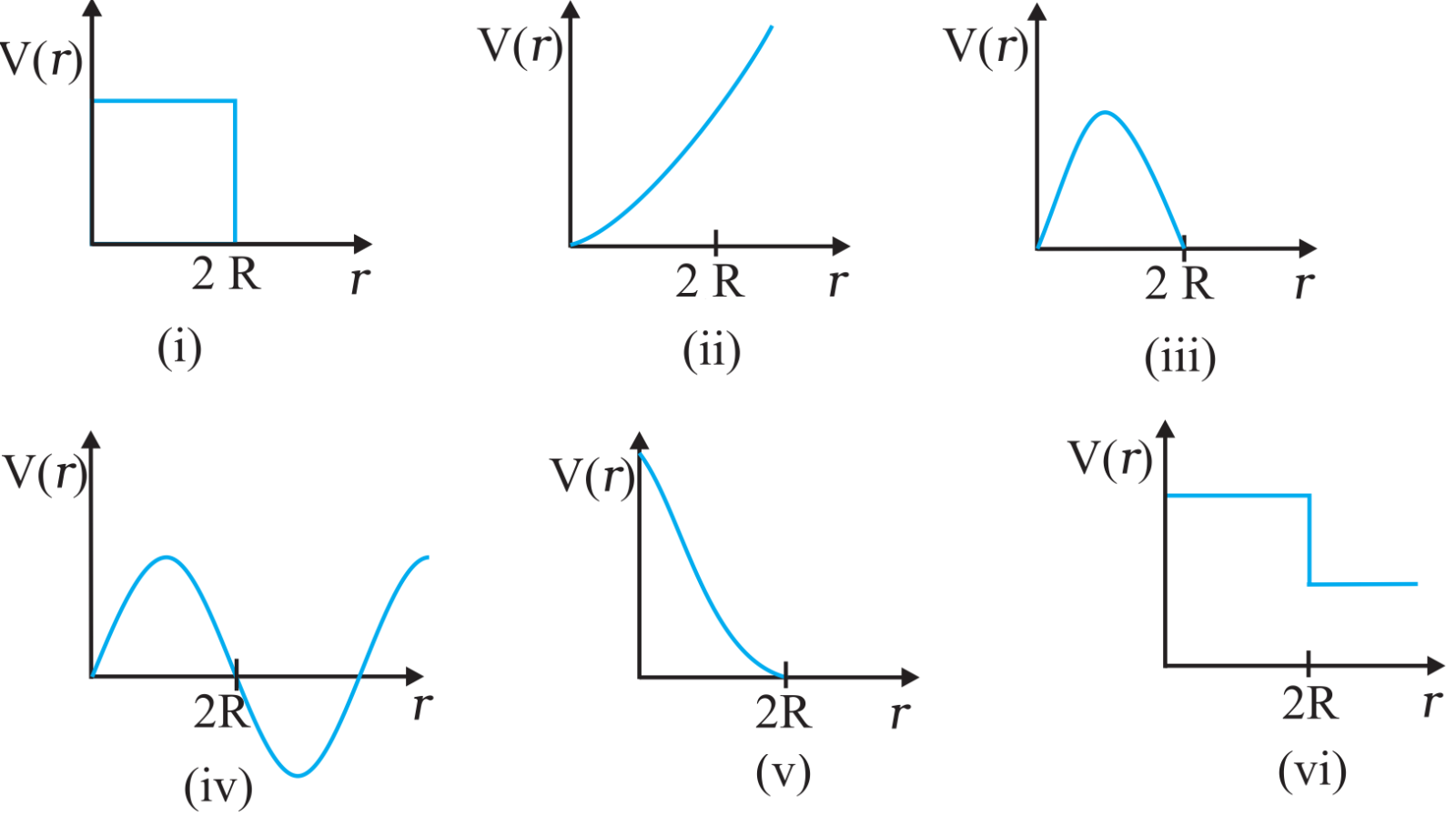
AnswerThe potential energy of a system of two masses is inversely proportional to the separation between them. In the given case, the potential energy of the system of the two balls will decrease as they come closer to each other. It will become zero (i.e., V(r) = 0) when the two balls touch each other, i.e., at r = 2R, where R is the radius of each billiard ball. The potential energy curves given in figures do not satisfy these two conditions. Hence, they do not describe the elastic collisions between them.
View full question & answer→Question 23 Marks
A body of mass 0.5kg travels in a straight line with velocity $\text{v}=\text{ax}^{3/2}$ where $\text{a}=5\text{m}^{-1/2}\text{s}^{-1}.$ What is the work done by the net force during its displacement from x = 0 to x = 2m?
AnswerGiven, Mass of the body, m = 0.5kg Velocity $\text{v} =\text{ax}^{(3/2)}\ ...(\text{i})$ Acceleration $\text{a}=5\text{m}^{–(1/2)}\text{s}^{–1}$ Initial velocity, u(at x = 0) = 0 Final velocity v(at x = 2m) $=\text{a}×2^{(3/2)} = 5\times2^{(3/2)}=10\sqrt{2}\text{m/s}$ Work done, W = Increase in kinetic energy $=\frac{1}{2}\text{m}(\text{v}^2–\text{u}^2)$ $=\frac{1}{2} \times0.5\big [(10\sqrt{2})^2 – (0)^2\big]$ $=\Big(\frac{1}{2}\times 0.5\times10\times10\times2\Big)$ $=50\text{J}$
View full question & answer→Question 33 Marks
A trolley of mass $300kg$ carrying a sandbag of $25kg$ is moving uniformly with a speed of $27km/h$ on a frictionless track. After a while, sand starts leaking out of a hole on the floor of the trolley at the rate of $0.05 kgs^{-1}$. What is the speed of the trolley after the entire sand bag is empty?
AnswerAs the trolley carrying the sand bag is moving uniformly, therefore, external force on the system = 0. When the sand leaks out, it does not lead to the application of any external force on the trolley. Hence, the speed of the trolley shall not change.
View full question & answer→Question 43 Marks
Consider the decay of a free neutron at rest: $n → p + e^-$ Show that the two-body decay of this type must necessarily give an electron of fixed energy and, therefore, cannot account for the observed continuous energy distribution in the β-decay of a neutron or a nucleus.
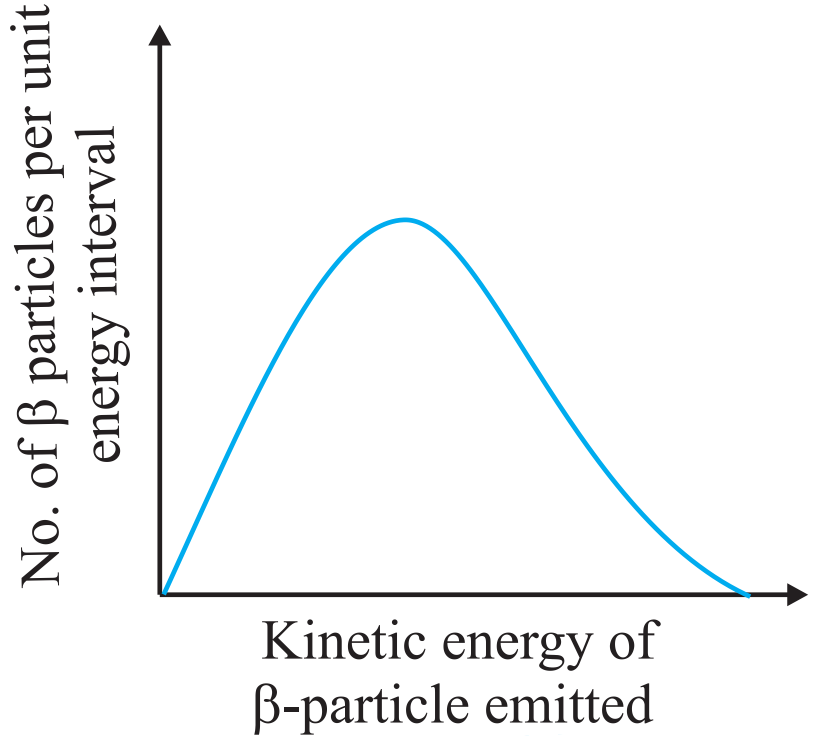
[Note: The simple result of this exercise was one among the several arguments advanced by W. Pauli to predict the existence of a third particle in the decay products of β-decay. This particle is known as neutrino. We now know that it is a particle of intrinsic spin ½ (like $e^-$, p or n), but is neutral, and either massless or having an extremely small mass (compared to the mass of electron) and which interacts very weakly with matter. The correct decay process of neutron is: $n → p + e^- + v]$ AnswerThe decay process of free neutron at rest is given as, $n → p + e^-$ From Einstein’s mass-energy relation, we have the energy of electron as $\Delta\text{mc}^2$ Where, $\Delta\text{m}$ = Mass defect = Mass of neutron - (Mass of proton + Mass of electron) c = Speed of light $\Delta\text{m}$ and c are constants. Hence, the given two-body decay is unable to explain the continuous energy distribution in the $\beta$-decay of a neutron or a nucleus. The presence of neutrino νon the LHS of the decay correctly explains the continuous energy distribution.
View full question & answer→Question 53 Marks
A molecule in a gas container hits a horizontal wall with speed $200ms^{-1}$ and angle 30° with the normal, and rebounds with the same speed. Is momentum conserved in the collision? Is the collision elastic or inelastic?
AnswerThe momentum of the gas molecule remains conserved whether the collision is elastic or inelastic. The gas molecule moves with a velocity of 200m/s and strikes the stationary wall of the container, rebounding with the same speed. It shows that the rebound velocity of the wall remains zero. Hence, the total kinetic energy of the molecule remains conserved during the collision. The given collision is an example of an elastic collision.
View full question & answer→Question 63 Marks
The potential energy function for a particle executing linear simple harmonic motion is given by $\text{V(x)} = \frac{\text{kx}^2}{2},$ where k is the force constant of the oscillator. For $k = 0.5Nm^{-1}$, the graph of V(x) versus x is shown in Show that a particle of total energy 1J moving under this potential must ‘turn back’ when it reaches $\text{x} =\pm 2\text{m}.$
AnswerGiven, Potential energy for a particle executing linear simple harmonic motion is, $\text{V(x)}=\frac{1}{2}\text{kx}^2$
Where, $\text{k}=\frac{1}{2}\text{N/m}$
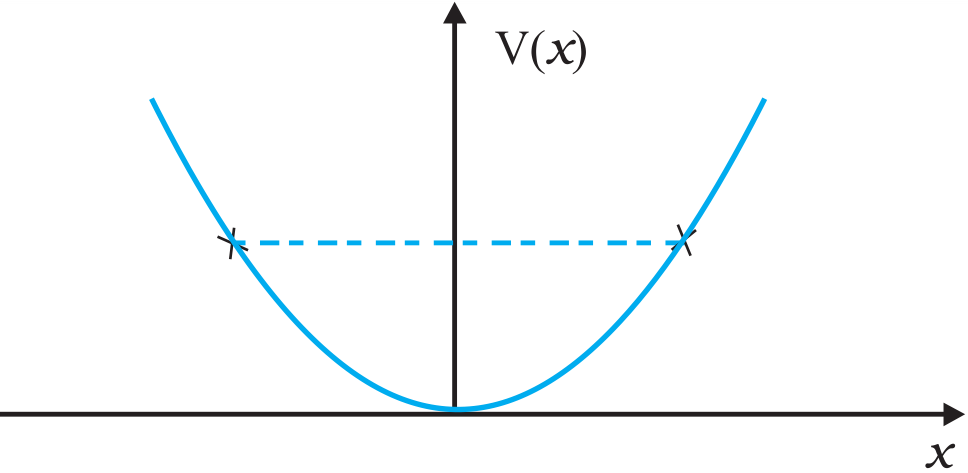
Total energy of particle $E = 1J$
Since at extreme position total energy is potential energy,
$\therefore\text{V}=\frac{1}{2}\text{kx}^2=1\text{J}$
$\Rightarrow\text{x}=\pm\sqrt{\frac{2}{\text{k}}}=\pm\sqrt{4}$
$\Rightarrow\text{x}=\pm2\text{m}$ Hence the results. View full question & answer→Question 73 Marks
The bob A of a pendulum released from 30° to the vertical hits another bob B of the same mass at rest on a table as shown in. How high does the bob A rise after the collision? Neglect the size of the bobs and assume the collision to be elastic.
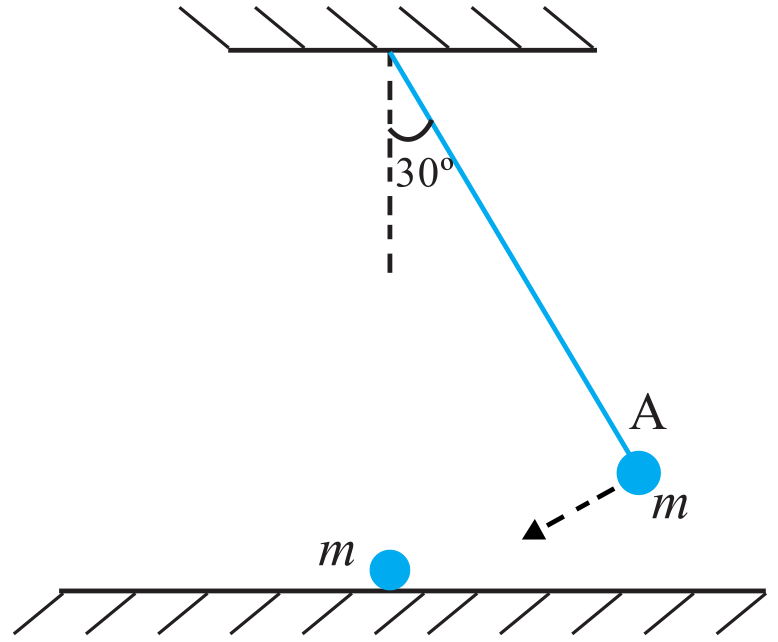
AnswerWhen two bodies of same mass undergo elastic collisions their velocities get interchanged. In the given situation, bob A is moving with certain speed and bob B is at rest. Therefore, after collision, bob A comes to rest and the bob B starts moving with the speed of bob A. The whole momentum of bob A will get transfer to bob B and so bob A, will not rise at all after the second collision. Therefore bob A will come to rest and bob B will keep on moving.
View full question & answer→Question 83 Marks
A raindrop of mass $1.00g$ falling from a height of $1km$ hits the ground with a speed of $50m s^{-1}$. Calculate:
- The loss of $P.E.$ of the drop.
- The gain in $K.E$. of the drop.
- Is the gain in $K.E$. equal to loss of $P.E$.? If not why.
Take $g = 10m s^{-2}$ Answera. Drop $m =0.001 kg, h =1 km=1000 m$ Speed of $v =50 m / s u =0$
b. PE at highest point of drop $= mgh =0.001 \times 10 \times 1000=10 J$ So loss pf $PE =10 J$
Gain in $\text{KE}=\frac{1}{2}\text{mv}^2$
$=\frac{1}{2}\times0.001\times50\times50=1.250$
Gain in = 1.250J
c. Gain in KE is not equal to the loss in $PE$. It is due to the loss of $PE$ or $KE$ against resistance or dragging force of air.
View full question & answer→Question 93 Marks
In an elastic collision of two billiard balls, which of the following quantities remain conserved during the short time of collision of the balls (i.e., when they are in contact).
- Kinetic energy.
- Total linear momentum?
Give reason for your answer in each case.
AnswerWhen two billiard balls collide each other then their linear momentum and kinetic energy remains conserved. Because here it is considered that there is not any non conservative force (like air resistance/ friction on surface etc.) and speed of ball is not so high so that they deformed on collision.
View full question & answer→Question 103 Marks
Why is electrical power required at all when the elevator is descending? Why should there be a limit on the number of passengers in this case?
AnswerWhen elevator is descending then it is not its free fall under gravity it descends with uniform speed. Power is required to decrease the velocity due to free fall. Power of motor or system of an elevator is constant and a limited or specified power can stop the speed of freely falling of passenger along with elevator.
View full question & answer→Question 113 Marks
A stone is dropped from a height ‘h'. Prove that the energy at any point in its path is mgh.
AnswerLet a stone of mass m be dropped from a point A at a height h. P.E. at A = mgh K.E. = 0 Total energy at A = mgh As it reaches B, it would have lost some P.E. and gained K.E. Velocity on reaching 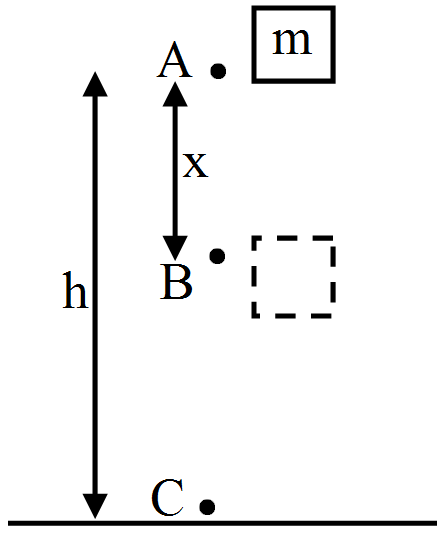 P.E at B = mg (h - x) $\text{K.E}=\frac{1}{2}\text{mv}_\text{B}^2=\frac{1}{2}\text{m}.2\text{gx}=\text{mgx}$ Total energy at B = mg (h – x) + mgx = mgh On reaching the ground C the mass must have gained a velocity $\sqrt{2\text{gx}}$ and the P.E must be zero. P.E. at C = 0 K.E. at $\text{C}=\frac{1}{2}\text{mv}_\text{c}^2=\frac{1}{2}\text{m}(2\text{gh)}=\text{mgh}$ Total energy at C = mgh Thus' it is proved that the total energy at any point in its path is mgh.
 View full question & answer→Question 123 Marks
Two blocks of masses $m_1$ and $m_2$ are connected by a spring of spring constant k. The block of mass $m_2$ is given a sharp impulse so that it acquires a velocity $v_0$ towards right. Find
- The velocity of the centre of mass.
- The maximum elongation that the spring will suffer.
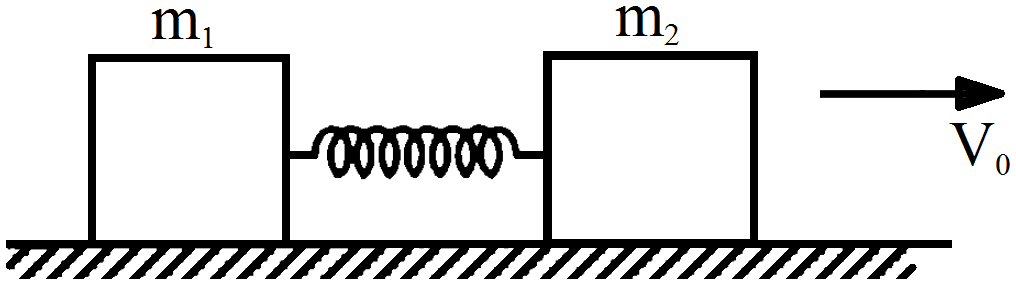
Answer
- $\therefore$ Velocity of centre of mass $=\frac{\text{m}_2\times\text{v}_0+\text{m}_1\times0}{\text{m}_1+\text{m}_2}=\frac{\text{m}_2\text{v}_0}{\text{m}_1+\text{m}_2}$
- The spring will attain maximum elongation when both velocity of two blocks will attain the velocity of centre of mass.
- x → maximum elongation of spring.
Change of kinetic energy = Potential stored in spring.

$\Rightarrow\Big(\frac{1}{2}\Big)\text{m}_2\text{v}_0^2-\Big(\frac{1}{2}\Big)(\text{m}_1+\text{m}_2)\Big(\frac{\text{m}_2\text{v}_0}{\text{m}_1+\text{m}_2}\Big)^2=\Big(\frac{1}{2}\Big)\text{kx}^2$
$\Rightarrow\text{m}_2\text{v}_0^2\Big(1-\frac{\text{m}_2}{\text{m}_1+\text{m}_2}\Big)=\text{kx}^2$
$\Rightarrow\text{x}=\Big(\frac{\text{m}_1\text{m}_2}{\text{m}_1+\text{m}_2}\Big)^{\frac{1}{2}}\times\text{v}_0$ View full question & answer→Question 133 Marks
Light in certain cases may be considered as a stream of particles called photons. Each photon has a linear momentum $\frac{\text{h}}{\lambda}$ where h is the Planck's constant and $\lambda$ is the wavelength of the light. A beam of light of wavelength $\lambda$ is incident on a plane mirror at an angle of incidence $\theta.$ Calculate the change in the linear momentum of a photon as the beam is reflected by the mirror.
Answer$\overrightarrow{\text{P}}_{\text{incidence}}=\Big(\frac{\text{h}}{\lambda}\Big)\cos\theta\hat{\text{i}}-\Big(\frac{\text{h}}{\lambda}\Big)\sin\theta\hat{\text{j}}$ $\overrightarrow{\text{P}}_{\text{Reflected}}=-\Big(\frac{\text{h}}{\lambda}\Big)\cos\theta\hat{\text{i}}-\Big(\frac{\text{h}}{\lambda}\Big)\sin\theta\hat{\text{j}}$ The change in momentum will be only in the x-axis direction. i.e. 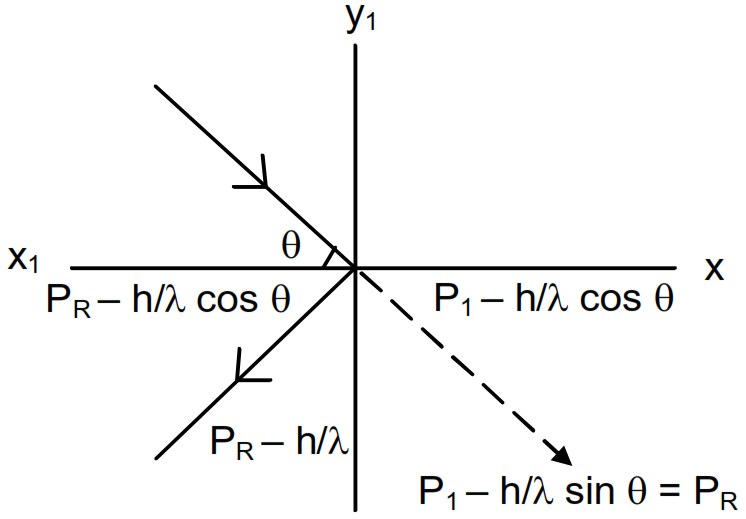 $|\triangle\text{P}|=\Big(\frac{\text{h}}{\lambda}\Big)\cos\theta-\Big(\frac{\text{h}}{\lambda}\Big)\cos\theta=\Big(\frac{\text{2h}}{\lambda}\Big)\cos\theta$
 View full question & answer→Question 143 Marks
What is an elastic collision? What will happen, when
- A heavy body collides with a light mass at rest.
- A light body collides with a heavy mass at rest.
AnswerElastic collision is one in which both momentum and energy are conserved. We know, when two bodies $m_1$ and $m_2$ moving with velocities $u_1$ and $u_2$ collide, their velocities become, $\text{v}_1=\frac{(\text{m}_1-\text{m}_2)\text{u}_1+2\text{m}_2\text{u}_2}{\text{(m}_1+\text{m}_2}$ $\text{v}_2=\frac{\text{m}_2-\text{m}_1)\text{u}_2+2\text{m}_1\text{u}_1}{(\text{m}_1+\text{m}_2)}$
- if $m_1 >> m_2$ and $u_2 = 0$, we get
$\text{v}_1=\frac{\text{m}_1\text{u}_1}{\text{m}_1}=\text{u}_1,\text{v}_2=2\text{u}_1$
- If $m_1 >> m_2$ and $u_1 = 0$, we get
$\text{v}_1=\frac{2\text{m}_2\text{u}_2}{\text{m}_1}, $ as $m_2 << m_1$
$\therefore\text{v}_1\approx0$
$\text{v}_2=-\frac{\text{m}_1\text{u}_2}{\text{m}_1}=-\text{u}_2$ View full question & answer→Question 153 Marks
A block of mass 2 kg is pulled up on a smooth incline of angle $30^{\circ}$ with horizontal. If the block moves with an acceleration of $1 m /$ $s^2$, find the power delivered by the pulling force at a time 4 seconds after motion starts. What is the/ frac delivered during these four seconds after the motion starts?
AnswerThe forces acting on the block are shown in the figure.
Resolving forces parallel to incline, $F - mg \sin \theta= ma$
$F - mg \sin \theta+ ma =2 \times 9.8 \times \sin 30^{\circ}+2 \times 1=11.8 N$
The velocity after 4 seconds $= u + at =0+14=4 m / s$
Power delivered by force at $t=4$
seconds $=$ Force $\times$ velocity $=11.8 N \times 4 s=47.2 W$
The displacement during 4 seconds is given by $v ^2= u ^2+2$ as
$\Rightarrow v ^2=0+2 \times 1 \times s s =8 m$
Work done in 4 seconds $=$ Force x distance $=$ $11.8 \times 8=94.4 J $
$\therefore$ Average power delivered $=\frac{\text { work done }}{\text { time }}=\frac{94.4}{4}=23.6 W$.
View full question & answer→Question 163 Marks
Define power. Obtain an expression for it in terms of force and velocity.
AnswerPower The rate of doing work is called power. $\text{P}=^{\ \ \text{Lt}}_{\Delta\text{t}\rightarrow0}\frac{\Delta\text{W}}{\Delta\text{t}}=\frac{\text{d}\text{W}}{\text{d}\text{t}}$ $=\frac{\text{d}}{\text{d}\text{t}}(\vec{\text{F}}.\vec{\text{S})}=\vec{\text{F}.}\frac{\text{d}\vec{\text{s}}}{\text{dt}}$ $\text{P}=\vec{\text{F}.}\vec{\text{V}}$ $\Rightarrow\text{P}=\text{Fv}$
View full question & answer→Question 173 Marks
Draw a graph showing variation of potential energy, kinetic energy and the total energy of a body freely falling on Earth from a height h.
AnswerGraphs depicting variation of:
- Gravitational potential energy (P.E.).
- Inetic energy (K.E.), and.
- The total sum of potential and kinetic energies for a freely falling body are as shown in adjoining Fig. From the graphs, it is clear that.
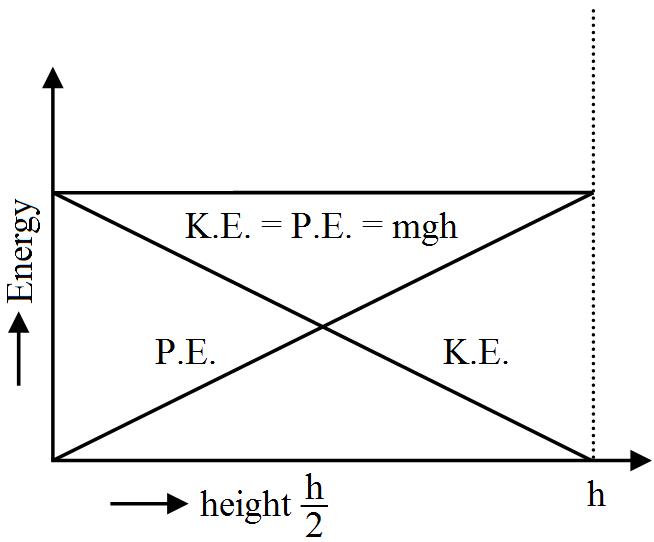
- Gravitational potential energy decreases as the body falls downwards and is zero at the Earth.
- Kinetic energy increases as the body falls downwards and is maximum when the body just strikes the ground.
- The sum of kinetic and potential energies remains constant at all points during its free fall.
View full question & answer→Question 183 Marks
A small block of mass is pressed against a horizontal spring fixed at one end to compress the spring through 5.0cm. When released the block moves horizontally till it leaves the spring. Where will it hit the ground at a distance 2m below the slab? [k = 100N/ m, m = 100g)
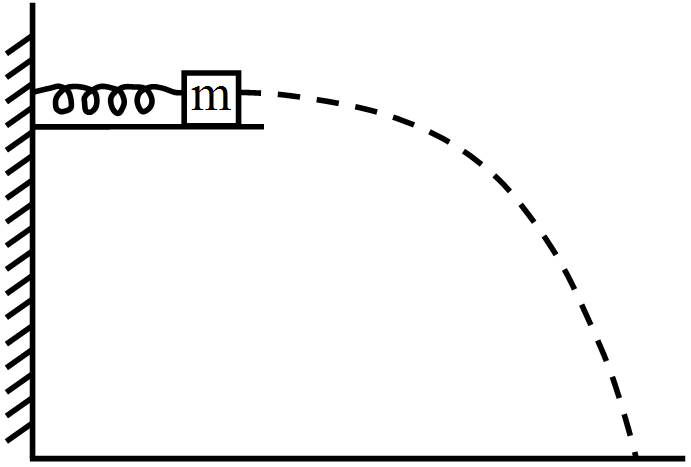
Answer$\frac{1}{2}\text{kx}^2=\frac{1}{2}\text{mv}^2$ $\text{v}=\sqrt{\frac{\text{k}}{\text{m}}}\text{x}^2=\sqrt{\frac{100}{100}\times\frac{25\times10^{-4}}{10^{-3}}}$ $=\sqrt{2.5}\text{ ms}^{-1}$ Height = 2m, $\text{t}=\sqrt{\frac{2\text{h}}{\text{g}}}=\sqrt{0.4}$ Horizontal length conered $=\sqrt{0.4}\times\sqrt{2.5}=1\text{m }$
View full question & answer→Question 193 Marks
The bob of a pendulum is released from a horizontal position. If the length of the pendulum is 1m. What is the speed with which the bob arrives at the lower most point given that it dissipates $10\%$ of it initial energy against air resistance. $(g = 10m/ s^{-2})$.
AnswerLength of pendulum = 1m Potential energy (P.E.) at A = mgh Kinetic energy (K.E.) at $\text{B}=\frac{1}{2}\text{mv}^2$ 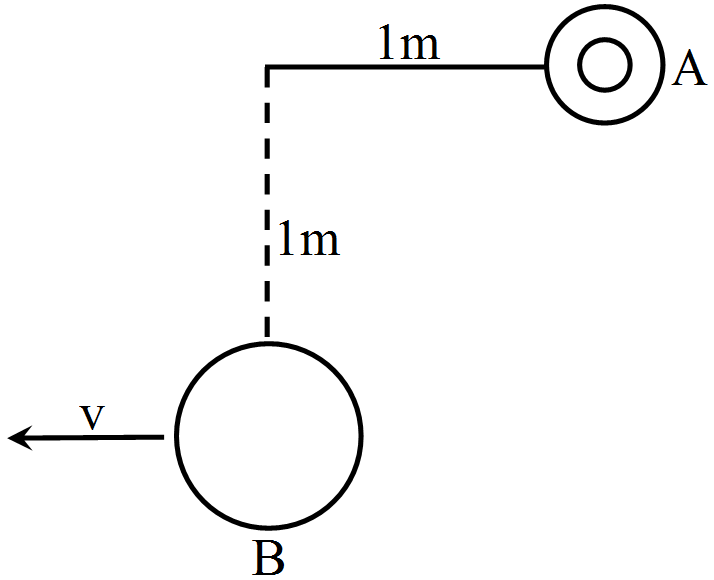
As 10% of P.E dissipated againt air resistance so, $\frac{1}{2}\text{m}\text{v}^2=90\%\text{ of P.E}$ $\Rightarrow\frac{1}{2}\text{m}\text{v}^2=\frac{90}{100}\times\text{mgh}$
$\Rightarrow\text{v}^2= 1.8\times1\times10$
$\Rightarrow\text{v}=\sqrt{18}\text{ms}^{-1}$
$\therefore\text{The speed is }\sqrt{18}\text{ ms}^{-1}$ View full question & answer→Question 203 Marks
Can kinetic energy of a system be increased without applying any external force on the system?
AnswerYes. Let us consider an isolated system of two particles falling towards each other under their mutual gravitational force of attraction. Here, the net force on the system is zero, but the velocities of the particles keep on increasing. Also, the kinetic energy of the system is increased without applying any external force on it.
View full question & answer→Question 213 Marks
What is Einstein's energy-mass equivalence? Explain the energy output of a mass on the basis of this relationship. Give two situations where this relationship can be employed. Also calculate energy released from complete annihilation of $1g$ matter.
AnswerEinstein's energy-mass equivalence relationship states that mass and energy are equivalent. The equivalence relation is given by $E = mc^2$ where 'm' is the mass that disappears. In the case of sun, four hydrogen (lighter) nuclei fuse to form a helium nucleus whose mass is less than the sum of masses of four hydrogen nuclei. This mass difference, called the mass defect $\Delta\text{m}$, it is the source of energy which is released by the sun.Two other examples are:
- Atom bomb based on uncontrolled nuclear fission process.
- To provide electrical energy as in nuclear power plant by controlled nuclear fission process
- In chemical reactions.
Annihilation of 1g of matter is
$E = mc^2$
$=(10^{-3}) \times (3 \times 10^8)^2 = 9 \times 10^{13}J$ View full question & answer→Question 223 Marks
Which of the following potential energy curves in cannot possibly describe the elastic collision of two billiard balls? Here r is the distance between centres of the balls.
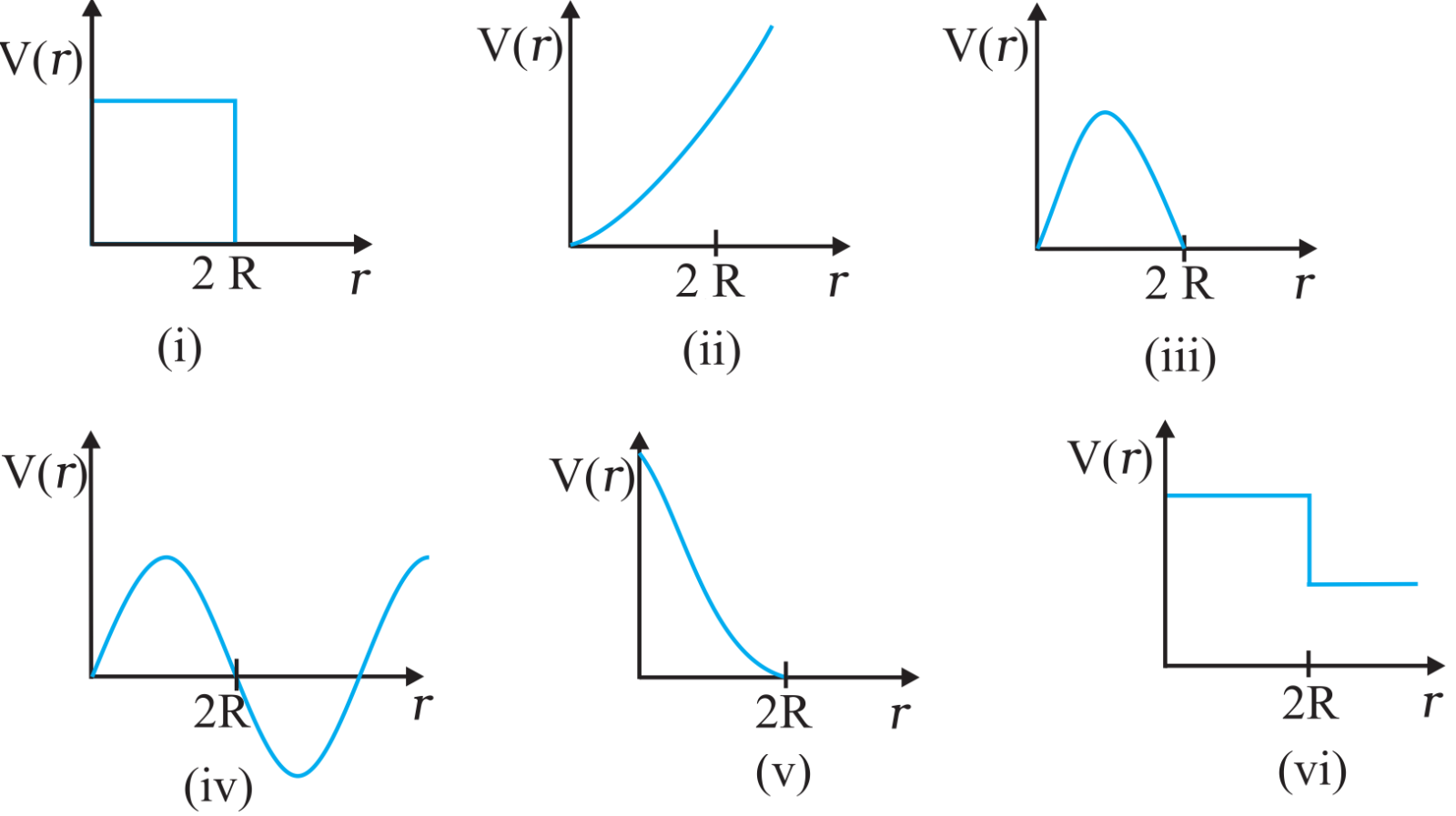
AnswerThe potential energy of a system of two masses is inversely proportional to the separation between them. In the given case, the potential energy of the system of the two balls will decrease as they come closer to each other. It will become zero (i.e., V(r) = 0) when the two balls touch each other, i.e., at r = 2R, where R is the radius of each billiard ball. The potential energy curves given in figures do not satisfy these two conditions. Hence, they do not describe the elastic collisions between them.
View full question & answer→Question 233 Marks
In a children's park, there is a slide which has a total length of 10m and a height of 8.0m (figure). Vertical ladder are provided to reach the top. A boy weighing 200N climbs up the ladder to the top of the slide and slides down to the ground. The average friction offered by the slide is three tenth of his weight. Find
- The work done by the ladder on the boy as he goes up.
- The work done by the slide on the boy as he comes down. Neglect any work done by forces inside the body of the boy.
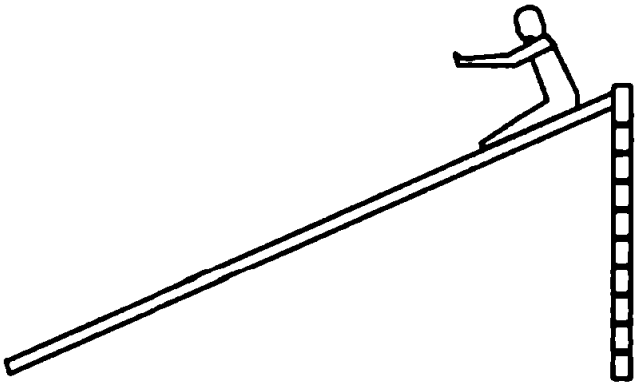
Answer$\ell=10\text{m},\text{h}=8\text{m},\text{mg}=200\text{N}$ $\text{f}=200\times\frac{3}{10}=60\text{N}$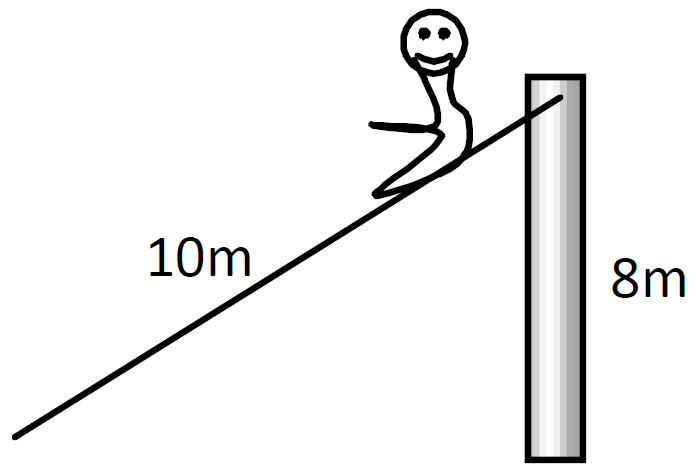
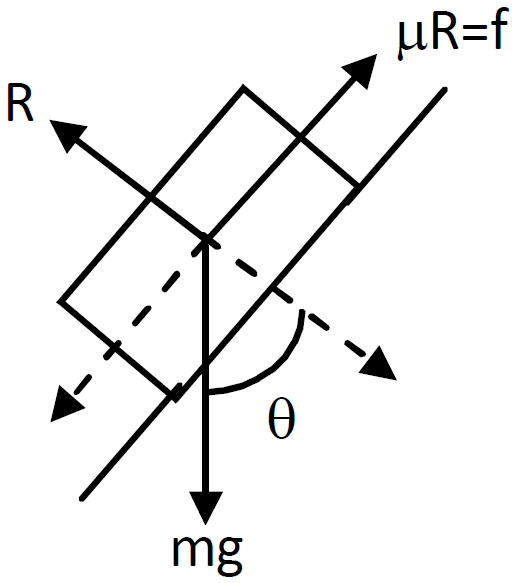
- Work done by the ladder on the boy is zero when the boy is going up because the work is done by the boy himself.
- Work done against frictional force, $\text{W}=\mu\text{RS}=\text{f}\ell$
$=(-60)\times10=-600\text{J}$
Work done by the forces inside the boy is,
$\text{W}_\text{b}=(\text{mg}\sin\theta)\times10$
$=200\times\frac{8}{10}\times10=1600\text{J}$ View full question & answer→Question 243 Marks
Consider the situation of the previous question from a frame moving with a speed v0 parallel to the initial velocity of the block.
- What are the initial and final kinetic energies?
- What is the work done by the kinetic friction?
AnswerThe relative velocity of the ball w.r.t. the moving frame is given by $\text{v}_\text{r}=\text{v}-\text{v}_0$
- Initial kinetic energy of the ball $=\frac{1}{2}\text{mv}_\text{r}^2=\frac{1}{2}\text{m}(\text{v}-\text{v}_0)^2$
Also, final kinetic energy of the ball $=\frac{1}{2}\text{m}(0-\text{v}_0)^2=\frac{1}{2}\text{mv}_0^2$
- Work done by the kinetic friction = final kinetic energy - initial kinetic energy
$=\frac{1}{2}\text{m}(\text{v}_0)^2-\frac{1}{2}\text{m}(\text{v}-\text{v}_0)^2$
$=-\frac{1}{2}\text{mv}^2+\text{mv}\text{v}_0$ View full question & answer→Question 253 Marks
A body is moved along a closed loop. Is the work done in moving the body necessarily zero? If not, state the condition under which work done over a closed path is always zero.
AnswerWork done by a body moving along closed loop can be zero if only conservative force acting on the body during motion. Work done by a body moving along a loop is not zero if any non-conservative force, i.e., frictional, electrostatic, magnetic force are acting on body.
View full question & answer→Question 263 Marks
State and explain Work-Energy theorem.
AnswerWork done on a body is reflected as change in kinetic energy, according to Work-Energy theorem. $\text{W}=\int\text{Fdx}=\int\text{m}\frac{\text{dv}}{\text{df}} \text{dx}$ $=\int\text{mv}\text{ dv}=\Big|\frac{1}{2}\text{mv}^2\Big|^\text{vf}_\text{vi}$ Work done $=\frac{1}{2}\text{m}(\text{v}^2_\text{f}-\text{v}_\text{i}^2)$ $=\frac{1}{2}\text{mv}_\text{f}^2-\frac{1}{2}\text{mv}_\text{i}^2$ Work done = Change in kinetic energy.
View full question & answer→Question 273 Marks
A ball bounces to $80\%$ of its original height. What fraction of its mechanical energy is lost in each bounce?
AnswerIf the mass of the ball is $m$ and its original height is $h$, thus, its initial potential energy will be
$U_i=m g h$
Complete step-by-step solution:
Let the mass of the ball bem and its original height be $h$, thus, its initial potential energy will be given by the equation
$U_i=m g h$
Now, after that one first bounce, the height is going to be $80 \%$ of $h$, i.e. the original height of the ball.
Thus, the final height is
$h_f=\frac{80}{100} \times h=0.80 h$
The final potential energy of the ball after each bounce will be
$U_f=0.80 mgh$
The potential energy lost in each bounce is equal to
$U_i-U_f=m g h-0.80 m g h=0.20 m g h$
Therefore, fraction of the potential energy lost by the ball in each bounce is equal to $: 0.20$
View full question & answer→Question 283 Marks
A block of mass $100g$ is moved with a speed of $5.0m/s$ at the highest point in a closed circular tube of radius $10cm$ kept in a vertical plane. The cross-section of the tube is such that the block just fits in it. The block makes several oscillations inside the tube and finally stops at the lowest point. Find the work done by the tube on the block during the process.
Answer
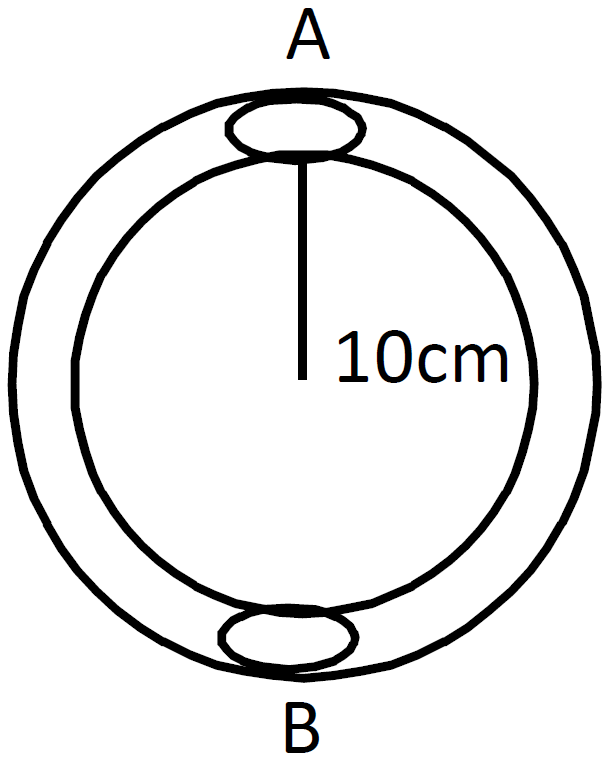
Given, m = 100g = 0.1kg, v = 5m/sec, r = 10cm
Work done by the block = total energy at A - total energy at B
$\Big(\frac{1}{2}\text{mv}^2+\text{mgh}\Big)-0$
$\Rightarrow\text{W}=\frac{1}{2}\text{mv}^2+\text{mgh}-0$
$=\frac{1}{2}\times(0.1)\times25+(0.1)\times10\times(0.2)$[h = 2r = 0.2m]
$\Rightarrow\text{W}=1.25+0.2$
$\Rightarrow\text{W}=1.45\text{J}$
So, the work done by the tube on the body is
$W_t = -1.45J$ View full question & answer→Question 293 Marks
A ball falls on the ground from a height of $2.0m$ and rebounds up to a height of $1.5m$. Find the coefficient of restitution.
AnswerLet the velocity of the ball falling from height $h_1$ be u (when it approaches the ground). Velocity on the ground $\text{u}=\sqrt{2\text{gh}}_1$ Let the velocity of ball when it separates from the ground be v. (Assuming it goes up to height $h_2$) $\Rightarrow\text{v}=\sqrt{2\text{gh}}_2$
$=\sqrt{2\times9.8\times1.5}$ Let the coefficient of restituti be e. We khow, v = eu $\Rightarrow\text{e}=\frac{\sqrt{2\times9.8\times1.5}}{\sqrt{2\times9.8\times2}}=\frac{\sqrt{3}}{2}$ Hence, the coefficient of restitution is $\frac{\sqrt{3}}{2}$
View full question & answer→Question 303 Marks
A simple pendulum consists of a 50cm long string connected to a 100g ball. The ball is pulled aside so that the string makes an angle of 37° with the vertical and is then released. Find the tension in the string when the bob is at its lowest position.
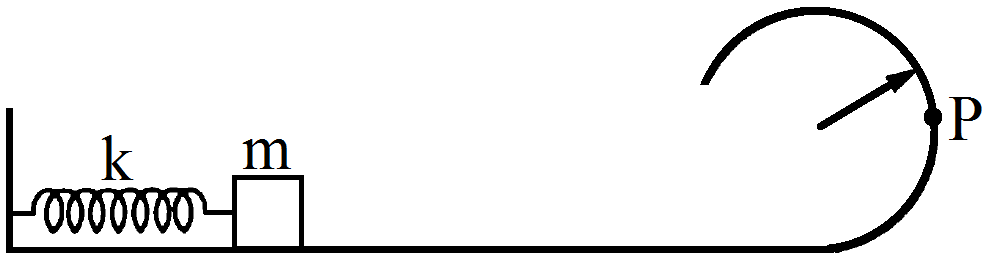
Answer From the figure, $\cos\theta=\frac{\text{AC}}{\text{AB}}$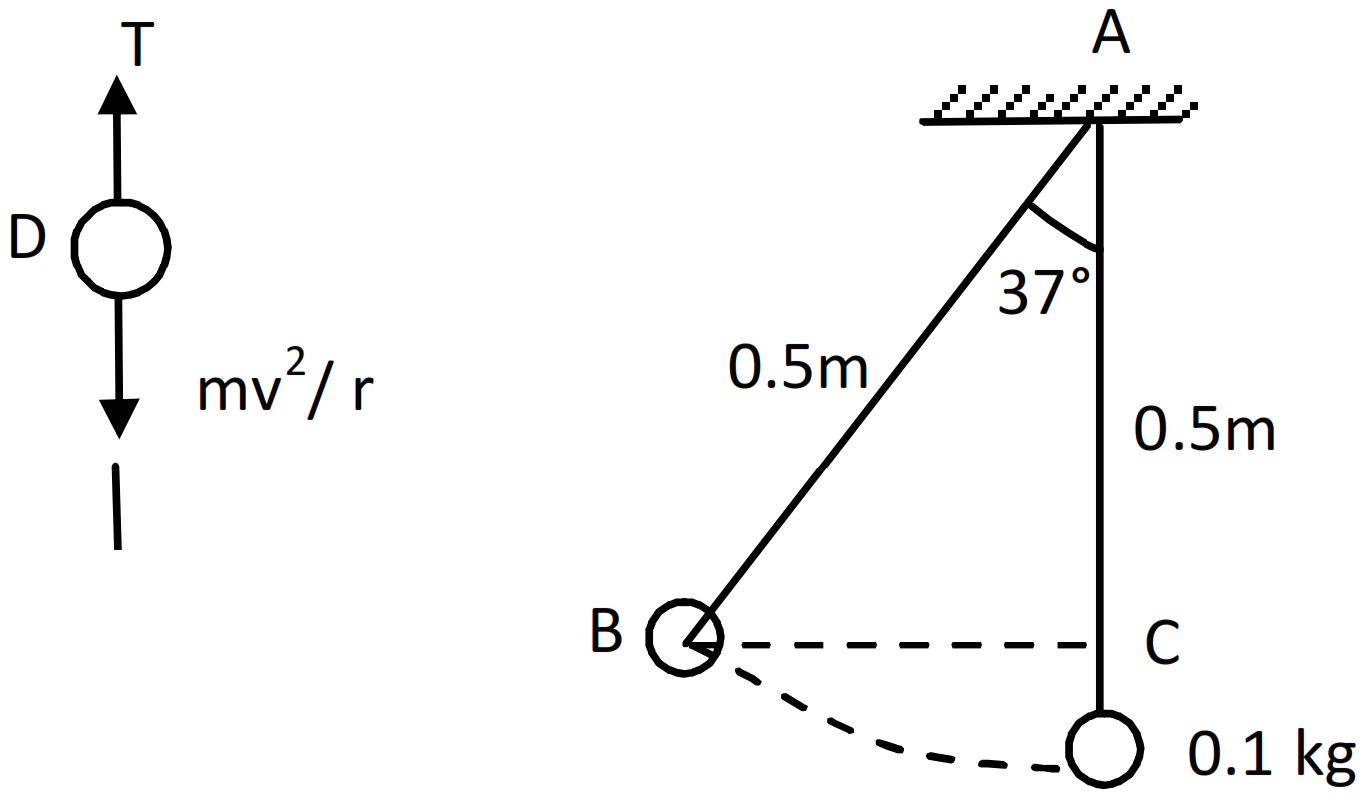
$\Rightarrow\text{AC}=\text{AB}\cos\theta$ $\Rightarrow(0.5)\times(0.8)=0.4$ So, CD = (0.5) - (0.4) = (0.1)m Energy at D = energy at B $\frac{1}{2}\text{mv}^2=\text{mg}(\text{CD})$ $\text{v}^2=2\times10\times(0.1)=2$ So, the tension is given by, $\text{T}=\frac{\text{mv}^2}{\text{r}}+\text{mg}$ $\Rightarrow(0.1)\Big(\frac{2}{0.5}+10\Big)=1.4\text{N}$ View full question & answer→Question 313 Marks
Find the work done in pulling and pushing a roller through $100m$ horizontally when a force of $1500N$ is acting along a chain making an angle of 60° with ground. Assume the floor to be smooth.
AnswerHere, forec F = 1500N and displacement, s = 100m $\theta=60^\circ$
$\therefore$ Work done, $\text{W}=\text{Fs}\cos\theta$
$=1500\times100\times\cos60^\circ$
$=1500\times100\times\frac{1}{2}$
$=75000\text{J}$
$=75\text{KJ}$
View full question & answer→Question 323 Marks
A ball of mass m, moving with a speed $2v_0$, collides inelastically $(e > 0)$ with an identical ball at rest. Show that: For head-on collision, both the balls move forward.
AnswerLet the $v_1, v_2$_ are the velocities of the two balls after the collision. Now by the principle of law of conservation of momentum. $\text{mv}_0=\text{mv}_1+\text{mv}_2$
$2\text{v}_0=\text{v}_1+\text{v}_2\ ...(\text{i})$
$\text{e}=\frac{\text{v}_2-\text{v}_1}{\text{v}_0+\text{v}_0}$
$\text{v}_2-\text{v}_1=2\text{ev}_0$ From (i) $\text{v}_1=-\text{v}_2+2\text{v}_0$
$\text{v}_1=-\text{v}_1-2\text{ev}_0+2\text{v}_0$
$2\text{v}_1=2\text{v}_0-2\text{ev}_0$
$\text{v}_1=\text{v}_0(1-\text{e})$
$\because\ \text{e}<1 v_0$_ is positive so the direction of $v_1$ is same as $v_0$ or $v_1$ is in forward direction. Hence proved.
View full question & answer→Question 333 Marks
An inclined plane $(\theta)$ has its topmost point at a height 'h'. Prove that the work done to bring a mass to the ground level either vertically or along the inclined surface is equal and is mgh. Also prove that the velocity of the mass at the lowermost point is $\sqrt{2\text{gh}}$.
AnswerIn path I. $\text{a}=\sin\theta,\text{u}=0$ 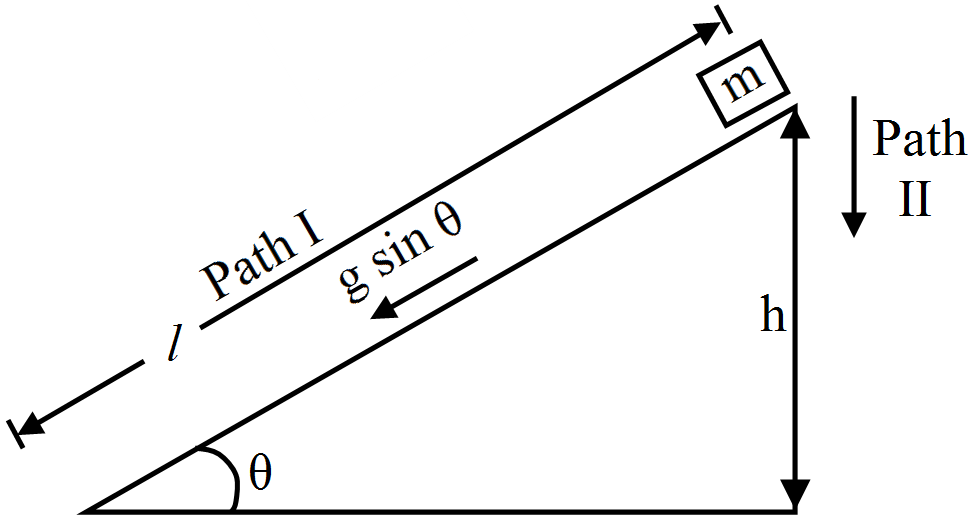 $\text{v}^2=0+2\text{g}\sin\theta\text{ l}$ $=2\text{ g}\sin\theta\frac{\text{h}}{\sin\theta}=2\text{gh}$ Change in Kinetic energy $= \frac{1}{2}\text{mv}^2-0=\frac{1}{2}\text{m}2\text{gh}=\text{mgh}$ Work done = Change in K.E. = mgh In path II. Gravitational force does work. Work done = mgh This will be converted into kinetic energy. $\frac{1}{2}\text{mv}^2=\text{mgh},\text{v}=\sqrt{2\text{gh}}$
 View full question & answer→Question 343 Marks
A small block of mass 'm' is pressed against a horizontal spring fixed at one end to compress the spring through 5.0cm. When released the block moves horizontally till it leaves the spring. Where will it hit the ground at a distance 2m below the slab? $[\text{k}=100\frac{\text{N}}{\text{m}}=100\text{g}]$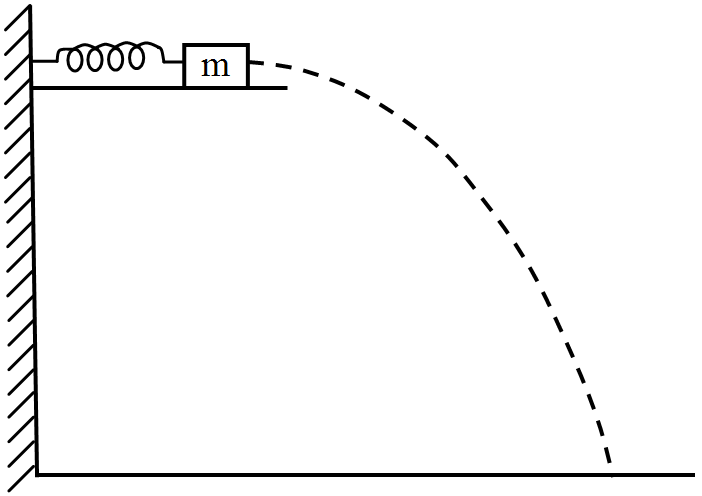
AnswerHere $\frac{1}{2}\text{kx}^2=\frac{1}{2}\text{m}\upsilon^2$ $\upsilon=\sqrt{\frac{\text{k}}{\text{m}}\text{x}^2}$ $=\sqrt{\frac{100}{100}\times\frac{25\times10^{-4}}{10^{-3}}}\text{ms}^{-1}$ $=\sqrt{2.5}\text{ms}^{-1}$ Height = 2m; $\text{t}=\sqrt{\frac{2\text{h}}{\text{g}}}$ $=\sqrt{0.4}\text{ms}^{-1}$
View full question & answer→Question 353 Marks
A block weighing 10N travels down a smooth curved track AB joined to a rough horizontal surface (figure). The rough surface has a friction coefficient of 0.20 with the block. If the block starts slipping on the track from a point 1.0m above the horizontal surface, how far will it move on the rough surface?
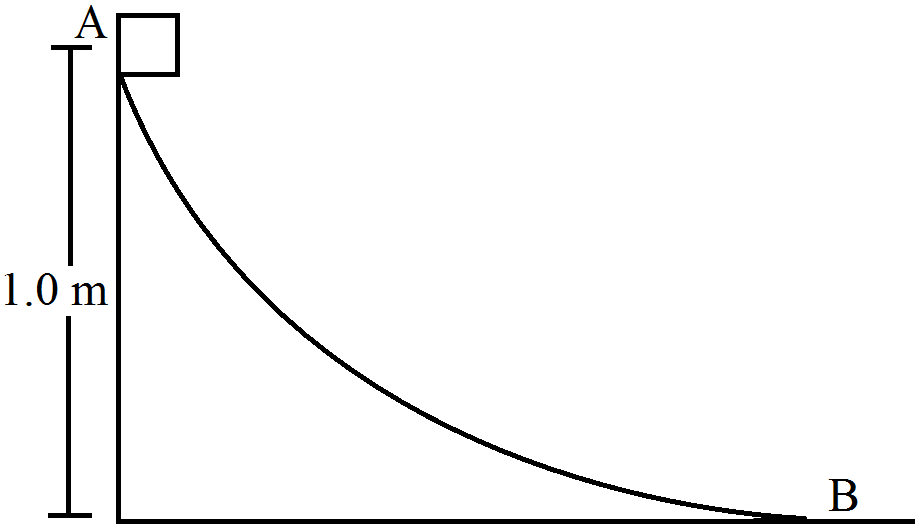
Answer
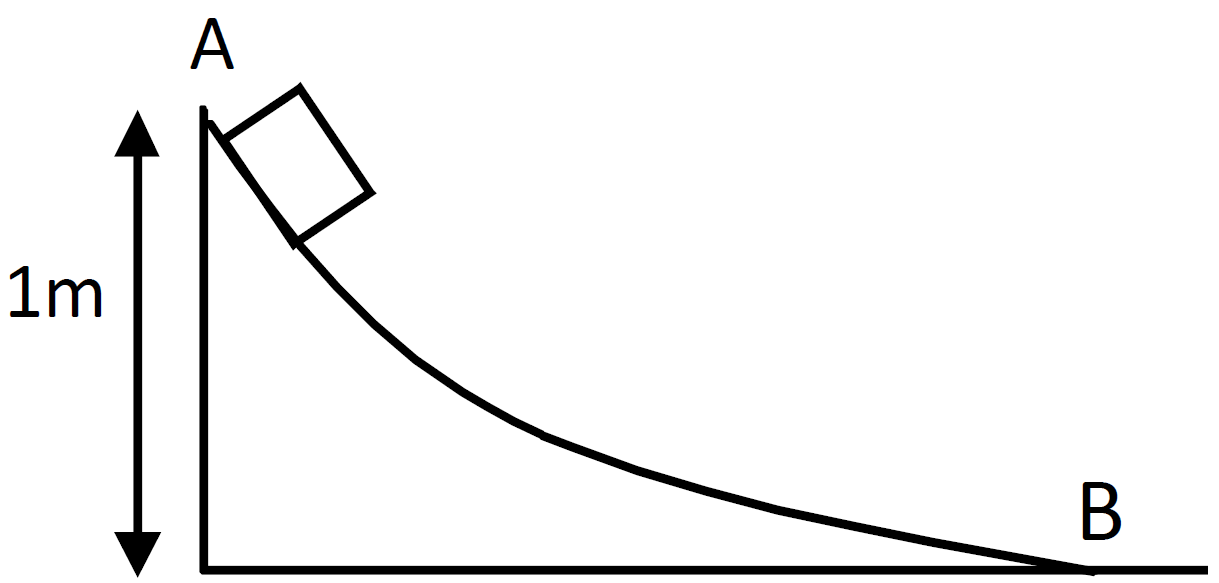 $\text{mg}=10\text{N},\mu=0.2,\text{H}=1\text{m},\text{u}=\text{v}=0$
change in P.E. = work done.
Increase in K.E.
⇒ w = mgh = 10 × 1 = 10J
Again, on the horizontal surface the fictional force
$\text{F}=\mu\text{R}=\mu\text{mg}$
$=0.2\times10=2\text{N}$
So, the K.E. is used to overcome friction
$\Rightarrow\text{S}=\frac{\text{W}}{\text{F}}=\frac{10\text{J}}{2\text{N}}=5\text{m}$ View full question & answer→Question 363 Marks
When you lift a box from the floor and put it on an almirah the potential energy of the box increases, but there is no change in its kinetic energy. Is it a violation of conservation of energy?
AnswerNo Work done in lifting the box increases the potential energy of the box. During lifting at every point, the force applied by us on the box in the upward direction is equal to the gravitational force acting on the box in the downward direction. Therefore, there is no change in the velocity of the box. As a result, the kinetic energy of the box will not change.
View full question & answer→Question 373 Marks
A body of mass 2kg is at rest at a height of 10m above the ground. Calculate its potential energy and kinetic energy after it has fallen through half the height. Also find the velocity at this instant.
AnswerTotal energy at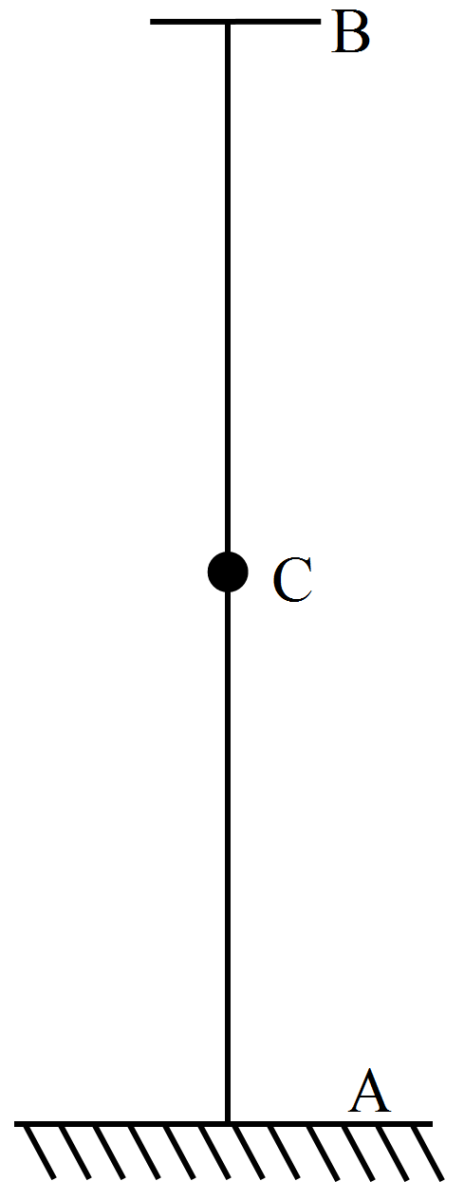
B = kinetic energy + potential energy = 0 + mgh = 2 × 9.8 × 10 = 196J As it descends half the height, it loses potential energy which is given by $=\text{mg}\frac{\text{h}}{2}=\frac{1}{2}\text{mgh}=98\text{J}$ $\therefore$ Its potential energy at C = (196 - 98) = 98J The loss of potential energy = gain in kinetic energy = 196 - 98 = 98 J But $\text{K.E.}=\frac{1}{2}\text{m}\text{v}^2$ $\therefore\frac{1}{2}\times2\times\text{v}^2$ $=98\Rightarrow\text{v}^2=98$ $\text{v}=7\sqrt{2}\text{m/ s}$ View full question & answer→Question 383 Marks
A body falls towards earth in air. Will its total mechanical energy be conserved during the fall? Justify
AnswerFor a body falling freely under gravity. The mechanical energy is not conserved because some part of mechanical energy utilized against force of friction of air molecules which is non conservative force. But if a body is falling freely under gravity in vacuum, the total mechanical energy remain conserved.
View full question & answer→Question 393 Marks
A body of mass 0.5kg travels in a straight line with velocity $\text{v}=\text{ax}^{3/2}$ where $\text{a}=5\text{m}^{-1/2}\text{s}^{-1}.$ What is the work done by the net force during its displacement from x = 0 to x = 2m?
AnswerGiven, Mass of the body, m = 0.5kg Velocity $\text{v} =\text{ax}^{(3/2)}\ ...(\text{i})$ Acceleration $\text{a}=5\text{m}^{–(1/2)}\text{s}^{–1}$ Initial velocity, u(at x = 0) = 0 Final velocity v(at x = 2m) $=\text{a}×2^{(3/2)} = 5\times2^{(3/2)}=10\sqrt{2}\text{m/s}$ Work done, W = Increase in kinetic energy $=\frac{1}{2}\text{m}(\text{v}^2–\text{u}^2)$ $=\frac{1}{2} \times0.5\big [(10\sqrt{2})^2 – (0)^2\big]$ $=\Big(\frac{1}{2}\times 0.5\times10\times10\times2\Big)$ $=50\text{J}$
View full question & answer→Question 403 Marks
A trolley of mass $300kg$ carrying a sandbag of $25kg$ is moving uniformly with a speed of $27km/h$ on a frictionless track. After a while, sand starts leaking out of a hole on the floor of the trolley at the rate of $0.05 kgs^{-1}$. What is the speed of the trolley after the entire sand bag is empty?
AnswerAs the trolley carrying the sand bag is moving uniformly, therefore, external force on the system = 0. When the sand leaks out, it does not lead to the application of any external force on the trolley. Hence, the speed of the trolley shall not change.
View full question & answer→Question 413 Marks
Define an electron volt. Express it in terms of joule.
AnswerElectron Volt. Electron volt is the amount of energy possessed by an electron in falling through a potential difference of 1 volt. $m=4 \mathrm{Kg}, u=0, F=16 \mathrm{~N}, \mathrm{t}=10 \mathrm{Sec} F=\mathrm{ma}, 16=4 a, a=4 \mathrm{~m} / \mathrm{s}^2 \mathrm{~V}=\mathrm{u}+\mathrm{at}=0+4(10) \mathrm{V}=40 \mathrm{~m} / \mathrm{s}$ K.E. of the body at end of 10 sec. $\text{E}=\frac{1}{2}\text{mv}^2$
$=\frac{1}{2}\times4\times(40)^2$ $=3200\text{J}$
View full question & answer→Question 423 Marks
How will you find work done by a variable force? What is the significance of F-x graph?
AnswerWork done is the product of force and displacement. When a variable force acts on the body, the displacement x is split into small parts dx and the work is estimated for each part. Since force is continuous in variation, the net work done will be $\int\text{Fdx}$ in the limits $x = x_i$ to $x = x_f$.
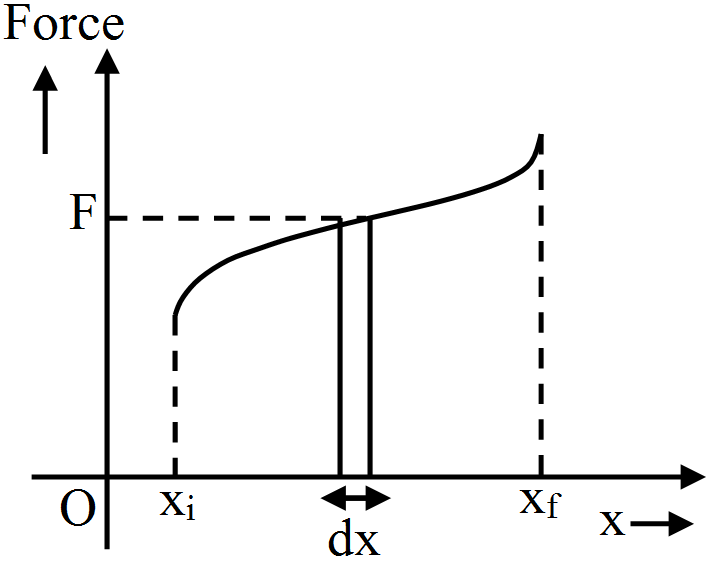
Since $\int\text{Fdx}$ geometrically is the area below the graph of F with x, the area below signifies work done in the displacement by the variable force acting. View full question & answer→Question 433 Marks
A ball is given a speed v on a rough horizontal surface. The ball travels through a distance l on the surface and stops.
- What are the initial and final kinetic energies of the ball?
- What is the work done by the kinetic friction?
Answer
- Initial kinetic energy of the ball, $\text{K}_\text{i}=\frac{1}{2}\text{mv}^2$
Here, m is the mass of the ball.
The final kinetic of the ball is zero.
Work done by the kinetic friction is equal to the change in kinetic energy of the ball.
- $\therefore$ Work done by the kinetic friction $=\text{K}_\text{f}-\text{K}_\text{i}$
$=0-\frac{1}{2}\text{mv}^2$
$=-\frac{1}{2}\text{mv}^2$ View full question & answer→Question 443 Marks
What are the conditions so that transfer of kinetic energy is maximum during a collision?
AnswerFor maximum transfer of kinetic energy during a collision, following conditions should be fulfilled.
- The collision should be a head on collision.
- The collision should be perfectly elastic.
- The target body should be at rest.
- The mass of the striking body and the target body should be exactly same.
View full question & answer→Question 453 Marks
An adult weighing 600N raises the centre of gravity of his body by 0.25m while taking each step of 1m length in jogging. If he jogs for 6km, calculate the energy utilised by him in jogging assuming that there is no energy loss due to friction of ground and air. Assuming that the body of the adult is capable of converting 10% of energy intake in the form of food, calculate the energy equivalents of food that would be required to compensate energy utilised for jogging.
AnswerEnergy used up by raising the centre of gravity by 0.25m by jogger in one step = mgh mg = 600N h = 0.25m $\therefore$ Number of steps in $6\text{Km}=\frac{600\text{m}}{1\text{m}}=600\text{ steps}$ Energy utilised in $6000\text{m}=6000\times600\times0.25\text{J}$ Since 10% of energy utilised in jogging. $\therefore$ Energy utilised in jogging $=\frac{10}{100}\times6000\times600\times0.25$ $=360000\times0.25$ $=90000\text{J}=9\times10^4\text{J}$
View full question & answer→Question 463 Marks
A block of mass $250g$ is kept on a vertical spring of spring constant $100N/m$ fixed from below. The spring is now compressed to have a length $10cm$ shorter than its natural length and the system is released from this position. How high does the block rise? Take $g =10m/s^2$.
Answer
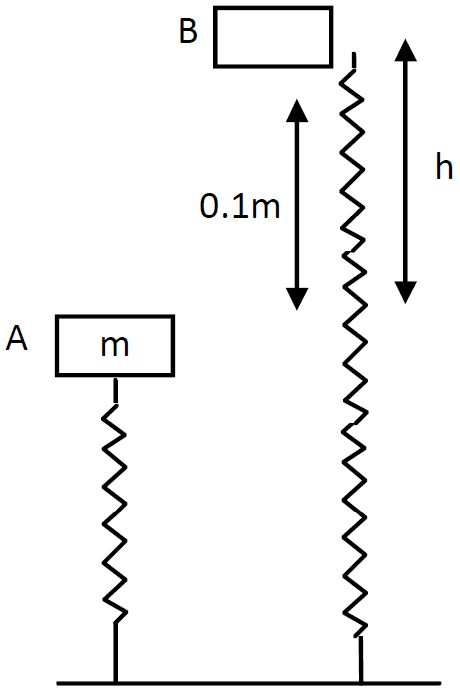
m = 250g = 0.250kg,
k = 100N/ m, m = 10cm = 0.1m
$g = 10m/ \sec^2$
Applying law of conservation of energy,
$=\frac{1}{2}\text{kx}^2=\text{mgh}$
$\Rightarrow\text{h}=\frac{1}{2}\Big(\frac{\text{kx}^2}{\text{mg}}\Big)$
$=\frac{100\times(0.1)^2}{2\times0.25\times10}$
$=0.2\text{m}=20\text{cm}$ View full question & answer→Question 473 Marks
Two masses, one 'n' times as heavy as the other, have equal kinetic energy. What is the ratio of their momenta?
AnswerSince $\text{p}=\sqrt{2\text{mE}_\text{k}}$
$\text{E}_\text{k}=\frac{\text{p}^2}{2\text{m}}$ As $E_k$_ is constant
$\therefore\text{p}\propto\sqrt{\text{m}}$ Cleariy, $\frac{\text{p}_1}{\text{p}_2}=\frac{\sqrt{\text{nm}}}{\sqrt{\text{m}}}=\frac{\sqrt{\text{n}}}{1}$
$\Rightarrow\text{p}_1:\text{p}_2=\sqrt{\text{n}}:1$
View full question & answer→Question 483 Marks
A particle is released from the top of an incline of height h. Does the kinetic energy of the particle at the bottom of the incline depend on the angle of incline? Do you need any more information to answer this question in Yes or No?
AnswerNo, the kinetic energy of the particle at the bottom of the inclined plane does not depend on the angle of inclination. When the particle reaches the ground, all its potential energy, while at the top of the inclined plane, is converted into kinetic energy. As we know that kinetic energy depends only on the height of the particle, it will be the same for different angles of inclination. No, we do not need any other information to answer this question.
View full question & answer→Question 493 Marks
Discuss elastic collision in one dimension. Obtain expression for velocities of two bodies after such a collision.
AnswerOne dimensional elastic collision is one in which both momentum and K.E. are conserved and the body moves in the same line of motion even after the collision. If $m_1 , m_2$ are the masses, $u_1 u_2$ are the initial velocities and $v_1 v_2$ are the final velocities, then $\text{m}_1\text{u}_1+\text{m}_2\text{u}_2=\text{m}_1\text{v}_1+\text{m}_2\text{v}_2\cdots\text{(i)}$
$\frac{1}{2}\text{m}_1\text{u}_1^2+\text{m}_2\text{u}_2^2=\frac{1}{2}\text{m}_1\text{v}_1^2+\frac{1}{2}\text{m}_2\text{v}_2^2\cdots\text{(ii)}$ (i.e.,) $\text{m}_1(\text{v}_1^2-\text{u}_1^2)=\text{m}_2(\text{v}_2^2-\text{u}_2^2)\text{ from(ii)}$
$\text{m}_1(\text{v}_1-\text{u}_1)=\text{m}_2(\text{v}_2-\text{u}_2)\text{ from (i)}$ Dividing both sides $\text{v}_1+\text{u}_1=\text{v}_2+\text{u}_2$
$\text{v}_1=\text{v}_2+\text{u}_2-\text{u}_1$ subtitutiong in (i) we have, $\text{m}_1\text{u}_1+\text{m}_2\text{u}_2=\text{m}_1(\text{v}_2+\text{u}_2-\text{u}_1)+\text{m}_2\text{v}_2$
$2\text{m}_1\text{u}_1+\text{u}_2(\text{m}_2-\text{m}_1)=\text{v}_2(\text{m}_1+\text{m}_2)$
$\therefore\text{v}_2=\frac{\text{u}_2(\text{m}_2-\text{m}_1)+2\text{m}_1\text{u}_1}{(\text{m}_1+\text{m}_2)}$
View full question & answer→Question 503 Marks
Two springs have force constants $K_1$ and $K_2 (K_1 > K_2)$. On which spring is more work done when they are stretched by the same force?
Answer$\text{K}_1=\frac{\text{F}}{\text{x}_1}$ and $\text{K}_2=\frac{\text{F}}{\text{x}_2}$ Since $K_1 > K_2$
$\therefore x_1 < x_2$_ $\text{W}_1=\frac{1}{2}\text{K}_1\text{x}_1^2$ and $\text{W}_2=\frac{1}{2}\text{K}_2\text{x}_2^2$
$\frac{\text{W}_1}{\text{W}_2}=\frac{\frac{1}{2}\text{K}_1\text{x}_1^2}{\frac{1}{2}\text{K}_2\text{x}_2^2}=\frac{\Big(\frac{\text{F}}{\text{x}_1}\Big)\times\text{x}_1^2}{\Big(\frac{\text{F}}{\text{x}_2}\Big)\times\text{x}_2^2}=\frac{\text{x}_1}{\text{x}_2}$ As $ x_1 < x_2$
$\therefore W_1 < W_2 W_2 > W_1$
View full question & answer→