The potential energy of a particle of mass $1\, kg$ in motion along the $x-$ axis is given by $U = 4\,(1 -cos\,2x)$, where $x$ is in $metres$ . The period of small oscillation (in $second$ ) is
Diffcult


Download our appand get started for free
Experience the future of education. Simply download our apps or reach out to us for more information. Let's shape the future of learning together!No signup needed.*
Similar Questions
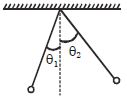
- 1Two masses, both equal to $100\, g$, are suspended at the ends of identical light strings of length $\lambda = 1.0\, m$, attached to the same point on the ceiling (see figure). At time $t = 0$, they are simultaneously released from rest, one at angle $\theta_1 = 1^o$, the other at angle $\theta_2 = 2^o$ from the vertical. The masses will collideView Solution
- 2Starting from the origin a body oscillates simple harmonically with a period of $2\ s$. After what time will its kinetic energy be $75\%$ of the total energy?View Solution
- 3View SolutionThe velocity of a particle performing simple harmonic motion, when it passes through its mean position is
- 4The force-deformation equation for a nonlinear spring fixed at one end is $F =4x^{1/ 2}$ , where $F$ is the force (expressed in newtons) applied at the other end and $x$ is the deformation expressed in metersView Solution
- 5A ring is suspended from a point $S$ on its rim as shown in the figure. When displaced from equilibrium, it oscillates with time period of $1\,second.$ The radius of the ring is ..... $m$ (take $g = \pi ^2$ )View Solution

- 6Two simple harmonic waves having equal amplitudes of $8\,cm$ and equal frequency of $10\,Hz$ are moving along the same direction. The resultant amplitude is also $8\,cm$. The phase difference between the individual waves is $..................$ degree.View Solution
- 7The displacement of a particle from its mean position (in metre) is given by $y = 0.2\sin (10\pi t + 1.5\pi )\cos (10\pi t + 1.5\pi )$. The motion of particle isView Solution
- 8$Assertion :$ For a particle performing $SHM$, its speed decreases as it goes away from the mean position.View Solution
$Reason :$ In $SHM$, the acceleration is always opposite to the velocity of the particle. - 9Two simple harmonic motions, as shown, are at right angles. They are combined to form Lissajous figuresView Solution
$x\left( t \right) = A\,\sin \,\left( {at + \delta } \right)$
$y\left( t \right) = B\,\sin \,\left( {bt} \right)$
Identify the correct match below
- 10A particle of mass $m$ is performing linear simple harmonic motion. Its equilibrium is at $x = 0,$ force constant is $K$ and amplitude of $SHM$ is $A$. The maximum power supplied by the restoring force to the particle during $SHM$ will beView Solution