MCQ
The power of a convex lens is :
- ANegative
- ✓Positive
- CZero
- DImaginary
Generate a complete, print-ready paper with questions like this in minutes — across 16+ boards, with answer keys.
The particles emitted by radioactive decay are deflected by magnetic field. The particles will be
|
(a) Protons and α - particles |
(b) Electrons, protons and α -particles |
|
(c) Electrons, protons and neutrons |
(d) Electrons and α -particles |
Wave nature of light follows because
|
(a) Light rays travel in a straight line |
|
(b) Light exhibits the phenomena of reflection and refraction |
|
(c) Light exhibits the phenomenon of interference |
|
(d) Light causes the phenomenon of photoelectric effect |
Photon and electron are given same energy ( . Wavelength associated with photon and electron are
  and
and  then correct statement will be
|
(a) |
(b) |
(c) |
(d) |
Two long conductors, separated by a distance d carry current I1 and I2 in the same direction. They exert a force F on each other. Now the current in one of them is increased to two times and its directions is reversed. The distance is also increased to 3d. The new value of the force between them is
|
(a) –2F |
(b) F/3 |
(c) 2F/3 |
(d) – F/3 |
A charged water drop whose radius is 0.1 μm is in equilibrium in an electric field. If charge on it is equal to charge of an electron, then intensity of electric field will be (g = 10
|
(a) 1.61 N/C |
(b) 26.2 N/C |
(c) 262 N/C |
(d) 1610 N/C |
The equivalent resistance of the following diagram A and B is
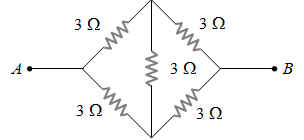
|
(a) |
(b) 9 W |
(c) 6 W |
(d) None of these |
In the following transitions, which one has higher frequency
|
(a) 3 – 2 |
(b) 4 – 3 |
(c) 4 – 2 |
(d) 3 – 1 |


