MCQ
The pressure exerted by a gas is dependent on its density:
  • Proportional
  • B
    Inversely proportional
  • C
    Proportional to the square
  • D
    does not depend on density

Answer

Correct option: A.
Proportional
A

Need a full question paper?

Generate a complete, print-ready paper with questions like this in minutes — across 16+ boards, with answer keys.
Start Generating Free

Similar questions

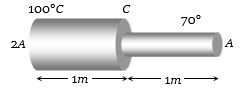
$A$ metal rod of length $2$$m$ has cross sectional areas $2A$ and $A$ as shown in figure. The ends are maintained at temperatures $100°C$ and $70°C$ . The temperature at middle point $C$ is...... $^oC$
The displacement of a body is given to be proportional to the cube of time elapsed. The magnitude of the acceleration of the body is
A particle of mass $m$ is tied to one end of $a$ string of length $l$. The particle is held horizontal with the string $mg$ taut. It is then projected upward with $a$ velocity $u$. The tension in the string is $\frac{{mg}}{2}$ when it is inclined at an angle $30^o$ to the horizontal. The value of $u$ is
A conducting loop is placed in a uniform magnetic field with its plane perpendicular to the field. An $\text{emf}$ is induced in the loop if:
  1. It is translated.
  2. It is rotated about its axis.
  3. It is rotated about a diameter.
  4. It is deformed.
The escape velocity of a projectile from the earth is approximately .......... $km/sec$
Following graph shows the correct variation in intensity of heat radiations by black body and frequency at a fixed temperature
When a body thrown vertically upward from the earth's surface is at its maximum height, then its :
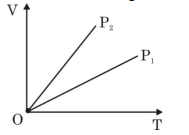
The given figure represents two isobaric processes for the same mass of an ideal gas, then
The specific heat capacity of solids is given by:
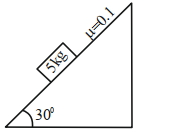
A block of mass $5 \mathrm{~kg}$ is placed on a rough inclined surface as shown in the figure.If $\vec{F}_1$ is the force required to just move the block up the inclined plane and $\vec{F}_2$ is the force required to just prevent the block from sliding down, then the value of $\left|\vec{F}_1\right|-\left|\vec{F}_2\right|$ is : [Use $g=10 \mathrm{~m} / \mathrm{s}^2$ ]