MCQ
The process by which ac is converted into dc is known as:
  • A
    Purification
  • B
    Amplification
  • C
    Rectification
  • D
    Current Amplification

Answer

  1. Rectification

Explanation:

The process by which ac is converted into dc is known as "Rectification".

Need a full question paper?

Generate a complete, print-ready paper with questions like this in minutes — across 16+ boards, with answer keys.

Start Generating Free

Similar questions

In a large building, there are 15 bulbs of 40W, 5 bulbs of 100W, 5 fans of 80W and 1 heater of 1kW. The voltage of electric mains is 220V. The minimum capacity of the main fuse of the building will be:

An LC resonant circuit contains a 400 pF capacitor and a 100 mH inductor. It is set into oscillation coupled to an antenna. The wavelength of the radiated electromagnetic waves is

(a) 377 mm

(b) 377 metre

(c) 377 cm

(d) 3.77 cm

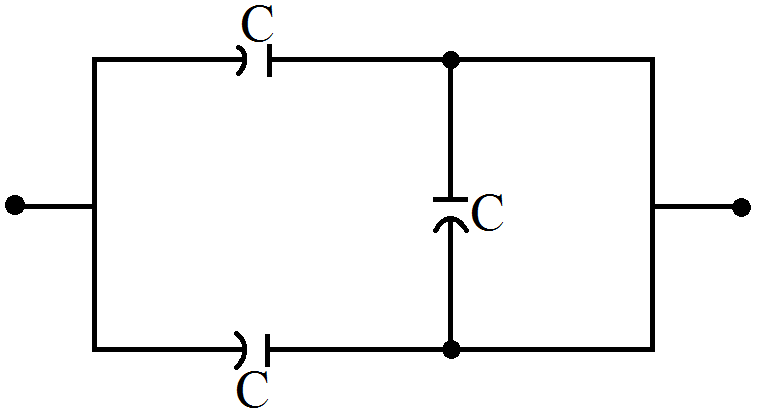
The equivalent capacitance of the combination shown in figure is:

  1. C
  2. 2C
  3. $\frac{\text{C}}{2}$
  4. None of these.
In electromagnetic spectrum, the frequencies $\gamma$-rays, X-rays and ultraviolet rays are denoted by n1, n2 and n3 respectively then:
The dielectric constant K of an insulator will be-
In a normal operation of a transistor:
  1. The base-emitter junction is forward-biased.
  2. The base-collector junction is forward-biased.
  3. The base-emitter junction is reverse-biased.
  4. The base-collector junction is reverse-biased.
Conduction occurs in semiconductors :
A metallic rod of length $l$ is kept perpendicular to a magnetic field and it is rotated on a circular path with frequency $f$. The potential difference across the ends of the rod is :

Masses of three wires of copper are in the ratio of 1 : 3 : 5 and their lengths are in the ratio of 5 : 3 : 1. The ratio of their electrical resistances are

(a) 1 : 3 : 5

(b) 5 : 3 : 1

(c) 1 : 15 : 125

(d) 125 : 15 : 1

The photoelectric threshold wavelength of a certain metal is 3000Å. If the radiation of 2000Å is incident on the metal

(a) Electrons will be emitted

(b) Positrons will be emitted

(c) Protons will be emitted

(d) Electrons will not be emitted