MCQ
The process requiring the absorptionof energy is
  • A
    $F \to {F^ - }$
  • B
    $H \to {H^ - }$
  • C
    $Cl \to {Cl^ - }$
  • $O \to {O^ {2-} }$

Answer

Correct option: D.
$O \to {O^ {2-} }$
d
Second electron affinity is zero for an element since already added electron repels existing electrons. Hence, it becomes difficult for an atom to take up another electron.

Therefore, the process $O ^{-} \rightarrow O ^{2-}$ requires energy.

Need a full question paper?

Generate a complete, print-ready paper with questions like this in minutes — across 16+ boards, with answer keys.

Start Generating Free

Similar questions

Which of the following intermediate is more stable
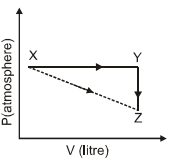
For an ideal gas, consider only $P - V$ work in going from an initial state $X$ to the final stat $Z$. The final state $Z$ can be reached by either of the two paths shown in the figure. Which of the following choice$(s)$ is (are) correct? [take $\Delta S$ as change in entropy and w as work done].

$(A)$ $\Delta S _{ x \rightarrow z}=\Delta S _{ x \rightarrow y}+\Delta S _{ y \rightarrow z}$

$(B)$ $w_{x \rightarrow z}=w_{x \rightarrow y}+w_{y \rightarrow z}$

$(C)$ $w_{x \rightarrow z \rightarrow z}=w_{x \rightarrow y}$

$(D)$ $\Delta S _{x \rightarrow y \rightarrow z}=\Delta S _{x \rightarrow y}$
Which of the following is used to distinguish ethylene and acetylene
What volume of oxygen gas $(O_2)$ measured at $0\,^o C$ and $1\ atm,$ is needed to burn completely $1\ L$ of propane gas $(C_3H_8)$ measured under the same conditions? .......... $\mathrm{L}$
correct statement regarding molecules $SF_4 , CF_4$ and $XeF_4$ are
In a Bohr's model of atom when an electron jumps from $n = 1$ to $n = 3$, how much energy will be emitted or absorbed
$pH$ of an aqueous solution of $CH_3COONH_4$ is found to be $6.7$ at $25\,^oC$. Concentration of $CH_3COONH_4$ solution may be ($K_a$ for $CH_3COOH = 1.0 \times 10^{-5}$ and $pK_b$ for $NH_4OH = 4.4$)
Which of the following compound has maximum $"C - C" $ single bond length ? 
Magnitude of Seebeck emf between the junctions does not depend on:
In endothermic reaction, the value of change in enthalpy $(\Delta H)$ is