MCQ
The product ‘$B$’ is
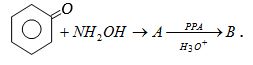
- A

- B

- ✓

- D

Generate a complete, print-ready paper with questions like this in minutes — across 16+ boards, with answer keys.
$\underset{Hexanal}{\mathop{C{{H}_{3\text{ }}}C{{H}_{2}}C{{H}_{2}}C{{H}_{2}}C{{H}_{2}}CH=O}}\,$

| Column $I$ | Column $II$ |
| $(a)\,XeO_6^{-4}$ | $(P)$ Tetrahedral |
| $(b)\,ClO_2$ | $(Q)\,V-$ Shape |
| $(c)\,NH_4^+$ | $(R)$ Trigonal Bipyramidal |
| $(d)\,XeO_3F_2$ | $(S)$ Octahedral |
$\mathrm{C}_6 \mathrm{H}_6(1)+\frac{15}{2} \mathrm{O}_2(\mathrm{~g}) \rightarrow \mathrm{CO}_2(\mathrm{~g})+3 \mathrm{H}_2 \mathrm{O}(1) \text {. }$
The standard enthalpy of combustion of $2 \mathrm{~mol}$ of benzene is - ' $x$ ' $k J$.
$\mathrm{x}=$. . . . . . . . . .
$(1)$ standard Enthalpy of formation of $1 \mathrm{~mol}$ of $\mathrm{C}_6 \mathrm{H}_6(1)$, for the reaction $6 \mathrm{C}$ (graphite) $+3 \mathrm{H}_2(\mathrm{~g}) \rightarrow \mathrm{C}_6 \mathrm{H}_n(1)$ is $48.5 \mathrm{~kJ} \mathrm{~mol}^{-1}$.
$(2)$ Standard Enthalpy of formation of $1 \mathrm{~mol}$ of $\mathrm{CO}_2(\mathrm{~g})$, for the reaction $\mathrm{C}$ (graphite) $+\mathrm{O}_{2(\mathrm{~g})} \rightarrow \mathrm{CO}_2(\mathrm{~g})$ is $-393.5 \mathrm{~kJ} \mathrm{~mol}^{-1}$.
$(3)$ Standard and Enthalpy of formation of $1 \mathrm{~mol}$ of $\mathrm{H}_2 \mathrm{O}(1)$, for the reaction $\mathrm{H}_2(\mathrm{~g})+\frac{1}{2} \mathrm{O}_2(\mathrm{~g}) \rightarrow \mathrm{H}_2 \mathrm{O}(1)$ is $-286 \mathrm{~kJ} \mathrm{~mol}^{-1}$.
