MCQ
Which of the following is most electronegative
  • $O$
  • B
    $S$
  • C
    $Te$
  • D
    $Se$

Answer

Correct option: A.
$O$
a
(a) 
Element - $O$ $S$ $Sc$ $Te$ $Po$
Electo negativity - $3.5$ $2.5$ $2.4$ $2.1$ $2.0$

Need a full question paper?

Generate a complete, print-ready paper with questions like this in minutes — across 16+ boards, with answer keys.
Start Generating Free

Similar questions

The rate for a first order reaction is $0.6932 \times {10^{ - 2}}\,mol\,{l^{ - 1}}\,mi{n^{ - 1}}$ and the initial concentration of the reactants is $1\,M$, ${T_{1/2}}$ is equal to ........ $\min$
Solubility product of a sulphide $MS$  is $3 \times {10^{ - 25}}$ and that of another sulphide $NS $ is $4 \times {10^{ - 40}}$. In ammoniacal solution
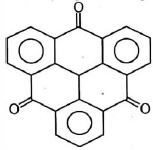
Which of the following is correct for the given compound?
How much water should be added to $200 \,c.c$ of semi normal solution of $NaOH$ to make it exactly deci normal ............ $\mathrm{cc}$
CaCO3(s) + 2HCl(aq) → CaCl2(aq) + CO2(g) H2O(l)
Consider the above reaction, what mass of CaCl2 will be formed if 250 mL of 0.76 M HCl reacts with 1000 g of CaCO3?
(Given: Molar mass of Ca, C, O, H and Cl are 40, 12, 16, 1 and 35.5 g mol-1, respectively)
Given below are two statements .

Statement $I :$ In $CuSO _{4} .5 H _{2} O , Cu - O$ bonds are present.

Statement $II :$ In $CuSO _{4} .5 H _{2} O$, ligands coordinating with $Cu$ $(II)$ ion are $O$-and $S$-based ligands.

In the light of the above statements, choose the correct answer from the options given below

In the reaction $C{H_3}CHO + HCN \to C{H_3}CH(OH)CN$ a chiral centre is produced. This product would be
A blue colouration is not obtained when
Which of the following oxidation reactions are carried out by both $\mathrm{K}_{2} \mathrm{Cr}_{2} \mathrm{O}_{7}$ and $\mathrm{KMnO}_{4}$ in acidic medium?
A. $\mathrm{I} \rightarrow \mathrm{I}_{2}$
B. $S^{2-} \rightarrow \mathrm{S}$
C. $\mathrm{Fe}^{2+} \rightarrow \mathrm{Fe}^{3+}$
D. $\mathrm{I}^{-} \rightarrow \mathrm{IO}_{3}^{-}$
E. $\mathrm{S}_{2} \mathrm{O}_{3}{ }^{2-} \rightarrow \mathrm{SO}_{4}{ }^{2-}$
Choose the correct answer from the options given below :
Which of the following is spin-free complex?