MCQ
The product obtained by heating ${(N{H_4})_2}S{O_4}$ and $KCNO$ is
  • A
    Hydrocyanic acid
  • B
    Ammonia
  • C
    Ammonium cyanide
  • Urea

Answer

Correct option: D.
Urea
d
(d) ${(N{H_4})_2}S{O_4} + KCNO \to $  $N{H_4}CNO + {K_2}S{O_4} \to \mathop {N{H_2} - CO - N{H_2}}\limits_{{\rm{Urea}}} $

Need a full question paper?

Generate a complete, print-ready paper with questions like this in minutes — across 16+ boards, with answer keys.

Start Generating Free

Similar questions

Ketone reacts with $NH_2OH$ to give oxime. The reaction is as follows 

The total number of organic products (ketoxime) formed when the simplest ketone and it's next higher homologue react with $NH_2OH$, is :
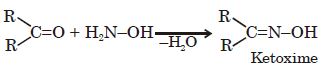
Which of the following obtained product is not correct
The e.m.f. of the cell $Ag|A{g^ + }(0.1\,M)||A{g^ + }(1\,M)|Ag$ at $298 K$  is ........... $\mathrm{V}$
In Carius method $0.099 \,g$ organic compound gave $0.287\, g$ $AgCl$. The percentage of chlorine in the compound will be
One litre of an aqueous solution contain $0.15\, mole$ of $CH_3COOH$ $(pK_a = 4.8)$ and $0.15\, mole$ of $CH_3COONa$. After the addition of $0.05\, mole$ of solid $NaOH$ to this solution, the $pH$ will be
Match List $I$ with List $II$ and select the correct answer using the codes given below the lists

 $\begin{array}{|l|l|} \hline List\,\,I & List\,\,II \\ \hline (A)\,\,Peroxide & (1)\,\,{C_3}{O_2} \\ \hline (B)\,\,Superoxide & (2)\,\,Pb{O_2} \\ \hline (C)\,\,Dioxide & (3)\,\,K{O_2} \\ \hline (D)\,\,Suboxide & (4)\,\,{H_2}{O_2} \\ \hline \end{array}$

An aqueous solution of $NaCl$ shows the depression of freezing point of water equal to $0.372\,K$. The boiling point of $BaCl_2$ solution of same molality will be  .........$^oC$ .$[K_f \,(H_2O)= 1.86\,K\,kg\,mol^{-1}$ ; $K_b\,(H_2O) = 0.52\,K\,kg\,mol^{-1} ]$
$0.3\,g$ of ethane undergoes combustion at $27^{\circ}\,C$ in a bomb calorimeter. The temperature of calorimeter system (including the water) is found to rise by $0.5^{\circ}\,C$. The heat evolved during combustion of ethane at constant pressure is $.......kJ\,mol { }^{-1}$.

(Nearest integer)

[Given : The heat capacity of the calorimeter system is $20\, kJ\, K ^{-1}, R =8.3\, JK ^{-1}\, mol ^{-1}$.

Assume ideal gas behaviour.

Atomic mass of $C$ and $H$ are $12$ and $1\, g\, mol ^{-1}$ respectively]

As electron moves away from the nucleus, its potential energy
Affinity for hydrogen decreases in the group from fluorine to iodine. Which of the halogen acids should have highest bond dissociation enthalpy?