MCQ
The quantities remaining constant in a collision are
  • A
    Momentum, kinetic energy and temperature
  • B
    Momentum and kinetic energy but not temperature
  • C
    Momentum and temperature but not kinetic energy
  • Momentum but neither kinetic energy nor temperature
Answer

Correct option: D.
Momentum but neither kinetic energy nor temperature
d
(d) since velocities of the colliding bodies change, the $K.E.$ will change. The shapes of the bodies at the time of collision change due to the force, hence temperature will also change.

Only the momentum will remain constant.

Need a full question paper?

Generate a complete, print-ready paper with questions like this in minutes — across 16+ boards, with answer keys.

Start Generating Free

Similar questions

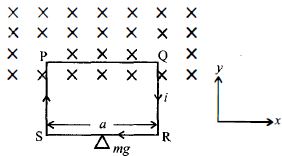
A rectangular loop of wire, supporting a mass $m$, hangs with one end in a uniform magnetic field $\overrightarrow B $ pointing out of the plane of the paper. A clockwise current is set up such that $i > mg/Ba$, where $a$ is the width of the loop. Then
A $6000 \,kg$ rocket is set for firing. If the exhaust speed is $1000 \,m / s$, how much gas must be ejected each second to supply the thrust needed to overcome the weight of the rocket is .......... $kg$
If the tension in the cable of $1000 \,kg$ elevator is $1000 \,kg$ weight, the elevator
Assertion : Environmental damage has increased the amount of ozone in the atmosphere.

Reason : Increase of ozone increases the amount of ultraviolet radiation on earth.

When wavelength of incident photon is decreased then
The equation of a wave is $y = 2\sin \pi (0.5x - 200t)$, where $x$ and $y$ are expressed in $cm$ and $t$ in $sec.$ The wave velocity is  ...... $cm/sec$
Characteristic $X-$ rays are produced due to
$27$ similar drops of mercury are maintained at $10 \,V$ each. All these spherical drops combine into a single big drop. The potential energy of the bigger drop is ....... times that of a smaller drop.
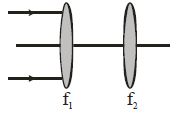
A parallel beam of light is incident on a system of two convex lenses of focal lengths $f_1 = 20\, cm$ and $f_2 = 10\, cm$. What should be the distance between the two lenses so that rays after refraction from both the lenses pass undeviated ?........$cm$
The material which practically does not show elastic after effect is