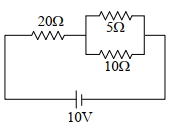
The ratio of heat dissipated per second through the resistance $5 \Omega$ and $10 \Omega$ in the circuit given below is: :
JEE MAIN 2024, Diffcult
Download our app for free and get started
$\frac{i_1}{i_2}=\frac{10}{5}=\frac{2}{1}$
$\frac{P_1}{P_2}=\frac{i_1^2 R_1}{i_2^2 R_2}=\left(\frac{2}{1}\right)^2 \times \frac{5}{10}=\frac{2}{1}$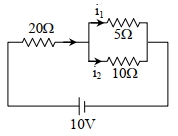

Download our appand get started for free
Experience the future of education. Simply download our apps or reach out to us for more information. Let's shape the future of learning together!No signup needed.*
Similar Questions
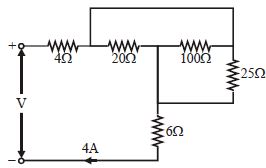
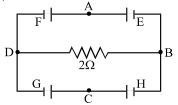
- 1In the circuit shown $E, F, G$ and $H$ are cells of $\mathrm{e.m.f.}$ $2\,V, 1\,V, 3\,V$ and $1\,V$ respectively and their internal resistances are $2\,\Omega , 1\,\Omega , 3\,\Omega$ and $1\,\Omega$ respectively.View Solution
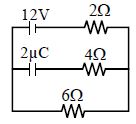
- 2Find the charge on the capacitor $C$ in the given circuit .................. $\mu C$View Solution
- 3Two bulbs consume same power when operated at $200\, V$ and $300\, V$ respectively. When these bulbs are connected in series across a $D.C$. source of $500\, V$, thenView Solution
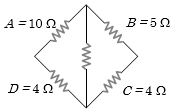
- 4In a typical Wheatstone network, the resistances in cyclic order are $A = 10 \,\Omega $, $B = 5 \,\Omega $, $C = 4 \,\Omega $ and $D = 4 \,\Omega $ for the bridge to be balancedView Solution
- 5The resistance ofeach arm of the Wheatstone's bridge is $10\; ohm$. A resistance of $10 \;ohm$ is connected in series with a galvanometer then the equivalent resistance across the battery will beView Solution
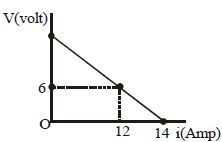
- 6$10\,Cells$, each of emf $'E'$ and internal resistance $'r'$, are connected in series to a variable external resistance. Figure shows the variation of terminal potential difference of their combination with the current drawn from the combination.$Emf$ of each cell is ............. $V$View Solution
- 7The value of internal resistance of an ideal cell is $\Omega$View Solution
- 8View SolutionThe fact that the conductance of some metals rises to infinity at some temperature below a few Kelvin is called
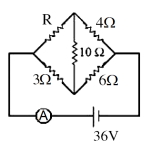
- 9Current measured by the ammeter $(A)$ in the reported circuit when no current flows through $10\,\Omega$ resistance. will be________$A$View Solution
- 10In given circuit find value of ................... $V$View Solution