The reading of voltmeter in the circuit shown is ............. $V$
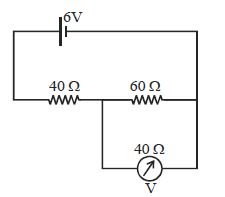
Medium
Download our app for free and get started
$\frac{60 \times 40}{60+40}=24\, \Omega$
$\mathrm{V}$ $=\frac{6 \times 24}{40+24}$ $ = \boxed{2.25\,{\text{V}}}$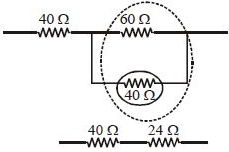

Download our appand get started for free
Experience the future of education. Simply download our apps or reach out to us for more information. Let's shape the future of learning together!No signup needed.*
Similar Questions
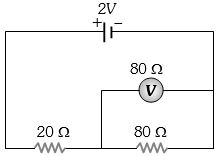
- 1In the adjoining circuit, the $e.m.f.$ of the cell is $2\, volt$ and the internal resistance is negligible. The resistance of the voltmeter is $80 \,ohm$. The reading of the voltmeter will be ............. $volt$View Solution
- 2When a current of $2\, A$ flows in a battery from negative to positive terminal, the potential difference across it is $12\, V$. If a current of $3 \,A$ flows in the opposite direction potential difference across the terminals of the battery is $15\, V$, the $emf$ of the battery is ................ $\mathrm{V}$View Solution
- 3A galvanometer of resistance, $G,$ is connected in a circuit. Now a resistance $R$ is connected in series of galvanometer. To keep the main current in the circuit unchanged, the resistance to be put in parallel with the series combination of $G$ and $R$ isView Solution
- 4Two wires each of radius of cross section $r$ but of different materials are connected together end to end (in series). If the densities of charge carriers in the two wires are in the ratio $1 : 4$, the drift velocity of electrons in the two wires will be in the ratio:View Solution
- 5The resistance of a wire is $20\, ohms$. It is so stretched that the length becomes three times, then the new resistance of the wire will be ............. $ohms$View Solution
- 6The same mass of copper is drawn into two wires $1\, mm$ and $2\, mm$ thick. Two wires are connected in series and current is passed through them. Heat produced in the wire is in the ratioView Solution
- 7Two wires of the same material and equal length are joined in parallel combination. If one of them has half the thickness of the other and the thinner wire has a resistance of $8\, ohms$, the resistance of the combination is equal toView Solution
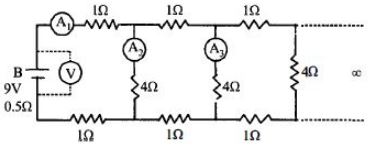
- 8A $9\, V$ battery with internal resistance of $0.5\,\Omega $ is connected across an infinite network as shown in the figure. All ammeters $A_1 , A_2, A_3$ and voltmeter $V$ are ideal. Choose correct statementView Solution
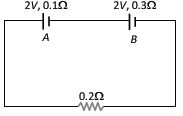
- 9The internal resistances of two cells shown are $0.1\,\Omega $ and $0.3\,\Omega $. If $R = 0.2\,\Omega $, the potential difference across the cellView Solution
- 10If $2.2\, Kwatt$ power is transmitted through a $10\, ohm$ line at $22000\, volt$, the power loss in the form of heat will be ............. $watt$View Solution