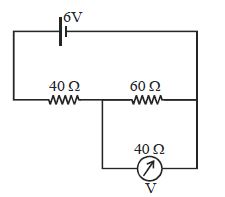
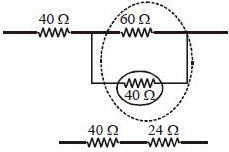
The reading of voltmeter in the circuit shown is ............. $V$
Medium


Download our appand get started for free
Experience the future of education. Simply download our apps or reach out to us for more information. Let's shape the future of learning together!No signup needed.*
Similar Questions
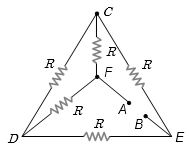
- 1Five equal resistances each of resistance $R$ are connected as shown in the figure. A battery of $V\, volts$ is connected between $A$ and $B$. The current flowing in $AFCEB$ will beView Solution
- 2$A$ wire of length $L$ and $3$ identical cells of negligible internal resistances are connected in series. Due to the current, the temperature of the wire is raised by $\Delta T$ in time $t. N$ number of similar cells is now connected in series with a wire of the same material and cross section but of length $2L$. The temperature of the wire is raised by the same amount $\Delta T$ in the same time $t$. The value of $N$ is :View Solution
- 3Some electric bulbs are connected in series across a $220\, V$ supply in a room. If one bulb is fused then remaining bulbs are connected again in series across the same supply. The illumination in the room willView Solution
- 4A $d.c.$ main supply of $e.m.f.\, 220\, V$ is connected across a storage battery of $e.m.f.\, 200\, V$ through a resistance of $1\,\Omega $. The battery terminals are connected to an external resistance $'R'$ . The minimum value of $'R'$, so that a current passes through the battery to charge it is ............... $\Omega$View Solution
- 5Two electric bulbs whose resistances are in the ratio of $1 : 2$ are connected in series. The powers dissipated in them have the ratioView Solution
- 6View SolutionOf the two bulbs in a house hold circuit, one glows brighter than the other, Which of the two bulbs has a large resistance?
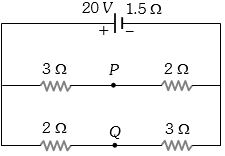
- 7If in the circuit shown below, the internal resistance of the battery is $1.5$ $\Omega$ and $V_P$ and $V_Q$ are the potentials at $P$ and $Q$ respectively, what is the potential difference between the points $P$ and $Q$View Solution
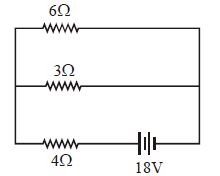
- 8The total power dissipated in watts in the circuit shown is ............. $W$View Solution
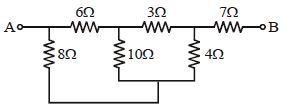
- 9The equivalent resistance between the points $A$ and $B$ is :-View Solution
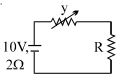
- 10In the figure shown the power generated in $y$ is maximum when $y = 5\,\Omega$ . Then $R$ is .............. $\Omega$View Solution