$A$. Tollen's reagent $B$. Schiff's reagent $C$. $\mathrm{HCN}$ $D$. $\mathrm{NH}_2 \mathrm{OH}$ $E$. $\mathrm{NaHSO}_3$
Choose the correct options from the given below:
- A$A$ and $D$
- ✓$B$ and $E$
- C$E$ and $D$
- D$B$ and $C$

$A$. Tollen's reagent $B$. Schiff's reagent $C$. $\mathrm{HCN}$ $D$. $\mathrm{NH}_2 \mathrm{OH}$ $E$. $\mathrm{NaHSO}_3$
Choose the correct options from the given below:
Generate a complete, print-ready paper with questions like this in minutes — across 16+ boards, with answer keys.
$Fe^{3+} + e \to Fe^{2+} ;$ $E^o = 0.771\, volts$
$I_2 + 2e\to 2I^-;$ $E^o = 0.536\, volts$
$E^o$ cell for the cell reaction
$2Fe^{3+} + 2I^-\to 2Fe^{2+} + I_2$ is

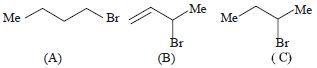
The correct order of $S_N1$ reactivity is
$(I)$ $S_2O_4^{2-}$ $(II)$ $S_2O_5^{2-}$ $(III)$ $S_2O_6^{2-}$
$F{e^{ + 3}}\left( {aq} \right) + {e^ - } \to F{e^{2 + }}\left( {aq} \right);{E^o} = + 0.77\,V$
$A{l^{ + 3}}\left( {aq} \right) + 3{e^ - } \to Al\left( s \right);{E^o} = - 1.66\,V$
$B{r_2}\left( {aq} \right) + 2{e^ - } \to 2B{r^ - };{E^o} = + 1.09\,V$
Considering the electrode potentials, which of the following represents the correct order of reducing power?