MCQ
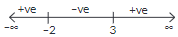
The real function $f(x)=2 x^3-3 x^2-36 x+7$ is
  • A
    Strictly increasing in $(-\infty,-2)$ and strictly decreasing in $(-2, \infty)$
  • B
    Strictly decreasing in $(-2,3)$
  • C
    Strictly decreasing in $(-\infty, 3)$ and strictly increasing in $(3, \infty)$
  • D
    Strictly decreasing in $(-\infty,-2) \cup(3, \infty)$
Need a full question paper?

Generate a complete, print-ready paper with questions like this in minutes — across 16+ boards, with answer keys.

Start Generating Free

Similar questions

The probabilities of a student getting I, II and III division in an examination are $\frac{1}{10},\frac{3}{5}$ and $\frac{1}{4}$ respectively. The probability that the student fails in the examination is.
  1. $\frac{197}{200}$
  2. $\frac{27}{100}$
  3. $\frac{83}{100}$
  4. None of these.
The existence of the unique solution of the system of equations:
x + y + z = λ
5x − y + µz = 10
2x + 3y − z = 6
depends on
  1. µ only.
  2. λ only.
  3. λ and µ both.
  4. neither λ nor µ.
If the radius of a circle increases from  $3 \,\, cm$ to  $3.2 \,\, cm,$ then the increase in the area of the circle is
If $A=\left[\begin{array}{ccc}3 & -1 & 2 \\ 2 & 1 & 3 \\ 1 & -3 & K\end{array}\right]$ is non-invertible matrix, then value of K :
Let $f$ be derivable funciton $f : R\ \rightarrow\  R$ satisfying the equation $f(x) = (1+x^2)\left[ {1 + \int\limits_0^x {\frac{{f(t)}}{{1 + {t^2}}}dt} } \right] $$\forall x \in R$ then $f(1)$ is-
It is given that $X\left[\begin{array}{cc}3 & 2 \\ 1 & -1\end{array}\right]=\left[\begin{array}{ll}4 & 1 \\ 2 & 3\end{array}\right]$. Then matrix $X$ is :
If $f(x) = {x^5} - 20{x^3} + 240x$, then $f(x)$ satisfies which of the following
$\int_{}^{} {{{\sin }^2}x\cos x\;dx} $ is equal to
The area of the circle $x^{2}+y^{2}=16$ exterior to the parabola $y^{2}=6 x$ is
Let $g(t)=\int \limits_{-\pi / 2}^{\pi / 2} \cos \left(\frac{\pi}{4} t+f(x)\right) \,d x$, where $f(x)=\log _{e}\left(x+\sqrt{x^{2}+1}\right), x \in R$. Then which one of the following is correct?