MCQ
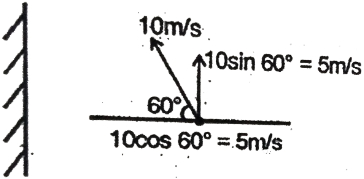
The reflection surface of a plane mirror is vertical. $A$ particle is projected in a vertical plane which is also perpendicular to the mirror. The initial velocity of the particle is $10\, m/s$ and the angle of projection is $60^o$. The point of projection is at a distance $5\, m$ from the mirror. The particle moves towards the mirror. Just before the particle touches the mirror the velocity of approach of the particle and its image is ......$m/s$
  • $10$
  • B
    $5$
  • C
    $10\sqrt 3 $
  • D
    $5\,\sqrt 3 $

Answer

Correct option: A.
$10$
a
$\left(V_{I, m}\right) x=-\left(V_{o, m}\right) x$

$\left(V_{1}-V_{m}\right) x=-\left(V_{0}-V_{m}\right) x$

$V_{i x}-O=V_{\otimes}$

$V_{i x}=-5 m / s$

$V_{a p p}=5-(-5)=10 m / s$

Need a full question paper?

Generate a complete, print-ready paper with questions like this in minutes — across 16+ boards, with answer keys.

Start Generating Free

Similar questions

The electric current in a circular coil of four turns produces a magnetic induction $32\,T$ at its centre. The coil is unwound and is rewound into a circular coil of single turn, the magnetic induction at the centre of the coil by the same current will be $..........\,T$
A sine wave is travelling in a medium. A particular particle has zero displacement at a certain instant. The particle closest to it having zero displacement is at a distance:
A thermocouple of negligible resistance produces an $e.m.f.$ of $40\,\mu V{/^o}C$ in the linear range of temperature. A galvanometer of resistance $10\; ohm$ whose sensitivity is $1\;\mu A/div$, is employed with the thermocouple. The smallest value of temperature difference that can be detected by the system will be
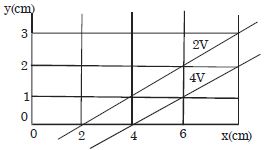
Figure shows two equipotential lines in $x, y$ plane for an electric field. The scales are marked. The $x-$ component $E_x$ and $y$ -component $E_y$ of the electric field in the space between these equipotential lines are respectively :-
A proton enters a magnetic field of flux density $1.5\,weber/{m^2}$ with a velocity of $2 \times {10^7}\,m/\sec $ at an angle of $30^\circ $ with the field. The force on the proton will be
When photons of energy $hf$ fall on an aluminium plate (of work function $ E_0$), photoelectrons of maximum kinetic energy $K$ are ejected. If the frequency of radiation is doubled, the maximum kinetic energy of the ejected photoelectrons will be 
The decay of a proton to neutron is :
A thin convex lens of focal length $10 cm$ is placed in contact with a concave lens of same material and of same focal length. The focal length of combination will be
The $K, L$ and $M$ energy levels of platinum lie roughly at $78, 12$ and $3\  keV$ respectively. The ratio of wavelength of $K_{\alpha}$ line to that of $K_{\beta}$ line in $X-$ ray spectrum is :
If the balance point is obtained at the $35^{th} cm$ in a meter bridge the resistances in the left and right gaps are in the ratio of