MCQ
The relation between phase difference  $ (\Delta \phi) $ and path difference $ (\Delta x) $ is
  • $\Delta \phi = \frac{{2\pi }}{\lambda }\Delta x$
  • B
    $\Delta \phi = 2\pi \lambda \Delta x$
  • C
    $\Delta \phi = \frac{{2\pi \lambda }}{{\Delta x}}$
  • D
    $\Delta \phi = \frac{{2\Delta x}}{\lambda }$
Answer

Correct option: A.
$\Delta \phi = \frac{{2\pi }}{\lambda }\Delta x$
a
(a)

Need a full question paper?

Generate a complete, print-ready paper with questions like this in minutes — across 16+ boards, with answer keys.

Start Generating Free

Similar questions

$A$ wall has two layers $A$ and $B$ made of different materials. The thickness of both the layers is the same. The thermal conductivity of $A$ and $B$ are $K_A$ and $K_B$ such that $K_A = 3K_B$. The temperature across the wall is $20°C$ . In thermal equilibrium
Two masses ${m_A}$and ${m_B}$moving with velocities ${v_A}$and ${v_B}$in opposite directions collide elastically. After that the masses ${m_A}$and ${m_B}$move with velocity ${v_B}$and ${v_A}$respectively. The ratio $ \frac{m_A}{m_B} =$
The $SI$ unit of mechanical equivalent of heat $(J)$ is:
When a body thrown vertically upward from the earth's surface is at its maximum height, then its :
A light rod of length $l$ has two masses $m_1$ and $m_2$ attached to its two ends. The moment of inertia of the system about an axis perpendicular to the rod and passing through the centre of mass is 
$50\, g$ ice at $0\,^oC$ is dropped into a calorimeter containing $100\, g$ water at $30\,^oC$. If thermal capacity of calorimeter is zero then amount of ice left in the mixture at equilibrium is ........ $gm$
The molar heat capacities of a mixture of two gases at constant volume is $13 R / 6$. The ratio of number of moles of the first gas to the second is $1: 2$. The respective gases may be
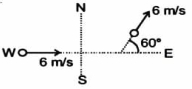
A particle is moving eastwards with a speed of $6 \,m / s$. After $6 \,s$, the particle is found to be moving with same speed in a direction $60^{\circ}$ north of east. The magnitude of average acceleration in this interval of time is ....... $m / s ^2$
A planet of radius $R_{p}$ is revolving around a star of radius $R^{*}$, which is at temperature $T^{*}$. The distance between the star and the planet is $d$. If the planet's temperature is $f T^{*}$, then $f$ is proportional to
Moment of Inertia $(M.I.)$ of four bodies having same mass ' $M$ ' and radius ' $2 R^{\prime}$ are as follows

$I _{1}=$ $M.I.$ of solid sphere about its diameter

$I _{2}=$ $M.I.$ of solid cylinder about its axis

$I _{3}=$ $M.I.$ of solid circular disc about its diameter

$I _{4}=$ $M.I.$ of thin circular ring about its diameter

If $2\left(I_{2}+I_{3}\right)+I_{4}=x$. $I_{1}$ then the value of $x$ will be.......