MCQ
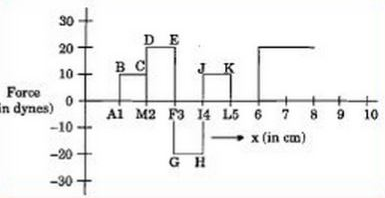
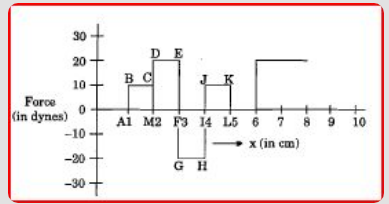
The relationship between force and position is shown in the figure (in one dimensional case). Work done by the force in displacing a body from
X = 1cmto X = 5cmis:
  • A
    700 ergs
  • B
    70 ergs
  • C
    60 ergs
  • D
    20 ergs

Answer

  1. 60 ergs

Explanation:

Work is area under the curve.

So In = In1​ + In2​ + In3​ + In4

In​= arandaundandr  A1​BCM2​

In2​ = arandaundandr M2​DEF3

In3​ = arandaundandr F3​GHI4​

In4​ = arandaundandr I4​JKL5

In​= 10 × 1 = 10ergs

In2​ = 20 × 1 = 20ergs

In= −20 × 1 = −20ergs

In4​ = 10 × 1 = 10ergs

In = In1​ + In+ In3​ + In4​ = 10 + 20 − 20 + 10 = 20ergs

Need a full question paper?

Generate a complete, print-ready paper with questions like this in minutes — across 16+ boards, with answer keys.

Start Generating Free

Similar questions

The phase difference between two waves represented by

${y_1} = {10^{ - 6}}\sin [100\,t + (x/50) + 0.5]m$

${y_2} = {10^{ - 6}}\cos \,[100\,t + (x/50)]m$

where $ x$ is expressed in metres and $t$ is expressed in seconds, is approximately .... $ rad$
A particle is confined to rotate in a circular path decreasing linear speed, then which of the following is correct?
A body takes $4\, {min}$. to cool from $61^{\circ} {C}$ to $59^{\circ} {C}$. If the temperature of the surroundings is $30^{\circ} {C}$, the time taken by the body to cool from $51^{\circ} {C}$ to $49^{\circ} {C}$ is $....\,min$
If the gravitational field in the space is given as $\left(-\frac{ K }{ r ^2}\right)$. Taking the reference point to be at $r =2\,cm$ with gravitational potential $V =10\,J / kg$. Find the gravitational potential at $r =3\,cm$ in $SI$ unit (Given, that $K =6\,J cm / kg$ )
$A$ block of mass $m$ slides down a plane inclined at an angle $\theta$ . Which of the following will $NOT$ increase the energy lost by the block due to friction?
If $T$ is the surface tension of soap solution, the amount of work done in blowing a soap bubble from a diameter $D$ to $2D$ is
In the gas equation $\Big(\text{p}+\frac{\text{a}}{\text{V}^2}\Big)(\text{V}-\text{b})=\text{RT}$ the dimensions of a are:
A soap bubble is blown to a diameter of $7 \mathrm{~cm}$. $36960 \mathrm{erg}$ of work is done in blowing it further. If surface tension of soap solution is $40 \mathrm{dyne} / \mathrm{cm}$ then the new radius is______. $\mathrm{cm}$. Take $:\left(\pi=\frac{22}{7}\right)$.
The plank in the figure moves a distance $100\ mm$ to the right while the centre of mass of the sphere of radius $150\, mm$ moves a distance $75\,mm$ to the left. The angular displacement of the sphere (in radian) is (there is no slipping anywhere) :-
Two trolleys of mass m and $3m$ are connected by a spring. They were compressed and released once, they move off in opposite direction and comes to rest after covering distances ${S_1}$and ${S_2}$ respectively. Assuming the coefficient of friction to be uniform, the ratio of distances ${S_1}:{S_2}$ is