MCQ
The relaxation time in conductors
  • A
    Increases with the increase of temperature
  • Decreases with the increase of temperature
  • C
    It does not depend on temperature
  • D
    All of sudden changes at $400\, K$

Answer

Correct option: B.
Decreases with the increase of temperature
b
(b) Because as temperature increases, the resistivity increases and hence the relaxation time decreases for conductors $\left( {\tau \propto \frac{1}{\rho }} \right).$

Need a full question paper?

Generate a complete, print-ready paper with questions like this in minutes — across 16+ boards, with answer keys.
Start Generating Free

Similar questions

Electromagnetic waves
Fusion reaction is initiated with the help of
When cathode rays (tube voltage $~ 10 kV$) collide with the anode of high atomic weight then we get
According to the pulsating theory the expansion and contraction of the universe repeats after every
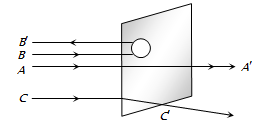
A beam of fast moving alpha particles were directed towards a thin film of gold. The parts A';B' and C' of the transmitted and reflected beams corresponding to the incident parts A, B and C of the beam, are shown in the adjoining diagram. The number of alpha particles in
A coil of $100$ turns and area $5$ square centimetre is placed in a magnetic field $B =\,0.2\, T$. The normal to the plane of the coil makes an angle of $60^o$ with the direction of the magnetic field. The magnetic flux linked with the coil is
The resistance of 10 metre long potentiometer wire is 1ohm/meter. A cell of e.m.f. 2.2 volts and a high resistance box are connected in series to this wire. The value of resistance taken from resistance box for getting potential gradient of 2.2 millivolt/metre will be
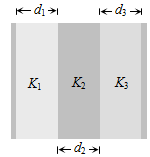
The expression for the capacity of the capacitor formed by compound dielectric placed between the plates of a parallel plate capacitor as shown in figure, will be (area of plate = A)
Two coherent sources of different intensities send waves which interfere. The ratio of maximum intensity to the minimum intensity is 25. The intensities of the sources are in the ratio:
What will be the phase difference between virtual voltage and virtual current, when the current in the circuit is wattless.....$^o$