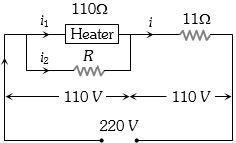
The resistance of a heater coil is $110\, ohm$. A resistance $R$ is connected in parallel with it and the combination is joined in series with a resistance of $11\, ohm$ to a $220\, volt$ main line. The heater operates with a power of $110\, watt$. The value of $R$ in $ohm$ is
Diffcult


Download our appand get started for free
Experience the future of education. Simply download our apps or reach out to us for more information. Let's shape the future of learning together!No signup needed.*
Similar Questions
- 1A potential $V_0$ is applied across a uniform wire of resistance $R$. The power dissipation is $P_1$. The wire is then cut into two equal halves and a potential of $V _0$ is applied across the length of each half. The total power dissipation across two wires is $P_2$. The ratio $P_2: P_1$ is $\sqrt{x}: 1$. The value of $x$ is $.............$.View Solution
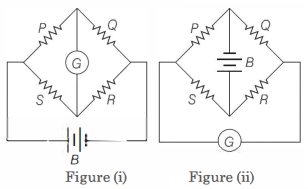
- 2Figure $(i)$ below shows a Wheatstone's bridge in which $P, Q, R$ and $S$ are fixed resistances, $G$ is a galvanometer and $B$ is a battery. For this particular case, the galvanometer shows zero deflection. Now, only the positions of $B$ and $G$ are interchanged, as shown in figure $(ii)$. The new deflection of the galvanometerView Solution
- 3The heating coils rating at $220\, volt$ and producing $50\, cal/sec$ heat are available with the resistances $55\,\Omega $ , $110\,\Omega$ , $220\,\Omega $ and $440\,\Omega $. The heater of maximum power will be of............. $\Omega$View Solution
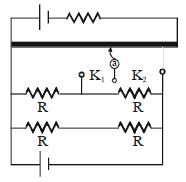
- 4In potentiometer experiment when $K_1$ is closed balance length is $100\,cm$. Then what will be balancing length when $K_2$ is closed ................ $\mathrm{cm}$View Solution
- 5View SolutionIn meter bridge or Wheatstone bridge for measurement of resistance, the known and the unknown resistances are interchanged. The error so removed is
- 6Electric room radiator which operates at $225\, volts$ has resistance of $50\, ohms$. Power of the radiator is approximately ............... $W$View Solution
- 7A $5\;ampere$ fuse wire can withstand a maximum power of $1\; watt$ in the circuit. The resistance of the fuse wire isView Solution
- 8Three unequal resistors in parallel are equivalent to a resistance $1\, ohm$. If two of them are in the ratio $1 : 2$ and if no resistance value is fractional, the largest of the three resistances in $ohms$ isView Solution
- 9View SolutionOn increasing the temperature of a conductor, its resistance increases because
- 10View SolutionWe are able to obtain fairly large currents in a conductor because