The resistance of a wire is $R$. It is bent at the middle by $180^{\circ}$ and both the ends are twisted together to make a shorter wire. The resistance of the new wire is
Easy
Download our app for free and get started
(c)
Resistance of wire $(R)=\rho \frac{l}{A}$ If wire is bent in the middle then $l^{\prime}=\frac{l}{2}, A^{\prime}=2 A$
$\therefore$ New resistance, $R ^{\prime}=\frac{R}{4}$.

Download our appand get started for free
Experience the future of education. Simply download our apps or reach out to us for more information. Let's shape the future of learning together!No signup needed.*
Similar Questions
- 1A resistance of $2 \Omega$ is comnected across one gap of a metre-bridge (the length of the wire is $100 \mathrm{~cm}$ ) and an unknown resistance, greater than $2 \Omega$, is connected across the other gap. When these resistance are interchanged, the balance point shifts by $20 \mathrm{~cm}$. Neglecting any corrections, the unknown resistance isView Solution
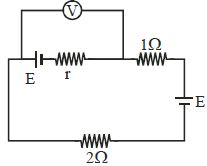
- 2In the given circuit reading of ideal voltmeter is $\frac{E}{2}$ then internal resistance of cell is ............. $\Omega$View Solution
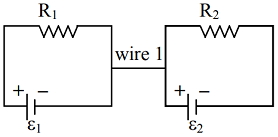
- 3In the circuit, wire $1$ is of negligible resistance. Then,View Solution
- 4View SolutionElectromotive force is the force, which is able to maintain a constant
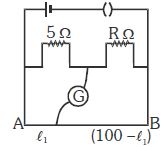
- 5The resistance in the two arms of a meter bridge are $5\,\Omega $ and $R\,\Omega $, respectively. When the resistance $R$ is shunted with an equal resistance, the new balance point is at $1.6\, l_1$. The resistance $‘R’$ is ................. $\Omega$View Solution
- 6The two ends of a uniform conductor are joined to a cell of $e.m.f.$ $E$ and some internal resistance. Starting from the midpoint $P$ of the conductor, we move in the direction of current and return to $P$. The potential $V$ at every point on the path is plotted against the distance covered $(x)$. Which of the following graphs best represents the resulting curveView Solution
- 7A steady current $i$ is flowing through a conductor of uniform cross-section. Any segment of the conductor hasView Solution
- 8View SolutionAn energy source will supply a constant current into the load if its internal resistance is
- 9Equivalent resistance between $A$ and $B$ is ............ $\Omega$View Solution
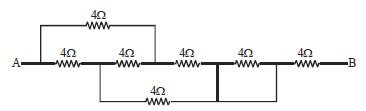
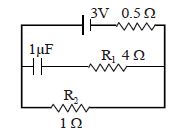
- 10A $1\,\mu F$ capacitor is connected in the circuit shown below. The emf of the cell is $3\ volts$ and internal resistance is $0.5\ ohms$ . The resistors $R_1$ and $R_2$ have values $4\ ohms$ and $1\ ohm$ respectively. The charge on the capacitor in steady state must be.......$\mu C$View Solution