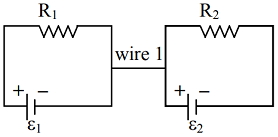
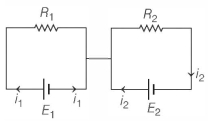
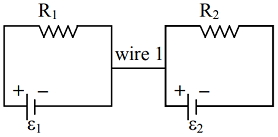
In the circuit, wire $1$ is of negligible resistance. Then,
KVPY 2016, Diffcult


Download our appand get started for free
Experience the future of education. Simply download our apps or reach out to us for more information. Let's shape the future of learning together!No signup needed.*
Similar Questions
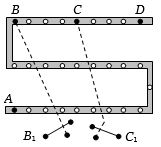
- 1View SolutionFor the post office box arrangement to determine the value of unknown resistance the unknown resistance should be connected between
- 2There are $0.8 \times 10^{23}$ free electrons $/ cm^3$ in copper. If $0.2\, A $ current is flowing is copper wire, then the drift velocity of electrons will be, if the cross sectional area of wire is $0.01 \,cm^2$View Solution
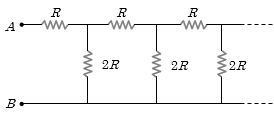
- 3An infinite ladder network is arranged with resistances $R$ and $2 R$ as shown. The effective resistance between terminals $A$ and $B$ isView Solution
- 4Two equal resistances when connected in series to a battery, consume electric power of $60\,W.$ If these resistances are now connected in parallel combination to the same battery, the electric power consumed will be .............. $W$View Solution
- 5We have two wires $A$ and $B$ of same mass and same material. The diameter of the wire $A$ is half of that $B$. If the resistance of wire $A$ is $24\, ohm$ then the resistance of wire $B$ will be ................ $Ohm$View Solution
- 6In the circuit, wire $1$ is of negligible resistance. Then,View Solution
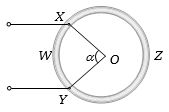
- 7A wire of resistor $R$ is bent into a circular ring of radius $r$. Equivalent resistance between two points $X$ and $Y$ on its circumference, when angle $XOY$ is $\alpha$, can be given byView Solution
- 8A letter $A$ is constructed of a uniform wire with resistance $1.0\,\Omega \,per\,cm$. The sides of the letter are $20\, cm$ and the cross piece in the middle is $10\, cm$ long. The apex angle is $60^o$. The resistance between the ends is .............. $\Omega$View Solution
- 9Consider the following two statements.View Solution
$(A)$ Kirchhoff's junction law follows from the conservation of charge.
$(B)$ Kirchhoff's loop law follows from the conservation of energy.
Which of the following is correct ?
- 10Two wires of same metal have the same length but their cross-sections are in the ratio $3:1$. They are joined in series. The resistance of the thicker wire is $10\,\Omega $. The total resistance of the combination will be ............. $\Omega$View Solution