The resistance of platinum wire at $0^{\circ}\,C$ is $2\,\Omega$ and $6.8\,\Omega$ at $80^{\circ} \,C$. The temperature coefficient of resistance of the wire is :
NEET 2023, Medium


Download our appand get started for free
Experience the future of education. Simply download our apps or reach out to us for more information. Let's shape the future of learning together!No signup needed.*
Similar Questions
- 1View SolutionThe mechanism of the heat produced in a conductor when an electric current flows through it, can be explained on the basis of
- 2A conducting wire of length $ l$ area of cross-section $A$ and electric resistivity $\rho$ is connected between the terminals of a battery. $A$ potential difference $V$ is developed between its ends, causing an electric current.If the length of the wire of the same material is doubled and the area of cross-section is halved, the resultant current would beView Solution
- 3Assertion $(A):$ In a meter bridge experiment, null point for an unknown resistance is put inside an enclosure maintained at a higher temperature. The null point can be obtained at the same $p$ as before by decreasing the value of the standard resistance.View Solution
Reason $(R):$ Resistance of metal increases with increase in temperature.
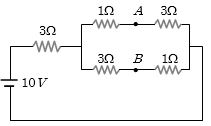
- 4A battery of $e.m.f.$ $10\, V$ is connected to resistance as shown in figure. The potential difference ${V_A} - {V_B}$ between the points $A$ and $B$ is .................... $V$View Solution
- 5The specific resistance of a wire is $\rho $, its volume is $3\,{m^3}$ and its resistance is $3\, ohms$, then its length will beView Solution
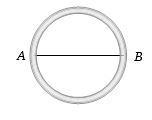
- 6The resistance of a wire is ${10^{ - 6}}\,\Omega $ per meter. It is bend in the form of a circle of diameter $2\,m$. A wire of the same material is connected across its diameter. The total resistance across its diameter $AB$ will beView Solution
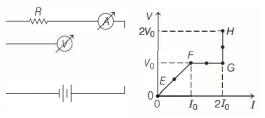
- 7In the circuit shown below (on the left) the resistance and the emf source are both variable. The graph of seven readings of the voltmeter and the ammeter ( $V$ and $I$, respectively) for different settings of resistance and the emf, taken at equal intervals of time $\Delta t$, are shown below (on the right) by the dots connected by the curve $E F G H$. Consider the internal resistance of the battery to be negligible and the voltmeter an ammeter to be ideal devices. (Take, $R_0 \equiv \frac{V_0}{I_0}$ ).View Solution
Then, the plot of the resistance as a function of time corresponding to the curve $E F G H$ is given by
- 8The length of a wire of a potentiometer is $100\, cm$, and the $emf$ of its standard cell is $E\,volt$. It is employed to measure the $e.m.f$ of a battery whose internal resistance is $0.5 \,\Omega$. If the balance point is obtained at $l = 30\, cm$ from the positive end, the $e.m.f.$ of the battery isView Solution
where $i$ is the current in the potentiometer
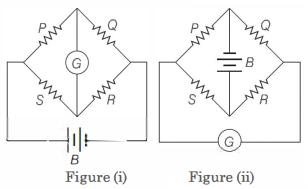
- 9Figure $(i)$ below shows a Wheatstone's bridge in which $P, Q, R$ and $S$ are fixed resistances, $G$ is a galvanometer and $B$ is a battery. For this particular case, the galvanometer shows zero deflection. Now, only the positions of $B$ and $G$ are interchanged, as shown in figure $(ii)$. The new deflection of the galvanometerView Solution
- 10View SolutionCarbon resistor has resistance specified by three bands having colours red, yellow and black. If the resistor is remolded to make a resistor twice of previous length, the new colour code will be