The resistance of the filament of a lamp increases with the increase in temperature. A lamp rated $100\, W, 220\, V$ is connected across $220\, V$ power supply. If the voltage drops by $10\%$ then the power of lamp will be
Medium
Download our app for free and get started
(d) Let the resistance of the lamp filament be $R$. Then $100 = \frac{{{{(220)}^2}}}{R}$. When then voltage drops, expected power is $P = \frac{{{{(220 \times 0.9)}^2}}}{{R'}}$. Here $R'$ will be less than $R$, because now the rise in temperature will be less. Therefore $P$ is more than $\frac{{{{(220 \times 0.9)}^2}}}{R} = 81W$
But it will not be $90\%$ of earlier value, because fall in temperature is small. Hence $(d)$ is correct.
But it will not be $90\%$ of earlier value, because fall in temperature is small. Hence $(d)$ is correct.

Download our appand get started for free
Experience the future of education. Simply download our apps or reach out to us for more information. Let's shape the future of learning together!No signup needed.*
Similar Questions
- 1A wire of length $100\, cm$ is connected to a cell of emf $2\,V$ and negligible internal resistance. The resistance of the wire is $3\,\Omega $. The additional resistance required to produce a potential difference of $1\, mV/cm$ is ............. $\Omega$View Solution
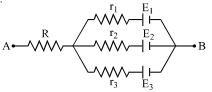
- 2In the network shown the potential difference between $A$ and $B$ is ................. $V$ $(R = r_1 = r_2 = r_3 = 1 \Omega$ ,$ E_1 = 3\, V, E_2 = 2\, V, E_3 = 1\, V)$View Solution
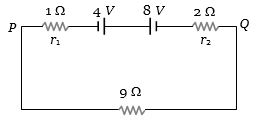
- 3Two batteries of $e.m.f.$ $4\,V$ and $8 \,V$ with internal resistances $1\, \Omega$ and $2\,\Omega$ are connected in a circuit with a resistance of $9 \,\Omega$ as shown in figure. The current and potential difference between the points $P$ and $Q$ areView Solution
- 4A cell of constant $e.m.f.$ first connected to a resistance ${R_1}$ and then connected to a resistance ${R_2}$. If power delivered in both cases is then the internal resistance of the cell isView Solution
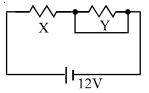
- 5When an ammeter of negligible internal resistance is inserted in series with circuit it reads $1A$. When the voltmeter of very large resistance is connected across $X$ it reads $1V$. When the point $A$ and $B$ are shorted by a conducting wire, the voltmeter measures $10\, V$ across the battery. The internal resistance of the battery is equal to .............. $\Omega$View Solution
- 6View SolutionThermopile is used for
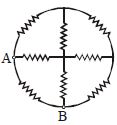
- 7Eight resistances each of resistance $5\,\Omega $ are connected in the circuit as shown in figure. The equivalent resistance between $A$ and $B$ isView Solution
- 8Equivalent resistance between the adjacent corners of a regular $n$-sided polygon of uniform wire of resistance $R$ would be:View Solution
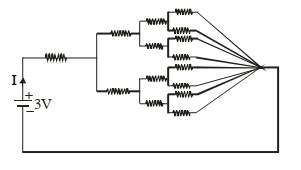
- 9All resistances in figure are $1\,\Omega$ each. The value of current ' $I$ ' is $\frac{a}{5}\,A$. The value of $a$ isView Solution
- 10View SolutionWhich device can convert all electrical energy into heat