A cell of constant $e.m.f.$ first connected to a resistance ${R_1}$ and then connected to a resistance ${R_2}$. If power delivered in both cases is then the internal resistance of the cell is
Diffcult
Download our app for free and get started
(a) Power dissipated$ = {i^2}R = {\left( {\frac{E}{{R + r}}} \right)^2}R$
${\left( {\frac{E}{{{R_1} + r}}} \right)^2}{R_1} = {\left( {\frac{E}{{{R_2} + r}}} \right)^2}{R_2}$
$==>$ ${R_1}(R_2^2 + {r_2} + 2{R_2}r) = {R_2}(R_1^2 + {r^2} + 2{R_1}r)$
$==>$ $R_2^2{R_1} + {R_1}{r^2} + 2{R_2}r = R_1^2{R_2} + {R_2}{r^2} + 2{R_1}{R_2}r$
$==>$ $({R_1} - {R_2}){r^2} = ({R_1} - {R_2}){r^2} = ({R_1} - {R_2}){R_1}{R_2}$
$==>$ $r = \sqrt {{R_1}{R_2}} $
${\left( {\frac{E}{{{R_1} + r}}} \right)^2}{R_1} = {\left( {\frac{E}{{{R_2} + r}}} \right)^2}{R_2}$
$==>$ ${R_1}(R_2^2 + {r_2} + 2{R_2}r) = {R_2}(R_1^2 + {r^2} + 2{R_1}r)$
$==>$ $R_2^2{R_1} + {R_1}{r^2} + 2{R_2}r = R_1^2{R_2} + {R_2}{r^2} + 2{R_1}{R_2}r$
$==>$ $({R_1} - {R_2}){r^2} = ({R_1} - {R_2}){r^2} = ({R_1} - {R_2}){R_1}{R_2}$
$==>$ $r = \sqrt {{R_1}{R_2}} $

Download our appand get started for free
Experience the future of education. Simply download our apps or reach out to us for more information. Let's shape the future of learning together!No signup needed.*
Similar Questions
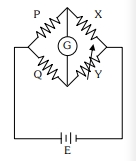
- 1A wheatstone bridge is used to determine the value of unknown resistance $X$ by adjusting the variable resistance $Y$ as shown in the figure. For the most precise measurement of $X$, the resistances $P$ and $Q$:View Solution
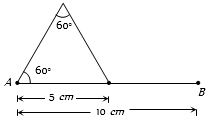
- 2A wire has resistance of $24\,\Omega$ is bent in the following shape. The effective resistance between $A$ and $B$ is .............. $\Omega$View Solution
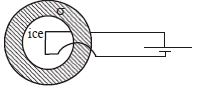
- 3Figure shows a thick shell made of electrical conductivity $\sigma$ and has inner & outer radii of $10\ cm$ & $20\ cm$ respectively and is filled with ice inside it. Its inside and outside surface are kept at different potentials by a battery of internal resistance $\frac{2}{\pi} \Omega \ \&\ \epsilon = 5V$. Find value of $\sigma$ for which ice melts at maximum possible rate if $25\%$ of heat generated by shell due to joule heating is used to melt ice.View Solution
- 4Two equal resistances when connected in series to a battery, consume electric power of $60\,W.$ If these resistances are now connected in parallel combination to the same battery, the electric power consumed will be .............. $W$View Solution
- 5View SolutionThe example for non-ohmic resistance is
- 6Consider the following two statements.View Solution
$(A)$ Kirchhoff's junction law follows from the conservation of charge.
$(B)$ Kirchhoff's loop law follows from the conservation of energy.
Which of the following is correct ?
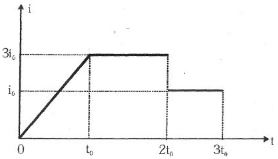
- 7A time varying current $i$ is passed through a resistance $R$ as shown in figure. The total heat generated in the resistance isView Solution
- 8View SolutionIf in the experiment of Wheatstone's bridge, the positions of cells and galvanometer are interchanged, then balance points will
- 9A material '$B$' has twice the specific resistance of '$A$'. A circular wire made of '$B$' has twice the diameter ofa wire made of '$A$'. then for the two wires to have the same resistance, the ratio $\frac{{{l_B}}}{{{l_A}}}$ of their respective lengths must beView Solution
- 10This question contains statement$-1$ and statement$-2$. Of the four choices given after the statements, choose the one that best describes the two statements.View Solution
statement$-1$ : The temperature dependence of resistance is usually given as $R=R_{0}(1+\alpha \Delta t)$. The resistance of a wire changes from $100\; \Omega$ to $150\; \Omega$ when its temperature is increased from $27^{\circ} C$ to $227^{\circ} C$. This implies that $\alpha=2.5$ $\times 10^{-3} /{ }^{\circ} C$
statement$-2\;: R=R_{0}(1+\alpha \Delta t)$ is valid only when the change in the temperature $\Delta T$ is small and $\Delta R=\left(R-R_{0}\right) < < R_{0}$