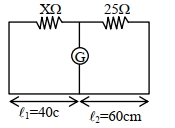
The resistance per centimeter of a meter bridge wire is $\mathrm{r}$, with $\mathrm{X}\ \Omega$ resistance in left gap. Balancing length from left end is at $40 \mathrm{~cm}$ with $25\ \Omega$ resistance in right gap. Now the wire is replaced by another wire of $2 \mathrm{r}$ resistance per centimeter. The new balancing length for same settings will be at
JEE MAIN 2024, Diffcult


Download our appand get started for free
Experience the future of education. Simply download our apps or reach out to us for more information. Let's shape the future of learning together!No signup needed.*
Similar Questions
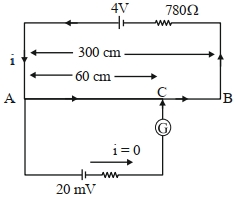
- 1A potentiometer wire of length $300\,cm$ is connected in series with a resistance $780\,\Omega$ and a standard cell of emf $4\,V$. A constant current flows through potentiometer wire. The length of the null point for cell of emf $20\,mV$ is found to be $60\,cm$. The resistance of the potentiometer wire is$...\Omega$View Solution
- 2A wire of resistance $4 \,\Omega$ is stretched to twice its original length. The resistance of stretched wire would be ........... $\Omega$View Solution
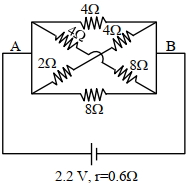
- 3In the given figure, the $emf$ of the cell is $2.2\, {V}$ and if internal resistance is $0.6\, \Omega$. Calculate the power dissipated in the whole circuit: (in $W$)View Solution
- 4The series combination of two batteries, both of the same emf $10 \mathrm{\;V},$ but different internal resistance of $20\; \Omega$ and $5\; \Omega,$ is connected to the parallel combination of two resistors $30\; \Omega$ and $\mathrm{R}\; \Omega .$ The voltage difference across the battery of internal resistance $20\; \Omega$ is zero, the value of $\mathrm{R}(\text { in } \Omega)$ isView Solution
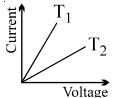
- 5The current in a metallic conductor is plotted against voltage at two different temperatures $T_1$ and $T_2$. Which is correctView Solution
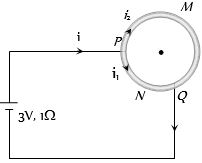
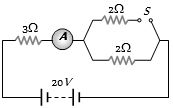
- 6In the circuit shown, the reading of ammeter when switch $S$ is open and when switch $S$ is closed respectively areView Solution
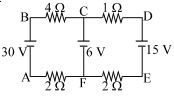
- 7View SolutionThe figure shows a network of four resistances and three batteries Mark the incorrect statement.
- 8If a power of $100\, W$ is being supplied across a potential difference of $200\, V$, current flowing is ............ $A$View Solution
- 9Assertion : A larger dry cell has higher $emf$View Solution
Reason : The $emf$ of a dry cell is proportional to its size
- 10A wire of resistance $10$ $\Omega$ is bent to form a circle. $P$ and $Q$ are points on the circumference of the circle dividing it into a quadrant and are connected to a Battery of $3\, V$ and internal resistance $1$ $\Omega$ as shown in the figure. The currents in the two parts of the circle areView Solution