The resistances of a wire at temperatures $t\,^oC$ and $0\,^oC$ are related by
Easy


Download our appand get started for free
Experience the future of education. Simply download our apps or reach out to us for more information. Let's shape the future of learning together!No signup needed.*
Similar Questions
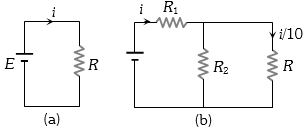
- 1Consider the circuits shown in the figure. Both the circuits are taking same current from battery but current through $R$ in the second circuit is $\frac{1}{{10}}$$^{th}$ of current through $R$ in the first circuit. If $R$ is $11$ $\Omega$, the value of $ R_1$ ................ $\Omega$View Solution
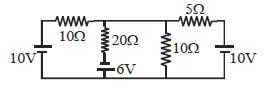
- 2The value of current through $20\,\Omega $ resistor is .................. $A$View Solution
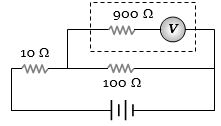
- 3The potential difference across the $100\,\Omega$ resistance in the following circuit is measured by a voltmeter of $900 \,\Omega$ resistance. The percentage error made in reading the potential difference isView Solution
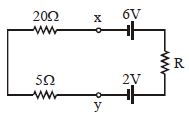
- 4The current flowing in the given circuit is $0.1\,A$ . The potential difference between the points $X$ and $Y$ is ................ $\mathrm{V}$View Solution
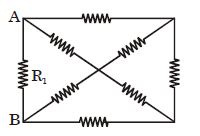
- 5As shown, the circuit is made of $8$ different resistors. It is found that when $R_1 = 4\,\,\Omega,$ the resistance between $A$ and $B$ is $2\,\,\Omega.$ Now replace $R_1$ by a $6\,\,\Omega$ resistor, what is the resistance between $A$ and $B$?View Solution
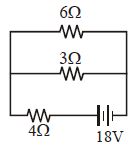
- 6The total power dissipated (in $watt$ ) in the circuit shown isView Solution
- 7A primary cell has an $e.m.f.$ of $1.5\,volts$, when short-circuited it gives a current of $3$ amperes. The internal resistance of the cell is .............. $ohm$View Solution
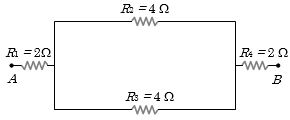
- 8In the given figure, the equivalent resistance between the points $A$ and $B$ is ............ $\Omega$View Solution
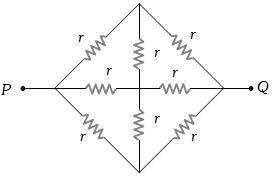
- 9The equivalent resistance between the points $P$ and $Q$ in the network given here is equal to ................ $\Omega$ (given $r = \frac{3}{2}\Omega $)View Solution
- 10Find the equivalent resistance between the points $a$ and $b$ .......... $\Omega$View Solution