MCQ
The resistivity of a wire depends on its
  • A
    Length
  • B
    Area of cross-section
  • C
    Shape
  • Material

Answer

Correct option: D.
Material
d
(d) Resistivity depends only on the material of the conductor.

Need a full question paper?

Generate a complete, print-ready paper with questions like this in minutes — across 16+ boards, with answer keys.
Start Generating Free

Similar questions

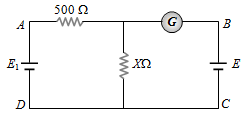
In the adjoining circuit, the battery $E_1$ has an e.m.f of 12 volt and zero internal resistance while the battery E has an e.m.f of 2 volt. If the galvanometer G reads zero, then the value of the resistance X in ohm is
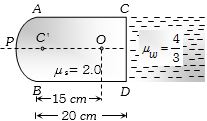
The slab of a material of refractive index $2$ shown in figure has curved surface $APB$ of radius of curvature $10\, cm$ and a plane surface $CD$. On the left of $APB$  is air and on the right of $CD $ is water with refractive indices as given in figure. An object $O$ is placed at a distance of $15\, cm$ from pole $P$ as shown. The distance of the final image of $O$ from $P$, as viewed from the left is.....$cm$
Anelectron is revolving in an orbit of radius $5.1 \times 10^{-11} m$ is revolving with a frequency of $6.8 \times 10^{15}$ cycles / second. The magnitude of equivalent current is :
The plates of parallel plate capacitor are charged upto $100\;V$. A $2\,mm$ thick plate is inserted between the plates. Then to maintain the same potential difference, the distance between the plates is increased by $1.6\;mm$. The dielectric constant of the plate is
A point charge q is rotated along a circle in the electric field generated by another point charge $Q$. The work done by the electric field on the rotating charge in one complete revolution is $......$?
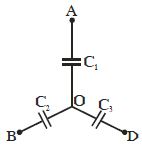
Three uncharged capacitors of capacitance $C_1$, $C_2$ and $C_3$ are connected as shown in figure to one another and to points $A$, $B$ and $D$ at potentials $V_A$, $V_B$ and $V_D$. Then the potential at $O$ will be
In a step up transformer, if ratio of turns of primary to secondary is 1 : 10 and primary voltage is 230 V. If the load current is 2A, then the current in primary is
The half-life of a radioactive element $A$ is the same as the mean-life of another radioactive element $B.$ Initially both substances have the same number of atoms, then
In a region, the potential is represented by $V(x, y, z) = 6x - 8xy - 8y + 6yz$, where $V$ is in volts and $x, y, z$ are in metres. The electric force experienced by a charge of $2$ coulomb situated at point $(1, 1, 1)$ is:
The acceleration of the moon just before it strikes the earth in the previous question is: