- Charge on the capacitor.
- Potential difference across the capacitor.
- Energy of the capacitor.
- Energy density between the plates.

Explanation:
Because the charge always remains conserved in an isolated system, it will remain the same.
Now,
$\text{V}=\frac{\text{Qd}}{\in_0\text{A}}$
Here, Q, A and d are the charge, area and distance between the plates, respectively.
Thus, as d increases, V increases.
Energy is given by:
$\text{E}=\frac{\text{qV}}{2}$
So, it will also increase.
Energy density u, that is, energy stored per unit volume in the electric field is given by:
$\text{u}=\frac{1}{2}\in_0\text{E}^2$
So, u will remain constant with increase in distance between the plates.
Generate a complete, print-ready paper with questions like this in minutes — across 16+ boards, with answer keys.
In a radioactive reaction
, the number of α - particles emitted is
|
(a) 7 |
(b) 6 |
(c) 5 |
(d) 4 |
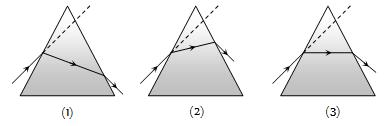
The figures represent three cases of a ray passing through a prism of angle A. The case corresponding to minimum deviation is

|
(a) 1 |
(b) 2 |
(c) 3 |
(d) None of these |
Energy conversion in a photoelectric cell takes place from
|
(a) Chemical to electrical |
(b) Magnetic to electrical |
|
(c) Optical to electrical |
(d) Mechanical to electrical |
Assertion : Ultraviolet radiation are of higher frequency waves are dangerous to human being.
Reason : Ultraviolet radiation are absorbed by the atmosphere
|
(a) If both assertion and reason are true and the reason is the correct explanation of the assertion. |
|
(b) If both assertion and reason are true but reason is not the correct explanation of the assertion. |
|
(c) If assertion is true but reason is false. |
|
(d) If the assertion and reason both are false. |
Three capacitors of capacitances 3 μF, 9μF and 18 μF are connected once in series and another time in parallel. The ratio of equivalent capacitance in the two cases
will be
|
(a) 1 : 15 |
(b) 15 : 1 |
(c) 1 : 1 |
(d) 1 : 3 |
The maximum illumination on a screen at a distance of 2 m from a lamp is 25 lux. The value of total luminous flux emitted by the lamp is
|
(a) 1256 lumen |
(b) 1600 lumen |
(c) 100 candela |
(d) 400 lumen |
Two identical circular loops of metal wire are lying on a table without touching each other. Loop-A carries a current which increases with time. In response, the loop-B
|
(a) Remains stationary |
|
(b) Is attracted by the loop-A |
|
(c) Is repelled by the loop-A |
|
(d) Rotates about its CM, with CM fixed |