MCQ
The set of points where the function $f(x) = x |x|$ is differentiable is:
  • $(-\infty,\infty)-\infty,\infty$
  • B
    $(-\infty,0)\cup(0,\infty)-\infty,0\cup0,\infty$
  • C
    $(0,\infty)0,\infty$
  • D
    $[0,\infty]0,\infty$

Answer

Correct option: A.
$(-\infty,\infty)-\infty,\infty$
We have,$\text{f(x)}=\text{x}|\text{x}|$
$\Rightarrow\text{f(x)}=\begin{cases}-\text{x}^2, & \text{x}<0\\0 ,& \text{x}= 0\\\text{x}^2,&\text{x}>0\end{cases}$
When, $x < 0,$ we have
$f(x) = -x^2$ which being a polynomial function is continuous and differentable in $(-\infty,0)$
When, $x > 0,$ we have
$f(x) = -x^2$ which being a polynomial function is continuous and differentable in $(0,\infty,)$
Thus possible point of non$-$differentiability of $f(x)$ is $x = 0$
Now, $\text{LHL} (at x = 0) =\lim\limits_{\text{x}\rightarrow0^{-}}\frac{\text{f(x)}-\text{f}(0)}{\text{x}-0}$
$=\lim\limits_{\text{x}\rightarrow0^{-}}\frac{-\text{x}^2-0}{\text{x}}$
$=\lim\limits_{\text{h}\rightarrow0}\frac{-(-\text{h})^2}{-\text{h}}$
$=\lim\limits_{\text{h}\rightarrow0}\text{h}$
$=0$
And $\text{RHL} (at x = 0) =\lim\limits_{\text{x}\rightarrow0^{+}}\frac{\text{f(x)}-\text{f}(0)}{\text{x}-0}$
$=\lim\limits_{\text{x}\rightarrow0^{+}}\frac{\text{x}^2-0}{\text{x}}$
$=\lim\limits_{\text{h}\rightarrow0}\frac{\text{h}^2}{\text{h}}$
$=\lim\limits_{\text{h}\rightarrow0}\text{h}$
$=0$
$\therefore \text{LHL} ($at $x = 0) = \text{RHL} ($at $x = 0)$
So, $f(x)$ is also differentiable at $x = 0$
i.e. $f(x)$ is differentiable in $(-\infty,\infty).$

Need a full question paper?

Generate a complete, print-ready paper with questions like this in minutes — across 16+ boards, with answer keys.
Start Generating Free

Similar questions

If two events are independent, then.
  1. They must be mutually exclusive.
  2. The sum of their probabilities must be equal to 1.
  3. (a) and (b) both are correct.
  4. None of the above is correctIf two. events are independent, then.
If for any two events $A$ and $B$, $P(A)=\frac{4}{5}$ and $P(A \cap B)=\frac{7}{10}$, then $P(B / A)$ is
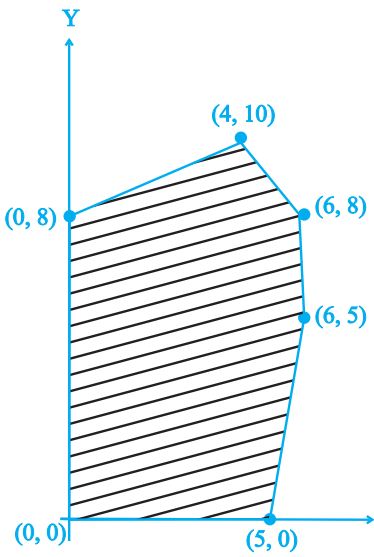
Choose the correct answer from the given four options. The feasible solution for a LPP is shown in. Let Z = 3x - 4y be the objective function.
Maximum of Z occurs at:
$\int\limits^\frac{\pi}{3}_\frac{\pi}{6}\frac{1}{\sin2\text{x}}\text{ dx}$ is equal to:
  1. $\log_\text{e}{3}$
  2. $\log_\text{e}\sqrt{3}$
  3. $\frac{1}{2}\log(-1)$
  4. $\log(-1)$
In a regular hexagon ABCDEF, $\overrightarrow{\text{AB}}=\vec{\text{a}},\ \overrightarrow{\text{BC}}=\vec{\text{b}}$ and $\overrightarrow{\text{CD}}=\vec{\text{c}}$. Then, $\overrightarrow{\text{AE}}=$
  1. $\vec{\text{a}}+\vec{\text{b}}+\vec{\text{c}}$
  2. $2\vec{\text{a}}+\vec{\text{b}}+\vec{\text{c}}$
  3. $\vec{\text{b}}+\vec{\text{c}}$
  4. $\vec{\text{a}}+2\vec{\text{b}}+2\vec{\text{c}}$
$\cot\Big(\frac{\pi}{4}-2\cot^{-1}3\Big)=$
  1. 7
  2. 6
  3. 5
  4. none of these
If $a, b, c $are in $A.P.,$ then the determinant $\begin{vmatrix}\text{x}+2&\text{x}+3&\text{x}+2\text{a}\\\text{x}+3&\text{x}+4&\text{x}+2\text{b}\\\text{x}+4&\text{x}+5&\text{x}+2\text{c}\end{vmatrix}$
The integrating factor for solving the differential equation $x \frac{d y}{d x}-y=2 x^2$ is
If $\Delta=\left|\begin{array}{ccc}l+m & m+n & n+l \\ n & l & m \\ 2 & 2 & 2\end{array}\right|,$ then
The domain of the function $\cos ^{-1}(2 x-1)$ is