MCQ
The shape of a molecule depends on :
- ANumber of bonded valence electron pairs.
- BNumber of non $-$ bonded valence electron pairs.
- CAll the electrons.
- ✓$'a\ '$ and $'b\ '$ above.
Generate a complete, print-ready paper with questions like this in minutes — across 16+ boards, with answer keys.
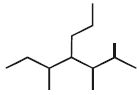
(figure) $\xrightarrow[{(2)\,Zn}]{{(1)\,{O_3}}}\mathop {\begin{array}{*{20}{c}}
{\,\,\,\,O\,\,\,\,\,\,\,O\,\,} \\
{\,||\,\,\,\,\,\,\,\,\,||} \\
{H - C - C - H}
\end{array}}\limits_{Glyoxal} + $ $\mathop {\begin{array}{*{20}{c}}
{\,\,\,O\,\,\,\,\,O\,\,} \\
{\,||\,\,\,\,\,\,\,\,||} \\
{C{H_3} - C - C - C{H_3}}
\end{array}}\limits_{2,3 - Bu\tan edione} + \mathop {\begin{array}{*{20}{c}}
{\,\,\,\,\,\,O\,\,\,\,\,O} \\
{\,\,\,\,\,\,||\,\,\,\,\,\,||} \\
{C{H_3} - C - C - H}
\end{array}}\limits_{Pyrualdehyde} $
[$A$] The work done on the gas is maximum when it is compressed irreversibly from ( $\mathrm{p}_2, \mathrm{~V}_2$ ) to ( $\mathrm{p}_1, \mathrm{~V}_1$ ) against constant pressure $\mathrm{pl}_1$
[$B$] The work done by the gas is less when it is expanded reversibly from $V_1$ to $V_2$ under adiabatic conditions as compared to that when expanded reversibly from $V_1$ to $V_2$ under isothermal conditions
[$C$] The change in internal energy of the gas is ($i$) zero, if it is expanded reversibly with $T_1=T_2$, and ($ii$) positive, if it is expanded reversibly under adiabatic conditions with $T_1 \neq T_2$
[$D$] If the expansion is carried out freely, it is simultaneously both isothermal as well as adiabatic