Question
The solution set of the inequality $3 x+5 y<4$ is

Answer

The strict inequality represents an open half plane and it contains the origin, as $(0,0)$ satisfies it.

Need a full question paper?

Generate a complete, print-ready paper with questions like this in minutes — across 16+ boards, with answer keys.
Start Generating Free

Similar questions

Corner points of the feasible region determined by the system of linear constraints are (0, 3), (1, 1) and (3, 0). Let Z = px + qy, where p, q > 0. Condition on p and q so that the minimum of Z occurs at (3, 0) and (1, 1) is:
  1. $\text{p}=2\text{q}$
  2. $\text{p}=\frac{\text{q}}{2}$
  3. $\text{p}=3\text{q}$
  4. $\text{p}=\text{q}$
Out of 30 consecutive integers, 2 are chosen at random. The probability that their sum is odd, is
  1. $\frac{14}{29}$
  2. $\frac{16}{29}$
  3. $\frac{15}{29}$
  4. $\frac{10}{29}$
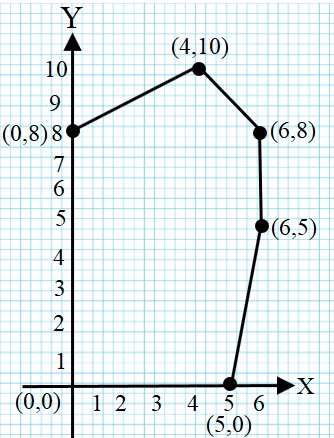
The feasible region for an LPP is shown below:
Let Z = 3x - 4y be the objective function. Minimum of Z occurs at
The solution of the differention $\frac{\text{dy}}{\text{dx}}+1=\text{e}^{\text{x}+\text{y}}$ is:
  1. $(\text{x}+\text{y})\text{e}^{\text{x}+\text{y}}=0$
  2. $(\text{x}+\text{C})\text{e}^{\text{x}+\text{y}}=0$
  3. $(\text{x}-\text{C})\text{e}^{\text{x}+\text{y}}=1$
  4. $(\text{x}-\text{C})\text{e}^{\text{x}+\text{y}}+1=0$ 
The general solution of differention eqution $\frac{\text{y}\ \text{dx}-\text{x}\ \text{dy}}{\text{y}}=0$ is:
If A and B are invertible matrices, then which of the following is not correct?
The area bounded by the curve $y = (x + 1)^2, y = (x - 1)^2$ and the line $y = 0$ is:
Which of the following differentials equation has y = x as one of its particular solution?
  1. $\frac{\text{d}^{2}\text{y}}{\text{dx}^{2}}-\text{x}^{2}\frac{\text{dy}}{\text{dx}}+\text{xy}=\text{x}$
  2. $\frac{\text{d}^{2}\text{y}}{\text{dx}^{2}}+\text{x}^{2}\frac{\text{dy}}{\text{dx}}+\text{xy}=\text{x}$
  3. $\frac{\text{d}^{2}\text{y}}{\text{dx}^{2}}-\text{x}^{2}\frac{\text{dy}}{\text{dx}}+\text{xy}=\text{0}$
  4. $\frac{\text{d}^{2}\text{y}}{\text{dx}^{2}}+\text{x}^{2}\frac{\text{dy}}{\text{dx}}+\text{xy}=\text{0}$
If $y=e^{3 x+7}$, then the value of $\left[\frac{d y}{d x}\right]_{x=0}$ is equal to
If the area of the triangle with vertices $(-3,0),(3,0)$ and $(0, k)$ is $9$ sq units, then the values of $k$ is will be