MCQ
The stopping potential $({V_0})$
  • A
    Depends upon the angle of incident light
  • B
    Depends upon the intensity of incident light
  • C
    Depends upon the surface nature of the substance
  • Is independent of the intensity of the incident light

Answer

Correct option: D.
Is independent of the intensity of the incident light
d
(d) Stopping potential depends upon the energy of photon

Need a full question paper?

Generate a complete, print-ready paper with questions like this in minutes — across 16+ boards, with answer keys.

Start Generating Free

Similar questions

In the equation ${ }_{13}^{27} Al +{ }_2^4 He \longrightarrow{ }_{15}^{30} P + X ,$ The correct symbol for $X$ is
A spherical ball of radius $1 \times 10^{-4} \mathrm{~m}$ and density $10^5$ $\mathrm{kg} / \mathrm{m}^3$ falls freely under gravity through a distance $h$ before entering a tank of water, If after entering in water the velocity of the ball does not change, then the value of $h$ is approximately:

(The coefficient of viscosity of water is $9.8 \times 10^{-6}$ $\left.\mathrm{N} \mathrm{s} / \mathrm{m}^2\right)$
The displacement of a particle is given at time $t$, by:$x=A \sin (-2 \omega t)+B \sin ^2 \omega t \quad$ Then,
A body takes $T$ minutes to cool from ${62^o}C$ to ${61^o}C$ when the surrounding temperature is ${30^o}C$. The time taken by the body to cool from ${70^o}$ to $({A_1}\,{\rm{and }}{A_{\rm{2}}})$ is
A body moves a distance of $10 \,m$ along a straight line under the action of a force of $5 \,N$. If the work done is $25\, joules$, the angle which the force makes with the direction of motion of the body is.....$^o$
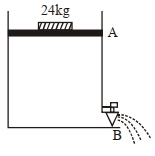
Consider a water tank as shown in the figure. It's cross-sectional area is $0.4\, m ^{2}$. The tank has an opening $B$ near the bottom whose cross-section area is $1\, cm ^{2}$. A load of $24\, kg$ is applied on the water at the top when the height of the water level is $40\, cm$ above the bottom, the velocity of water coming out the opening $B$ is $v\, ms ^{-1}$. The value of $v$, to the nearest integer, is ......$m/s$. [Take value of $g$ to be $10 \,ms ^{-2}$ ]
The dispersive power is maximum for the material
In a series $LCR$ current the voltage across resistance, capacitance and inductance is $10\, V$ each. If the inductor is short circuited, the voltage across the capacitor will be:-
A thin bar of length $L$ has a mass per unit length $\lambda $, that increases linearly with distance from one end. If its total mass is $M$ and its mass per unit length at the lighter end is $\lambda_0$, then the distance of the centre of mass from the lighter end is
A particle of mass m is attached to a spring (of spring constant k) and has a natural angular frequency ${\omega _0}$ - An external force $F (t)$ proportional to $\cos \omega \,t((\omega \ne {\omega _0})$ is applied to the oscillator. The time displacement of the oscillator will be proportional to