MCQ
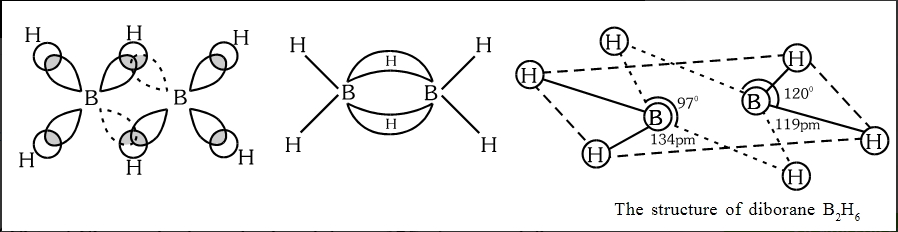
The structure of diborane contains :-
- AFour $2C -2e^-$ bonds & two $2C -3e^-$ bonds
- BTwo $(2C -2e^-)$ bonds & four $3C -2e^-$ bonds
- ✓Four $2C -2e^-$ bonds & two $3C -2e^-$ bonds
- DTwo $2C -2e^-$ bonds & two $3C -2e^-$ bonds
Generate a complete, print-ready paper with questions like this in minutes — across 16+ boards, with answer keys.

(Note: Degree of dissociation ( $\alpha$ ) of weak acid and weak base is $<<1$; degree of hydrolysis of salt $<<1 ;\left[ H ^{+}\right]$represents the concentration of $H ^{+}$ions)
| $LIST-I$ | $LIST-II$ |
|
$P$ $(10 mL $of $0.1 M NaOH +20 mL$ $of 0.1 M $ acetic acid) diluted to $60 mL$ |
$1$ the value of $\left[ H ^{+}\right]$does not change on dilution |
|
$Q $ $(20 mL $ of $ 0.1 M NaOH +20 mL $of $0.1 M $ acetic acid) diluted to $ 80 mL$ |
$2$ the value of $\left[ H ^{+}\right]$changes to half of its initial value on dilution the value of $\left[ H ^{+}\right]$changes to two times of its initial value on dilution |
|
$R$ $(20 mL $ of $ 0.1 M HCl +20 mL$of $0.1 M$ ammonia solution) diluted to $80 mL$ |
$3$ the value of $\left[ H ^{+}\right]$changes to $1 / \sqrt{2}$ times of its initial value on dilution |
|
$S$ $10 mL$ saturated solution of Ni $( OH )_2$in equilibrium with excess solid Ni $( OH )_2$ s diluted to $20 mL$ (solid Ni $( OH )_2$ is still present afterdilution). |
$4$the value of $\left[ H ^{+}\right]$changes to $\sqrt{2}$ times of its initial value on dilution |
| $5$ the value of $\left[ H ^{+}\right]$changes to $\sqrt{2}$ times of its initial value on dilution |
Match each process given in $LIST-I$ with one or more effect(s) in $LIST-II$. The correct option is