MCQ
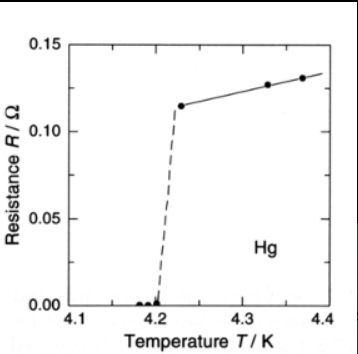
The temperature bellow which a material becomes a superconductor is called:
- ACritical temperature.
- BAbsolute temperature.
- CTripple point.
- DNone of the above.
Explanation:
Critical temperature is the temperature below which metals when taken exhibit zero resistivity and turns into a superconductor. The critical temperature varies with the individual material. Because these materials have no electrical resistance, meaning electrons can travel freely through them, they can carry large amounts of electrical current for long periods of time without losing energy as heat. The transition is so sudden and complete that it appears to be a transition to a different phase of matter; known as the superconducting phase.
Generate a complete, print-ready paper with questions like this in minutes — across 16+ boards, with answer keys.
Assertion : Blue colour of sky appears due to scattering of blue colour.
Reason : Blue colour has shortest wave length in visible spectrum.
|
(a) If both assertion and reason are true and the reason is the correct explanation of the assertion. |
|
(b) If both assertion and reason are true but reason is not the correct explanation of the assertion. |
|
(c) If assertion is true but reason is false. |
|
(d) If the assertion and reason both are false. |
Assertion : When two coils are wound on each other, the mutual induction between the coils is maximum.
Reason : Mutual induction does not depend on the orientation of the coils.
|
(a) If both assertion and reason are true and the reason is the correct explanation of the assertion. |
|
(b) If both assertion and reason are true but reason is not the correct explanation of the assertion. |
|
(c) If assertion is true but reason is false. |
|
(d) If the assertion and reason both are false. |
When light falls on a metal surface, the maximum kinetic energy of the emitted photo-electrons depends upon
|
(a) The time for which light falls on the metal |
|
(b) Frequency of the incident light |
|
(c) Intensity of the incident light |
|
(d) Velocity of the incident light |
When objects at different distances are seen by the eye, which of the following remains constant
|
(a) The focal length of the eye lens |
(b) The object distance from the eye lens |
|
(c) The radii of curvature of the eye lens |
(d) The image distance from the eye lens |
In the spectrum of light of a luminous heavenly body the wavelength of a spectral line is measured to be 4747 Å while actual wavelength of the line is 4700 Å. The relative velocity of the heavenly body with respect to earth will be (velocity of light is 3 )
)
|
(a) 3 |
|
(b) 3 |
|
(c) 3 |
|
(d) 3 |
The photoelectric effect can be understood on the basis of
|
(a) The principle of superposition |
(b) The electromagnetic theory of light |
|
(c) The special theory of relativity |
(d) Line spectrum of the atom |
The energy of a hydrogen atom in its ground state is -13.6eV. The energy of the level corresponding to the quantum number n = 2 (first excited state) in the hydrogen atom is
|
(a) – 2.72 eV |
(b) – 0.85 eV |
(c) – 0.54 eV |
(d) – 3.4 eV |
For the sustained interference of light, the necessary condition is that the two sources should
|
(a) Have constant phase difference |
(b) Be narrow |
|
(c) Be close to each other |
(d) Of same amplitude |
What is the difference between soft and hard X-rays
|
(a) Velocity |
(b) Intensity |
(c) Frequency |
(d) Polarization |


