The terminal potential difference of a cell is greater than its $e.m.f.$ when it is
Easy


Download our appand get started for free
Experience the future of education. Simply download our apps or reach out to us for more information. Let's shape the future of learning together!No signup needed.*
Similar Questions
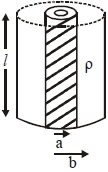
- 1Model a torch battery of length $l$ to be made up of a thin cylindrical bar of radius $'a'$ and a concentric thin cylindrical shell of radius ' $b$ ' fille in between with an electrolyte of resistivity $\rho$ (see figure). If the battery is connected to a resistance of value $R ,$ the maximum Joule heating in $R$ will take place forView Solution
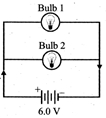
- 2A $6.0\,volt$ battery is connected to two light bulbs as shown in figure. Light bulb $1$ has resistance $3\,ohm$ while light bulb $2$ has resistance $6\,ohm.$ Battery has negligible internal resistance. Which bulb will glow brighter?View Solution
- 3A copper wire has a square cross-section, $2.0\, mm$ on a side. It carries a current of $8\, A$ and the density of free electrons is $8 \times {10^{28}}\,{m^{ - 3}}$. The drift speed of electrons is equal toView Solution
- 4A certain piece of silver of given mass is to be made like a wire. Which of the following combination of length $(L)$ and the area of cross-sectional $(A) $ will lead to the smallest resistanceView Solution
- 5Two bulbs are in parallel and they together consume $48\, W$ from a battery of $6\, V$. The resistance of each bulb is ............ $\Omega$View Solution
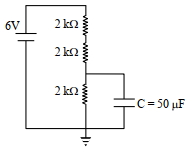
- 6A capacitor of $50 \,\mu {F}$ is connected in a circuit as shown in figure. The charge on the upper plate of the capacitor is $......\,\mu {C} .$View Solution
- 7An electric heater of resistance $6 \,ohm$ is run for $10$ minutes on a $120\, volt$ line. The energy liberated in this period of time isView Solution
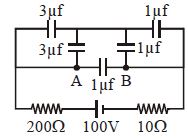
- 8Find potential difference between $A$ and $B$ in given circuit in steady state ............... $\mathrm{V}$View Solution
- 9A cell, shunted by a $8 \; \Omega$ resistance, is balanced across a potentiometer wire of length $3 \; m$. The balancing length is $2 \; m$ when the cell is shunted by $4 \; \Omega$ resistance. The value of internal resistance of the cell will be $\dots \; \Omega .$View Solution
- 10View SolutionAssertion : An electric bulb becomes dim, when the electric heater in parallel circuit is switched on.
Reason : Dimness decreases after sometime.