MCQ
The three basic properties possessed by the electric charge are:
- AQuantisation.
- BAdditivity.
- CConservation.
- DAll.
Generate a complete, print-ready paper with questions like this in minutes — across 16+ boards, with answer keys.
In the process of electrolysis, the current is carried out inside the electrolyte by
|
(a) Electrons |
(b) Atoms |
|
(c) Positive and negative ions |
(d) All the above |
Assertion : Amongst alpha, beta and gamma rays, a-particle has maximum penetrating power.
Reason : The alpha particle is heavier than beta and gamma rays.
|
(a) If both assertion and reason are true and the reason is the correct explanation of the assertion. |
|
(b) If both assertion and reason are true but reason is not the correct explanation of the assertion. |
|
(c) If assertion is true but reason is false. |
|
(d) If the assertion and reason both are false. |
The electric field at a point on equatorial line of a dipole and direction of the dipole moment
|
(a) Will be parallel |
(b) Will be in opposite direction |
|
(c) Will be perpendicular |
(d) Are not related |
A ray of light passes through an equilateral glass prism in such a manner that the angle of incidence is equal to the angle of emergence and each of these angles is equal to 3/4 of the angle of the prism. The angle of deviation is
|
(a) 45° |
(b) 39° |
(c) 20° |
(d) 30° |
Which of the following rays are not electromagnetic waves
|
(a) g-rays |
(b) b-rays |
(c) Heat rays |
(d) X-rays |
An electron moves along the line AB, which lies in the same plane as a circular loop of conducting wires as shown in the diagram. What will be the direction of current induced if any, in the loop
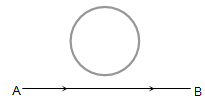
| (a) No current will be induced |
|
(b) The current will be clockwise |
|
(c) The current will be anticlockwise |
|
(d) The current will change direction as the electron passes by |