The total energy of a particle executing S.H.M. is proportional to
Easy
Download our app for free and get started
(d)$E = \frac{1}{2}m{\omega ^2}{a^2}$
==> $E \propto {a^2}$

Download our appand get started for free
Experience the future of education. Simply download our apps or reach out to us for more information. Let's shape the future of learning together!No signup needed.*
Similar Questions
- 1If a simple pendulum oscillates with an amplitude of $50\, mm$ and time period of $2\, sec$, then its maximum velocity is .... $m/s$View Solution
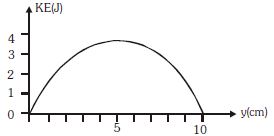
- 2A mass on a vertical spring begins its motion at rest at $y = 0\ cm$. It reaches a maximum height of $y = 10\ cm$. The two forces acting on the mass are gravity and the spring force. The graph of its kinetic energy ($KE$) versus position is given below. Net force on the mass varies with $y$ asView Solution
- 3A pendulum is hung from the roof of a sufficiently high building and is moving freely to and fro like a simple harmonic oscillator. The acceleration of the bob of the pendulum is $20\; m/s^2$ at a distance of $5\; m$ from the mean position. The time period of oscillation isView Solution
- 4A particle with restoring force proportional to displacement and resisting force proportional to velocity is subjected to a force $F\sin \omega t$. If the amplitude of the particle is maximum for $\omega = {\omega _1}$ and the energy of the particle is maximum for $\omega = {\omega _2}$, then (where ${\omega _0}$ natural frequency of oscillation of particle)View Solution
- 5A particle executes simple harmonic motion with a frequency $f$. The frequency with which its kinetic energy oscillates isView Solution
- 6A spring has a certain mass suspended from it and its period for vertical oscillation is $T$. The spring is now cut into two equal halves and the same mass is suspended from one of the halves. The period of vertical oscillation is nowView Solution
- 7A small body of mass $0.10\, kg$ is executing $S.H.M.$ of amplitude $1.0 \,m$ and period $0.20\, sec$. The maximum force acting on it is.... $N$View Solution
- 8View SolutionThe total energy of a particle executing simple harmonic motion is
- 9A simple pendulum oscillates in air with time period $T$ and amplitude $A$. As the time passesView Solution
- 10A particle executes $SHM$ of amplitude $25\, cm$ and time period $3\, s$. What is the minimum time required for the particle to move between two points $12.5\, cm$ on either side of the mean position ..... $\sec$View Solution