Two masses $m_1$ and $m_2$ connected by a spring of spring constant $k$ rest on a frictionless surface. If the masses are pulled apart and let go, the time period of oscillation is
KVPY 2010, Diffcult
Download our app for free and get started
(a)
Let displacements of masses $m_1$ and $m_2$ are $x_1$ and $x_2$, respectively.
Total elongation of spring is $x=x_1+x_2$.
So, when spring snaps back, pull on each of mass is
$F=-k x$
Hence, by second law equation for $m_1$ and $m_2$ are
$m_1 a _1=-k x \Rightarrow m_1 \frac{d^2 x_1}{d t^2}=-k x$
and $m_2 a_2=-k x \Rightarrow m_2 \frac{d^2 x_2}{d t^2}=-k x$
Now, from $x=x_1+x_2$, we have
$\frac{d^2 x}{d t^2}=\frac{d^2 x_1}{d t^2}+\frac{d^2 x_2}{d t^2}$
$\Rightarrow \quad \frac{d^2 x}{d t^2}=\frac{-k}{m_1} x+\frac{-k}{m_2} x$
$\Rightarrow \quad \frac{d^2 x}{d t^2}=-k\left(\frac{1}{m_1}+\frac{1}{m_2}\right) x$
Hence, time period of oscillation is
$T=\frac{2 \pi}{\omega}=2 \pi \sqrt{\frac{1}{k}\left(\frac{m_1 m_2}{m_1+m_2}\right)}$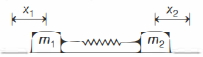

Download our appand get started for free
Experience the future of education. Simply download our apps or reach out to us for more information. Let's shape the future of learning together!No signup needed.*
Similar Questions
- 1Two particles are in $SHM$ on same straight line with amplitude $A$ and $2A$ and with same angular frequency $\omega .$ It is observed that when first particle is at a distance $A/\sqrt{2}$ from origin and going toward mean position, other particle is at extreme position on other side of mean position. Find phase difference between the two particlesView Solution
- 2Two bodies performing $SHM$ have same amplitude and frequency. Their phases at a certain instant are as shown in the figure. The phase difference between them isView Solution
- 3The velocity of a particle in simple harmonic motion at displacement $y$ from mean position isView Solution
- 4In a linear simple harmonic motion $(SHM)$View Solution
$(A)$ Restoring force is directly proportional to the displacement.
$(B)$ The acceleration and displacement are opposite in direction.
$(C)$ The velocity is maximum at mean position.
$(D)$ The acceleration is minimum at extreme points.
Choose the correct answer from the options given below :
- 5A pendulum with time period of $1\, s$ is losing energy due to damping. At certain time its energy is $45\, J$. If after completing $15\,oscillations$ , its energy has become $15\, J$, its damping constant (in $s^{-1}$ ) isView Solution
- 6A particle of mass $2 \,kg$, executing $SHM$ has amplitude $20 \,cm$ and time period $1 \,s$. Its maximum speed is ......... $m / s$View Solution
- 7Figure shows the position-time graph of an object in $S.H.M.$ The correct equation representing this motion is ..........View Solution
- 8View SolutionWhich of the following statements is not true ? In the case of a simple pendulum for small amplitudes the period of oscillation is
- 9A particle executes simple harmonic motion (amplitude $= A$) between $x = - A$ and $x = + A$. The time taken for it to go from $0$ to $A/2$ is ${T_1}$ and to go from $A/2$ to $A$ is ${T_2}$. ThenView Solution
- 10A uniform stick of mass $M$ and length $L$ is pivoted at its centre. Its ends are tied to two springs each of force constant $K$ . In the position shown in figure, the strings are in their natural length. When the stick is displaced through a small angle $\theta $ and released. The stickView Solution