MCQ
The transverse displacement of a string $($clamped at its both ends$)$ is given by $\text{y}(\text{x, t})=0.06\sin(1\pi\text{x/ 3})\cos(120\pi\text{t}).$
All the points on the string between two consecutive nodes vibrate with
  • A
    Same frequency.
  • B
    Same phase.
  • C
    Different amplitude.
  • All of the above

Answer

Correct option: D.
All of the above
The frequencies of all particles are same, verifies the option $(a).$
particles between any two consecutive nodes vibrates either upside or downside having sameb phase $120\pi\text{t}$ any time, verifies the option $(b)$
particles have ditternt energies. so rejects the option $(c)$
As the amplitude of different particles are diffrent between two nodes energy $(E) \propto\text{A}^2.$ 

Need a full question paper?

Generate a complete, print-ready paper with questions like this in minutes — across 16+ boards, with answer keys.

Start Generating Free

Similar questions

A particle is in uniform circular motion, then its velocity is perpendicular to
The mass and the diameter of a planet are three times the respective values for the Earth. The period of oscillation of a simple pendulum on the Earth is $2\,s$. The period of oscillation of the same pendulum on the planet would be
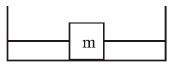
A block of mass $m$ is having two similar rubber ribbons attached to it as shown in the figure. The force constant of each rubber ribbon is $K$ and surface is frictionless. The block is displaced from mean position by $x\,cm$ and released. At the mean position the ribbons are underformed. Vibration period is
A wire is suspended by one end. At the other end a weight equivalent to $20\, N$ force is applied. If the increase in length is $1.0\, mm,$ the ratio of the increase in energy of the wire to the decrease in gravitational potential energy when load moves downwards by $1\, mm,$ will be
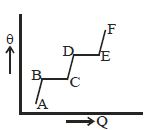
A solid cube having certain fixed melting and boiling points takes heat from some source.The variation  of temperature $\theta$ of the cube with the heat supplied $Q$ is shown in the adjoining graph. The portion $BC$ of the graph represents the conversion of
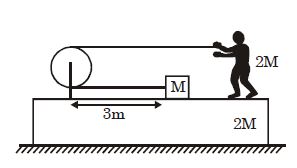
A block of mass $M$ is tied to one end of massless rope. The other end of rope is in the hands of a man of mass $2M$ as show in figure. Initially the block and the man are resting on a rough plank of mass $2M$ as shown in figure. The whole system is resting on a smooth horizontal surface. The man pulls the rope. Pulley is massless and frictionless. What is the magnitude of displacement of the plank when the block meets the pulley ......... $m $ (Man does not leave his position on the plank during the pull).
The mass and volume of a body are $4.237g$ and $2.5\ cm^3$, respectively. The density of the material of the body in correct significant figures is:
A ring, a solid sphere, a disc and a solid cylinder of same radii roll down an inclined plane, which would reach the bottom in the last
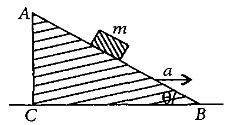
A block of mass $m$ is placed on a smooth inclined wedge $ABC$ of  inclination $\theta$ as shown in the figure. The wedge is given an acceleration $a$ towards the right. The relation between $a$ and $\theta$ for the block to remain stationary on the wedge is
The mean free path of molecules ofa gas, (radius $r$) is inversely proportional to