MCQ
The units of angular momentum are
  • A
    $kg - {m^2}/{s^2}$
  • $Joule - s$
  • C
    $Joule/s$
  • D
    $kg - m - {s^2}$

Answer

Correct option: B.
$Joule - s$
b
$=m \vee r W =F \cdot d $

$L  =[k g][m / s][m]  y =m \cdot a \cdot d $

$ L  =k g \cdot m^2 s^{-1} =k g\left( m / s ^2\right)$So, Joule-$s$  $=k g \frac{m^2}{s^2} \times s=k g m^2 s^{-1} .$

Need a full question paper?

Generate a complete, print-ready paper with questions like this in minutes — across 16+ boards, with answer keys.
Start Generating Free

Similar questions

A tuning fork of frequency $340Hz$ is vibrated just above the tube of $120 cm$ height. Water is poured slowly in the tube. What is the minimum height of water necessary for the resonance .... $cm$ (speed of sound in the air $= 340 m/sec$)
A sphere of solid material of relative density $9$ has a concentric spherical cavity and  floats having just sinked in water. If the radius of the sphere be $R$, then the radius of  the  cavity $(r)$ will be related to $R$ as :-
The horizontal range and maximum height attained by a projectile are $R$ and $H$, respectively. If a constant horizontal acceleration $a=g / 4$ is imparted to the projectile due to wind, then its horizontal range and maximum height will be
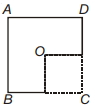
From a uniform square plate, one-fourth part is removed as shown. The centre of mass of remaining part will lie on
The dimensions of "time constant" $\frac{L}{R}$ during growth and decay of current in all inductive circuit is same as that of
A black body radiates energy at the rate of $1 \times 10^5 J / s \times m^2$ at temperature of $227^o C$. The temperature to which it must be heated so that it radiates energy at rate of $1 \times 10^9J/s m^2$, is
Given below are two statements :

Statement $I$ : The contact angle between a solid and a liquid is a property of the material of the solid and liquid as well.

Statement $II$ : The rise of a liquid in a capillary tube does not depend on the inner radius of the tube.

In the light of the above statements, choose the correct answer from the options given below :
If the earth stops rotating, the value of $‘g’$ at the equator will
$Assertion :$ The ratio of $\frac{C_p}{C_v}$ for an ideal diatomic gas is less than that for an ideal monoatomic gas (where $C_p$ and $C_v$ have usual meaning).
$Reason :$ The atoms of a monoatomic gas have less degrees of freedom as compared to molecules of the diatomic gas.
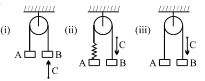
In the figure $(i), (ii)$ & $(iii)$ shown the objects $A, B$ & $C$ are of same mass. String, spring & pulley are massless. $C$ strikes $B$ with velocity $‘u’$ in each case and sticks to it. The ratio of velocity of $B$ in case $(i)$ to $(ii)$ to $(iii)$ is