MCQ
The V-i graphs A and B drawn for two voltameters. Identify each graph
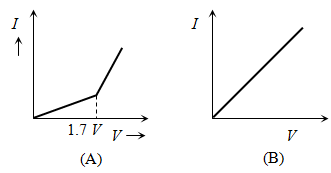
  • A for water voltameter and B for Cu voltameter
  • B
    A for Cu voltameter and B for water voltameter
  • C
    Both A and B represents Cu voltameter
  • D
    None of these

Answer

Correct option: A.
A for water voltameter and B for Cu voltameter
(a) A for water voltameter and B for Cu voltameter

Need a full question paper?

Generate a complete, print-ready paper with questions like this in minutes — across 16+ boards, with answer keys.

Start Generating Free

Similar questions

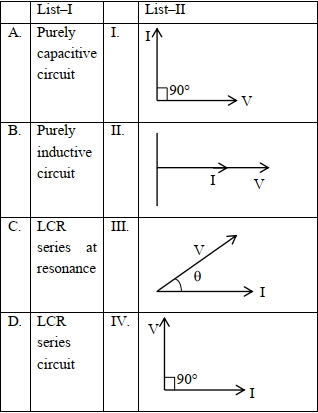
Match List I with List $II$

Choose the correct answer from the options given below:
The energy of hydrogen atom in its ground state is – 13.6 eV. The energy of the level corresponding to the quantum number n is equal 5 is
An electron enters in an electric field with its velocity in the direction of the electric lines of force. Then
Which of the following statements is false?
What will be the angle of diffracting for the first minimum due to Fraunhoffer diffraction with sources of light of wave length 550 nm and slit of width 0.55 mm
The resolving power of a telescope can be increased by increasing:
There are two plane mirror with reflecting surfaces facing each other. The mirrors are moving with speed $v$ away from each other.$A$ point object is placed between the mirrors. The velocity of the $n$ -th image will be
To an observer on the earth the stars appear to twinkle. This can be ascribed to
A circular loop of radius $0.3\, cm$ lies parallel to a much bigger circular loop of radius $20 \,cm$. The centre of the small loop on the axis of the bigger loop. The distance between their centres is $15\, cm$. If a current of $20\, A$ flows through the smaller loop, then the flux linked with bigger loop is
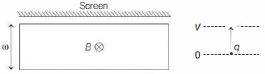
A rectangular region of dimensions ( $\omega \times l(\omega) \ll l$ ) has a constant magnetic field into the plane of the paper as shown in the figure below. On one side, the region is bounded by a screen. On the other side, positive ions of mass $m$ and charge $q$ are accelerated from rest and towards the screen by a parallel plate capacitor at constant potential difference $V < 0$ and come out through a small hole in the upper plate. Which one of the following statements is correct regarding the charge on the ions that hit the screen?