MCQ
The value of contact angle for kerosene with solid surface ........ $^o$
  • $0$
  • B
    $90$
  • C
    $45$
  • D
    $33$

Answer

Correct option: A.
$0$
a
The value of contact angle for kerosene with solid surface is $0^{\circ}$

Need a full question paper?

Generate a complete, print-ready paper with questions like this in minutes — across 16+ boards, with answer keys.
Start Generating Free

Similar questions

The compressibility of water is $6 \times 10^{-10} N ^{-1} m ^{2} .$ If one litre is subjected to a pressure of $4 \times 10^{7} Nm ^{-2}$ the decrease in its volume is (in $cc$)
A shell of mass $m$ moving with velocity $v$ suddenly breaks into $2$ pieces. The part having mass $m/3$ remains stationary. The velocity of other part will be
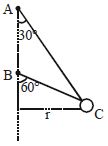
A single wire $ACB$ passes through a smooth ring at $C$ which revolves at a constant speed in the horizontal circle of radius $r$ as shown in the figure. The speed of revolution is
An ice cube at temperature $-20^o C$ is kept in a room at temperature $20^o C$. The variation of temperature of the body with time is given by
The molar specific heat at constant pressure for monoatomic gas molecule is given by:
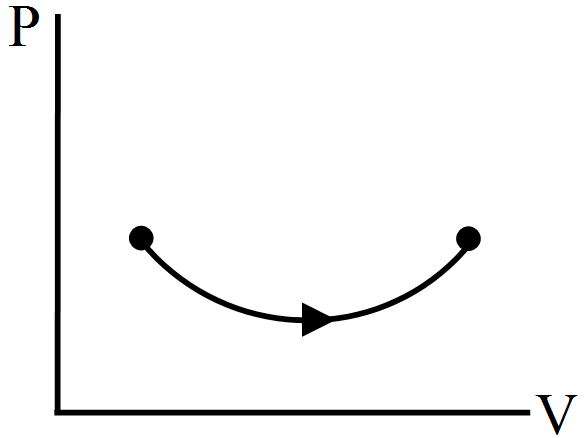
Consider the process on a system shown in figure. During the process, the work done by the system:
A soap bubble of radius $R$ and surface tension $T$ is formed in vacuum. It is slowly charged so that it slowly expands. It is stopped charging when the radius becomes $2R$ . Find the amount of charge given to the bubble.
The moment of inertia of a disc of mass $M$ and radius $R$ about an axis, which is tangential to circumference of disc and parallel to its diameter is:
A wire of length $L$ and radius $r$ is rigidly fixed at one end. On stretching the other end of the wire with a force $F$, the increase in its length is $l$. If another wire of same material but of length $2L$ and radius $2r$ is stretched with a force of $2F$, the increase in its length will be
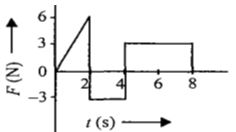
The force $F$ acting on a particle of mass $m$ is indicated by the force-time graph shown below. The change in momentum of the particle over the time interval from zero to $8\, s$ is   .......... $N-s$