MCQ
The values of $x $ in the following determinant equation, $\left| {\,\begin{array}{*{20}{c}}{a + x}&{a - x}&{a - x}\\{a - x}&{a + x}&{a - x}\\{a - x}&{a - x}&{a + x}\end{array}\,} \right| = 0$ are
  • A
    $x = 0,x = 4a$
  • B
    $x = 0,x = a$
  • C
    $x = 0,x = 2a$
  • $x = 0,x = 3a$

Answer

Correct option: D.
$x = 0,x = 3a$
d
(d) Trick: Putting $x = 0$ and $x = 3a,$ the value of determinant becomes zero.

Need a full question paper?

Generate a complete, print-ready paper with questions like this in minutes — across 16+ boards, with answer keys.

Start Generating Free

Similar questions

Choose the correct answer from the given four option.
The order and degree of the differential equation $\frac{\text{d}^2\text{y}}{\text{d}\text{x}^2}+\Big(\frac{\text{d}\text{y}}{\text{d}\text{x}}\Big)^{\frac{1}{4}}+\text{x}^{\frac{1}{5}}$ respectively, are:
  1. 2 and 4
  2. 2 and 2
  3. 2 and 3
  4. 3 and 3
Choose the correct answer from the given four options.
The probability of guessing correctly at least 8 out of 10 answers on a true-false type examination is:
Let $f$ be a real-valued function defined on the interval $(0, \infty)$ by $f(x)=\ln x+\int_0^x \sqrt{1+\sin t} d t$. Then which of the following statement(s) is (are) true?

$(A)$ $f^{\prime \prime}(x)$ exists for all $x \in(0, \infty)$

$(B)$ $f^{\prime}(x)$ exists for all $x \in(0, \infty)$ and $f^{\prime}$ is continuous on $(0, \infty)$, but not differentiable on $(0, \infty)$

$(C)$ there exists $\alpha>1$ such that $\left|f^{\prime}(x)\right|<|f(x)|$ for all $x \in(\alpha, \infty)$

$(D)$ there exists $\beta>0$ such that $|f(x)|+\left|f^{\prime}(x)\right| \leq \beta$ for all $x \in(0, \infty)$
$\int \limits_0^{\infty} \frac{6}{e^{3 x}+6 e^{2 x}+11 e^x+6} d x$

If the mean and variance of a binomial distribution are 4 and 3, respectively, the probability of getting exactly six successes in this distribution is:

  1. $\text{ }^{16}\text{C}_6\big(\frac{1}{4}\big)^{10}\big(\frac{3}{4}\big)^6$

  2. $\text{ }^{16}\text{C}_6\big(\frac{1}{4}\big)^{6}\big(\frac{3}{4}\big)^{10}$

  3. $\text{ }^{12}\text{C}_6\big(\frac{1}{20}\big)\big(\frac{3}{4}\big)^6$

  4. $\text{ }^{12}\text{C}_6\big(\frac{1}{20}\big)^6\big(\frac{3}{4}\big)^6$

The area bounded by the curve $y=\sec ^2 x, y=0$ and $|x|=\frac{\pi}{3}$ is
Choose the correct answer from the given four options.

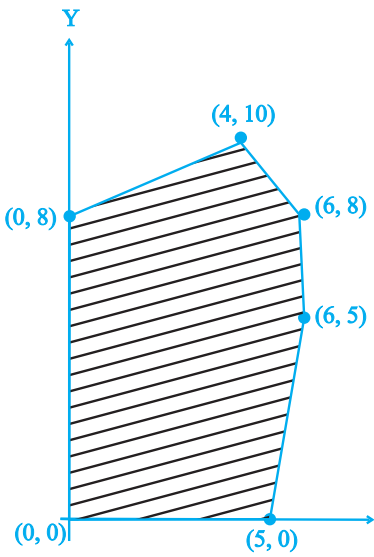
The feasible solution for a LPP shown in Fig. 12.12. Let z = 3x - 4y be objective functio. (Maximum value of Z + Minimum value of Z) is equal to:
Choose the correct answer from the given four options.
A flashlight has 8 batteries out of which 3 are dead. If two batteries are selected without replacement and tested, the probability that both are dead is:
The area of the region bounded by the curve $y=\cos x, x=0$ and $x=\frac{3 \pi}{2}$ is __________ .
If $A$ is square matrix such that $A^2=A$, then $(I+A)^3-7 A$ $=$ _________ .