Question
The width of the $nth$ $HPZ$  will be

Answer

(b)Width of $nth$ $HPZ$  ${B_n} = {r_n} - {r_{n - 1}}$
${r_n} = \sqrt {nb\lambda } $, ${r_{n - 1}} = \sqrt {(n - 1)b\lambda } $
${B_n} = \sqrt {nb\lambda } - \sqrt {(n - 1)b\lambda } = \sqrt {b\lambda } \,[\sqrt n - \sqrt {(n - 1)} ]$

Need a full question paper?

Generate a complete, print-ready paper with questions like this in minutes — across 16+ boards, with answer keys.

Start Generating Free

Similar questions

The retarding acceleration of $7.35\, ms^{-2}$ due to frictional force stops the car of mass $400\, kg$ travelling on a road. The coefficient of friction between the tyre of the car and the road is
A radioactive nucleus ${ }_{\mathrm{Z}}^{\mathrm{A}} \mathrm{X}$ undergoes spontaneous decay in the sequence

${ }_{\mathrm{Z}}^{\mathrm{A}} \mathrm{X} \rightarrow {}_{\mathrm{Z}-1}{\mathrm{B}} \rightarrow {}_{\mathrm{Z}-3 }\mathrm{C} \rightarrow {}_{\mathrm{Z}-2} \mathrm{D}$, where $\mathrm{Z}$ is the atomic number of element $X.$ The possible decay particles in the sequence are :
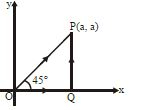
A particle is moved from $(0, 0)$  to $(a, a)$  under a force $F = (3\hat i + 4\hat j)$ from two paths. Path $1$ is $OP$ and path $2$  is $OQP$ . Let $W_1$ and $W_2$ be the work done by this force in these two paths respectively. Then
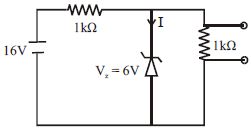
What is value of current $I$ in given circuit..........$mA$
A beaker of radius $15\, cm$ is filled with a liquid of surface tension $0.075\, N/m.$ Force  across an imaginary diameter on the surface of the liquid is:-
It is possible to hear beats from the two vibrating sources of frequency
When a diode is forward biased, it has a voltage drop of $0.5\, V.$ The safe limit of current through the diode is $10\, mA$. If a battery of emf $1.5\, V$ is used in the circuit, the value of minimum resistance to be connected in series with the diode so that the current does not exceed the safe limit is$.....\Omega$
The-relation between the magnetic susceptibility and the magnetic permeability is
If the distance between object and its two times magnified virtual image produced by a curved mirror is $15 \mathrm{~cm}$, the focal length of the mirror must be :
The acceleration of a train travelling with speed of $400 \,m/s$ as it goes round a curve of radius $160\,m$, is