Question
There are many observable patterns in thephysical and chemical properties of elementsas we descend in a group or move across aperiod in the Periodic Table.Atomic Radius the determination of the atomic sizecannot be precise. In other words, there is no practical way by which the size of an individualatom can be measured. However, an estimateof the atomic size can be made by knowing thedistance between the atoms in the combinedstate. One practical approach to estimate thesize of an atom of a non-metallic element is tomeasure the distance between two atoms whenthey are bound together by a single bond in acovalent molecule and from this value, the“Covalent Radius” For metals, we define theterm “Metallic Radius” which is taken as halfthe internuclear distance separating the metalcores in the metallic crystal. Atomic Radius to refer to both covalent ormetallic radius depending on whether theelement is a non-metal or a metal. Atomic radiican be measured by X-ray or otherspectroscopic methods. The atomic size generallydecreases across a period. It is because within the period the outerelectrons are in the same valence shell and theeffective nuclear charge increases as the atomicnumber increases resulting in the increasedattraction of electrons to the nucleus.Note that the atomic radii of noble gasesAre not considered here. Being monoatomic,Their (non-bonded radii) values are very large.In fact radii of noble gases should be comparednot with the covalent radii but with the van derWaals radii of other elements. The removal of an electron from an atom resultsin the formation of a cation, whereas gain ofan electron leads to an anion. The ionic radiican be estimated by measuring the distancesbetween cations and anions in ionic crystals.In general, the ionic radii of elements exhibitthe same trend as the atomic radii. A cation issmaller than its parent atom because it hasfewer electrons while its nuclear charge remainsthe same. The size of an anion will be largerthan that of the parent atom because theaddition of one or more electrons would resultin increased repulsion among the electronsand a decrease in effective nuclear charge. When we find some atoms and ions whichcontain the same number of electrons, we callthem isoelectronic species. For example,$O2–, F–, Na+$ and $Mg2+$ have the same number ofelectrons (10). Their radii would be differentbecause of their different nuclear charges.A quantitative measure of the tendency of anelement to lose electron is given by itsIonization Enthalpy. It represents the energyrequired to remove an electron from an isolatedgaseous atom (X) in its ground state. The ionization enthalpy is expressed inunits of kJ mol–1. We can define the secondionization enthalpy as the energy required toremove the second most loosely boundelectron The first ionization enthalpies of elementshaving atomic numbers up to 60 are plotted then The periodicity of the graph is quitestriking. You will find maxima at the noble gaseswhich have closed electron shells and verystable electron configurations. On the otherhand, minima occur at the alkali metals andtheir low ionization enthalpies can be correlated with their high reactivity. In addition, you willnotice two trends the first ionization enthalpygenerally increases as we go across a periodand decreases as we descend in a group. Electron Gain Enthalpy. when an electron is added to a neutral gaseousatom (x) to convert it into a negative ion, theenthalpy change accompanying the process isdefined as the electron gain enthalpy (∆egh).Electron gain enthalpy provides a measure ofthe ease with which an atom adds an electronto form anion. electron gain enthalpies have largenegative values toward the upper right of theperiodic table preceding the noble gases.The variation in electron gain enthalpies ofelements is less systematic than for ionizationenthalpies. As a general rule, electron gainenthalpy becomes more negative with increasein the atomic number across a period. Theeffective nuclear charge increases from left toright across a period and consequently it willbe easier to add an electron to a smaller atomsince the added electron on an average wouldbe closer to the positively charged nucleus. ElectronegativityA qualitative measure of the ability of an atomin a chemical compound to attract sharedelectrons to itself is called electronegativity.Unlike ionization enthalpy and electron gainenthalpy, it is not a measureable quantity.However, a number of numerical scales ofelectronegativity of elements viz., Pauling scale,Mulliken-Jaffe scale, Allred-Rochow scale havebeen developed. The one which is the most widely used is the Pauling scale. Electronegativity generallyincreases across a period from leftto right (say from lithium tofluorine) and decrease down a group(say from fluorine to astatine) inthe periodic table. Non-metallic elements have strong tendencyto gain electrons. Therefore, electronegativityis directly related to that non-metallicproperties of elements. It can be furtherextended to say that the electronegativity isinversely related to the metallic properties of elements. Thus, the increase inelectronegativities across a period isaccompanied by an increase in non-metallicproperties (or decrease in metallic properties)of elements. Similarly, the decrease inelectronegativity down a group is accompanied by a decrease in non-metallic properties (orincrease in metallic properties) of elements.
  1. The atomic size generally … across a period.
  1. Increases
  2. Decreases
  3. Remains Constant
  4. None of above
  1. The ionization enthalpy is expressed in units of ….
  1. $kJ mol^{–1}$
  2. $mole kJ^{-1}$
  3. $mole kJ$
  4. $-kJ mol^{-1}$
  1. Which of the following is/are numerical scales of electronegativity of elements.
  1. Pauling scale
  2. Mulliken-Jaffe scale
  3. Allred-Rochow scale
  4. All the above
  1. The … in electronegativity down a group is accompanied by a … in non-metallic properties.
  1. Increase, Decrease
  2. Decrease, Increase
  3. Decrease, Decrease
  4. Increase , Increase
  1. Electronegativity generally … across a period from left to right and … down a group in the periodic table.
  1. Increase, Decrease
  2. Decrease, Increase
  3. Decrease, Decrease
  4. Increase, Increase

Answer

  1. (b) Decreases
  1. (a) $kJ mol^{–1}$​​​​​​​
  1. (d) All the above
  1. (c) Decrease, Decrease
  1. (a) Increase, Decrease

Need a full question paper?

Generate a complete, print-ready paper with questions like this in minutes — across 16+ boards, with answer keys.

Start Generating Free

Similar questions

The molecular orbital theory is based on the principle of a linear combination of atomic orbitals. According to this approach when atomic orbitals of the atoms come closer, they undergo constructive interference as well as destructive interference giving molecular orbitals, i.e., two atomic orbitals overlap to form two molecular orbitals, one of which lies at a lower energy level (bonding molecular orbital). Each molecular orbital can hold one or two electrons in accordance with Pauli's exclusion principle and Hund's rule of maximum multiplicity. For molecules up to $N _2$, the order of filling of orbitals is:
Image
Bond order $=\frac{1}{2}$ [bonding electrons - antibonding electrons]
Bond order gives the following information:
i. If bond order is greater than zero, the molecule/ion exists otherwise not.
ii. Higher the bond order, higher is the bond dissociation energy.
iii. Higher the bond order, greater is the bond stability.
iv. Higher the bond order, shorter is the bond length.

1. Arrange the following negative stabilities of $CN , CN ^{+}$and $CN ^{-}$in increasing order of bond.
2. The molecular orbital theory is preferred over valence bond theory. Why?
3. Ethyne is acidic in nature in comparison to ethene and ethane. Why is it so?
OR
Bonding molecular orbital is lowered by a greater amount of energy than the amount by which antibonding molecular orbital is raised. Is this statement correct?
The ionic character of metallic halides tends toward covalent nature as per Fajan's rule. Such covalent halides behave as non-metal in their higher oxidation states. The property to hydrolyse to give oxy-acids of the element and corresponding hydro halogen acid for most non-metallic elements proceeds exceptionally in the way, keeping oxidation number of element and halide sam in oxo-acids.
Non-polar halides are immiscible in water, as they do not show hydrolysis, but halides of some elements with empty d-orbital undergo hydrolysis. Stability of halides of the higher state is governed by the inert-pair effect.

1. How does halide undergo hydrolysis to give oxy-acids of underlined element $PCl _3$ ? (1)
2. Out of $NCl _3$ and $BCl _3$ undergoes hydrolysis to form oxy-acids? Write the chemical reaction for the correct answer. (1)
3. Out of $PbCl _4, PbF _4, PbI _4$ and $PbBr _4$ which one doesn't exist? (2)
OR
Non-Polar halides are immiscible in water. Why? (2)
Read the passage given below and answer the following questions from 1 to 5. Since the isotopes have the same electronic Configuration, they have almost the same Chemical properties.The only difference is in Their rates of reactions, mainly due to their Different enthalpy of bond dissociation . However, in physical properties these Isotopes differ considerably due to their large Mass differences. There are a number of methods for preparing Dihydrogen from metals and metal hydrides. 1.) Laboratory Preparation of Dihydrogen – It is usually prepared by the reaction of Granulated zinc with dilute hydrochloric. $Zn + 2H + \rightarrow Zn_2+ + H_2$ It can also be prepared by the reaction of Zinc with aqueous alkali. $Zn + 2NaOH \rightarrow Na_2ZnO_2 + H_2$ Commercial Production of Dihydrogen – The commonly used processes are outlined Below: i) Electrolysis of acidified water using Platinum electrodes gives hydrogen. ii) High purity (> 99.95%) dihydrogen is Obtained by electrolysing warm aqueous Barium hydroxide solution between nickel iii) It is obtained as a by product in the Manufacture of sodium hydroxide and Chlorine by the electrolysis of brine Solution. During electrolysis, the reactions That take place are: at anode: $2\text{CI}(\text{aq})\rightarrow\text{CI}_2(\text{g})+2\bar{\text{e}}$ at cathode: $2\text{H}_2\text{O}(\text{l})+2\text{e}\rightarrow\text{H}_2(\text{g})+2\text{O}\bar{\text{H}}(\text{aq})$ The overall reaction is $2\text{Na }(\text {aq})+2\text{C}\bar{\text{I}}(\text{aq})+2\text{H}_2\text{O}(\text{l})$ $\text{CI}_2(\text{g})+\text{H}_2(\text{g})+2\text{Na}^+(\text{aq})+2\text{O}\bar{\text{H}}(\text{aq})$ That take place are: iv) Reaction of steam on hydrocarbons or coke At high temperatures in the presence of Catalyst yields hydrogen.

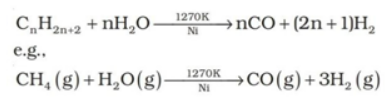
 The mixture of $CO$ and $H_2$ is called water Gas. As this mixture of $CO$ and $H_2$ is used for The synthesis of methanol and a number of Hydrocarbons, it is also called synthesis gas Or ‘syngas’. Nowadays ‘syngas’ is produced From sewage, saw-dust, scrap wood, Newspapers etc. The process of producing ‘syngas’ from coal is called ‘coal gasification’. The production of dihydrogen can be Increased by reacting carbon monoxide of Syngas mixtures with steam in the presence of Iron chromate as catalyst. This is called water-gas shift reaction. Carbon dioxide is removed by scrubbing with Sodium arsenite solution. Presently ~77% of the industrial Dihydrogen is produced from petro-chemicals, 18% from coal, 4% from electrolysis of aqueous Solutions and 1% from other sources. Physical Properties Dihydrogen is a colourless, odourless, Tasteless, combustible gas. It is lighter than Air and insoluble in water. Its other physical Properties are alongwith those of deuterium. The chemical behaviour of dihydrogen (and for That matter any molecule) is determined, to a Large extent, by bond dissociation enthalpy. The H–H bond dissociation enthalpy is the Highest for a single bond between two atoms Of any element. What inferences would you Draw from this fact ? It is because of this factor That the dissociation of dihydrogen into its Atoms is only~0.081% around 2000K which Increases to 95.5% at 5000K. Also, it is Relatively inert at room temperature due to the high H–H bond enthalpy. Thus, the atomic Hydrogen is produced at a high temperature In an electric arc or under ultraviolet Radiations. Since its orbital is incomplete with 1s1 Electronic configuration, it does combine With almost all the elements. It accomplishes Reactions by
i) loss of the only electron to Give H+, ii) gain of an electron to form H–, and iii) Sharing electrons to form a single covalent bond. The chemistry of dihydrogen can be Illustrated by the following reactions: Reaction with halogens: It reacts with Halogens, $X_2$ to give hydrogen halides, $\text{H}_2(\text{g})+\text{x}_2(\text{g})\rightarrow2\text{HX}(\text{g})(\text{x}=\text{F.CI.Br.I})$ While the reaction with fluorine occurs even in The dark, with iodine it requires a catalyst. Reaction with dioxygen: It reacts with Dioxygen to form water. The reaction is highly Exothermic. $2\text{H}_2(\text{g})+\text{O}_2(\text{g})\xrightarrow{\text{catalyst or beading}}2\text{H}_2\text{O}(\text{l}):$ $\triangle\text{H}^-=-285.9\text{kj}\text{mol}^-1$ This is the method for the manufacture of Ammonia by the Haber process. Reactions with metals: With many metals it Combines at a high temperature to yield the Corresponding hydrides $H_2$ (g) + 2M (g) → 2 MH (s); Where M is an alkali metal Reactions with metal ions and metal Oxides: It reduces some metal ions in aqueous Solution and oxides of metals (less active than Iron) into corresponding metals. $\text{H}_2(\text{g})+\text{Pd}^{2+}\text{(aq)}\rightarrow\text{Pd}(\text{s})+2\text{H}^+(\text{aq})$ $\text{y}\text{H}_2(\text{g})+\text{M}_\text{x}\text{O}_\text{y}(\text{S})\rightarrow\text{xM}(\text{s})+\text{y}\text{H}_2\text{O}\text{(l)}$ Reactions with organic compounds: It Reacts with many organic compounds in the Presence of catalysts to give useful Hydrogenated products of commercial Importance. For example: Hydrogenation of vegetable oils using Nickel as catalyst gives edible fats (margarine and vanaspati ghee) Hydroformylation of olefins yields Aldehydes which further undergo Reduction to give alcohols. $\text{H}_2+\text{CO}+\text{RCH}=\text{CH}_2\rightarrow\text{RCH}_2\text{CH}_2\text{CHO}$ $\text{H}_2+\text{RCH}_2\text{CH}_2\text{CHO}\rightarrow\text{RCH}_2\text{CH}_2\text{CH}_2\text{OH}$
  1. The mixture of CO and H2 is called …
  1. water Gas
  2. Dry ice
  3. Dry carbon
  4. Dry hydrogen
  1. Which of the following is not physical property of Dihydrogen.
  1. colourless
  2. Highest dissociation enthalpy
  3. odourless
  4. Tasteless
  1. Dihydrogen is reacts with dioxygen to get ….
  1. $H_2O_2$
  2. $2H_2O_2$
  3. $2H_2O$
  4. $H_2O$
  1. High purity dihydrogen is obtained by electrolysing warm aqueous barium hydroxide solution between… electrodes.
  1. Chromium
  2. Copper
  3. Platinum
  4. Nickel
Read the passage given below and answer the following questions from 1 to 5.
The dipositive oxidation state $(M^{2+})$ is the Predominant valence of Group 2 elements. The Alkaline earth metals form compounds which Are predominantly ionic but less ionic than the Corresponding compounds of alkali metals. This is due to increased nuclear charge and Smaller size. The oxides and other compounds Of beryllium and magnesium are more covalent Than those formed by the heavier and large Sized members (Ca, Sr, Ba). The general Characteristics of some of the compounds of Alkali earth metals are described below.
Oxides and Hydroxides: The alkaline Earth metals burn in oxygen to form the Monoxide, MO which, except for BeO, have Rock-salt structure. The BeO is essentially Covalent in nature. The enthalpies of formation Of these oxides are quite high and consequently They are very stable to heat. BeO is amphoteric While oxides of other elements are ionic in Nature. All these oxides except BeO are basic In nature and react with water to form sparingly Soluble hydroxides.
$MO + H2O \rightarrow M(OH)_2$
The solubility, thermal stability and the Basic character of these hydroxides increase With increasing atomic number from $Mg(OH)_2 To Ba(OH)_2$.The alkaline earth metal Hydroxides are, however, less basic and less Stable than alkali metal hydroxides. Beryllium Hydroxide is amphoteric in nature as it reacts With acid and alkali both.
$Be(OH)_2 + 2OH^– \rightarrow [Be(OH)4]^{2–}$
Beryllate ion
$Be(OH)_2 + 2HCl + 2H_2O \rightarrow [Be(OH)_4]Cl_2$​​​​​​​
Halides: Except for beryllium halides, all Other halides of alkaline earth metals are ionic In nature. Beryllium halides are essentially Covalent and soluble in organic solvents. Beryllium chloride has a chain structure in the Solid state as shown below: In the vapour phase $BeCl_2$ tends to form a Chloro-bridged dimer which dissociates into the Linear monomer at high temperatures of the Order of 1200 K. The tendency to form halide Hydrates gradually decreases down the group. The dehydration Of hydrated chlorides, bromides and iodides Of Ca, Sr and Ba can be achieved on heating; However, the corresponding hydrated halides Of Be and Mg on heating suffer hydrolysis. The Fluorides are relatively less soluble than the Chlorides owing to their high lattice energies.
Salts of Oxoacids: The alkaline earth Metals also form salts of oxoacids. Some of These are :
Carbonates: Carbonates of alkaline earth Metals are insoluble in water and can be Precipitated by addition of a sodium or Ammonium carbonate solution to a solution Of a soluble salt of these metals. The solubility Of carbonates in water decreases as the atomic Number of the metal ion increases. All the Carbonates decompose on heating to give Carbon dioxide and the oxide. Beryllium Carbonate is unstable and can be kept only in The atmosphere of $CO_2$. The thermal stability Increases with increasing cationic size.
Sulphates: The sulphates of the alkaline earth Metals are all white solids and stable to heat. $BeSO_4,$ and $MgSO_4$ are readily soluble in water; The solubility decreases from $CaSO_4$ to $ BaSO_4$. The greater hydration enthalpies of $Be_2+$ and $Mg_2+$ ions overcome the lattice enthalpy factor And therefore their sulphates are soluble in Water.​​​​​​​
Nitrates: The nitrates are made by dissolution Of the carbonates in dilute nitric acid. Magnesium nitrate crystallises with six Molecules of water, whereas barium nitrate Crystallises as the anhydrous salt. This again Shows a decreasing tendency to form hydrates With increasing size and decreasing hydration Enthalpy. All of them decompose on heating to Give the oxide like lithium nitrate.
$2\text{M}(\text{NO}_3)_2\rightarrow2\text{MO}+4\text{NO}_2+\text{O}_2$
(M = Be. Mg. Ca. Sr. Ba)
Beryllium, the first member of the Group 2 Metals, shows anomalous behaviour as Compared to magnesium and rest of the Members. Further, it shows diagonal Relationship to aluminium which is discussed Subsequently.
i) Beryllium has exceptionally small atomic And ionic sizes and thus does not compare Well with other members of the group. Because of high ionisation enthalpy and Small size it forms compounds which are Largely covalent and get easily hydrolysed.
ii) Beryllium does not exhibit coordination Number more than four as in its valence Shell there are only four orbitals. The Remaining members of the group can have A coordination number of six by making Use of d-orbitals.
iii) The oxide and hydroxide of beryllium, Unlike the hydroxides of other elements in The group, are amphoteric in nature.
Diagonal Relationship between Beryllium and Aluminium-The ionic radius of 4 is estimated to be 31 pm; the charge/radius ratio is nearly the Same as that of the $Al^{3+}$ ion. Hence beryllium Resembles aluminium in some ways. Some of The similarities are:
i) Like aluminium, beryllium is not readily Attacked by acids because of the presence Of an oxide film on the surface of the metal.
ii) Beryllium hydroxide dissolves in excess of Alkali to give a beryllate ion, $[Be(OH)_4]^{2–}$ just As aluminium hydroxide gives aluminate Ion, $[Al(OH)_4]^–.$
iii) The chlorides of both beryllium and Aluminium have $Cl^–$ Bridged chloride Structure in vapour phase. Both the Chlorides are soluble in organic solvents And are strong Lewis acids. They are used As Friedel Craft catalysts.
iv) Beryllium and aluminium ions have strong Tendency to form complexes, $BeF_4^{2–}, AlF_6^{3–}.$​​​​​​​
  1. The dipositive oxidation state $(M2^+)$ is the Predominant valence of … elements.
  1. Group 2
  2. Group 1
  3. Group 17
  4. Group 18
  1. … the first member of the Group 2 metals.
  1. Magnesium
  2. Beryllium
  3. Barium
  4. Radium
  1. Except for beryllium halides, all other halides of alkaline earth metals are ionic in nature.
  1. Magnesium halides
  2. beryllium halides
  3. Calcium halides
  4. Radium halides
  1. The ionic radius of $Be^{2+}$ is estimated to be … pm.
  1. 310
  2. 500
  3. 50
  4. 31
  1. Beryllium carbonate can be kept only in the atmosphere of …
  1. $N_2$
  2. $H_2$
  3. $CO_2$
  4. $O_2$
When anions and cations approach each other, the valence shell of anions are pulled towards the cation nucleus and thus, the shape of the anion is deformed. The phenomenon of deformation of anion by a cation is known as polarization and the ability of the cation to polarize the anion is called as polarizing power of cation. Due to polarization, sharing of electrons occurs between two ions to some extent and the bond shows some covalent character.
The magnitude of polarization depends upon a number of factors.

1. Out of $AlCl _3$ and $AlI _3$ which halides show maximum polarization? (1)
2. Out of $AlCl _3$ and $CaCl _2$ which one is more covalent in nature? (1)
3. The non-aqueous solvent like ether is added to the mixture of $LiCl , NaCl$ and KCl . Which will be extracted into the ether? (2)
OR
Out of $CaF _2$ and $CaI _2$ which one has a minimum melting point? (2)

The orbital wave function or $\psi$ for an electronin an atom has no physical meaning. It issimply a mathematical function of thecoordinates of the electron. However, fordifferent orbitals the plots of correspondingwave functions as a function of r (the distancefrom the nucleus) are different. According to the German physicist, MaxBorn, the square of the wave function(i.e.,$\psi^2$) at a point gives the probability densityof the electron at that point. Boundary surface diagrams of constantprobability density for different orbitals give afairly good representation of the shapes of theorbitals. In this representation, a boundarysurface or contour surface is drawn in spacefor an orbital on which the value of probabilitydensity $\mid\psi\mid2$ is constant. In principle manysuch boundary surfaces may be possible.However, for a given orbital, only thatboundary surface diagram of constantprobability density* is taken to be goodrepresentation of the shape of the orbital whichencloses a region or volume in which theprobability of finding the electron is very high,say, 90%.
In hydrogen atom, electron has the same energy when it is in the2s orbital as when it is present in 2p orbital.The orbitals having the same energy are calleddegenerate. The 1s orbital in a hydrogenatom, as said earlier, corresponds to the moststable condition and is called the ground stateand an electron residing in this orbital is moststrongly held by the nucleus.
An electron inthe 2s, 2p or higher orbitals in a hydrogen atomis in excited state.The filling of electrons into the orbitals ofdifferent atoms takes place according to theaufbau principle which is based on the Pauli’sexclusion principle, the Hund’s rule ofmaximum multiplicity and the relativeenergies of the orbitals. Theaufbausprinciple states : In the ground state of theatoms, the orbitals are filled in order oftheir increasing energies. In other words,electrons first occupy the lowest energy orbitalavailable to them and enter into higher energyorbitals only after the lower energy orbitals arefilled.The number of electrons to be filled in variousorbitals is restricted by the exclusion principle,given by the Austrian scientist Wolfgang Pauli(1926). According to this principle : No twoelectrons in an atom can have the sameset of four quantum numbers. Pauliexclusion principle can also be stated as : “Onlytwo electrons may exist in the same orbitaland these electrons must have oppositespin.” This means that the two electrons canhave the same value of three quantum numbersn, l and $m_l$, but must have the opposite spinquantum number.Hund’s Rule of Maximum Multiplicity rule deals with the filling of electrons into the orbitals belonging to the same subshell. It states : pairing ofelectrons in the orbitals belonging to thesame subshell (p, d or f) does not take placeuntil each orbital belonging to thatsubshell has got one electron each i.e., itis singly occupied.
The distribution of electrons into orbitals of anatom is called its electronic configuration.If one keeps in mind the basic rules whichgovern the filling of different atomic orbitals,the electronic configurations of different atomscan be written very easily.The electronic configuration of differentatoms can be represented in two ways. Forexample :
  1. $s^a p^bd^c$​​​​​​​…… notation
  2. Orbital diagram
  1. …at a point gives the probability density of the electron at that point.
  1. $\psi\times2$
  2. $-\psi^2$
  3. $\psi$
  4. $\psi^2$
  1. Only …. electrons may exist in the same orbital and these electrons must have opposite spin.
  1. One
  2. Two
  3. Three
  4. Four
  1. …deals with the filling of electrons into the orbitals belonging to the same subshell.
  1. Hund’s Rule of Maximum Multiplicity rule
  2. Pauli’s exclusion principle
  3. Aufbau principle
  4. Werner Heisenberg
  1. Electrons first occupy the …. energy orbital available to them and enter into … energy orbitals.
  1. Lowest, Higher
  2. Higher, Lowest
  3. Middle, Higher
  4. Higher, Middle
The molecular orbital theory is based on the principle of a linear combination of atomic orbitals. According to this approach when atomic orbitals of the atoms come closer, they undergo constructive interference as well as destructive interference giving molecular orbitals, i.e., two atomic orbitals overlap to form two molecular orbitals, one of which lies at a lower energy level (bonding molecular orbital). Each molecular orbital can hold one or two electrons in accordance with Pauli's exclusion principle and Hund's rule of maximum multiplicity.
For molecules up to $N _2$, the order of filling of orbitals is:
Image
Bond order $=\frac{1}{2}$ [bonding electrons - antibonding electrons]
Bond order gives the following information:
I. If bond order is greater than zero, the molecule/ion exists otherwise not.
II. Higher the bond order, higher is the bond dissociation energy.
III. Higher the bond order, greater is the bond stability.
IV. Higher the bond order, shorter is the bond length.

1. Arrange the following negative stabilities of $CN , CN ^{+}$and $CN ^{-}$in increasing order of bond. (1)
2. The molecular orbital theory is preferred over valence bond theory. Why? (1)
3. Ethyne is acidic in nature in comparison to ethene and ethane. Why is it so? (2)
OR
Bonding molecular orbital is lowered by a greater amount of energy than the amount by which antibonding molecular orbital is raised. Is this statement correct? (2)
Read the passage given below and answer the following questions from (i) to (v).
The identity of a substance is defined not only by the types of atoms or ions it contains, but by the quantity of each type of atom or ion. The experimental approach required the introduction of a new unit for amount of substances, the mole, which remains indispensable in modern chemical science. The mole is an amount unit similar to familiar units like pair, dozen, gross, etc. It provides a specific measure of the number of atoms or molecules in a bulk sample of matter. A mole is defined as the amount of substance containing the same number of discrete entities (atoms, molecules, ions, etc.) as the number of atoms in a sample of pure 12 C weighing exactly 12 g . One Latin connotation for the word "mole" is "large mass" or "bulk," which is consistent with its use as the name for this unit. The mole provides a link between an easily measured macroscopic property, bulk mass, and an extremely important fundamental property, number of atoms, molecules and so forth. The number of entities composing a mole has been experimentally determined to be $6.02214179 \times 10^{23}$. $6.02214179 \times 10^{23}$, a fundamental constant named Avogadro's number (NA) or the Avogadro constant in honor of Italian scientist Amedeo Avogadro. This constant is properly reported with an explicit unit of "per mole," a conveniently rounded version being $6.022 \times 10^{23} / mol$. Consistent with its definition as an amount unit, 1 mole of any element contains the same number of atoms as 1 mole of any other element. The masses of 1 mole of different elements, however, are different, since the masses of the individual atoms are drastically different. The molar mass of an element (or compound) is the mass in grams of 1 mole of that substance, a property expressed in units of grams per mole ( $g / mol$ ). The following questions are multiple choice questions. Choose the most appropriate answer:
i. A sample of copper sulphate pentahydrate contains 8.64 g of oxygen. How many grams of Cu is present in the sample?
  1. A sample of copper sulphate pentahydrate contains 8.64g of oxygen. How many grams of Cu is present in the sample?
  1. 0.952g
  2. 3.816g
  3. 3.782g
  4. 8.64g
  1. A gas mixture contains 50% helium and $50\%$ methane by volume. What is the percent by \ weight of methane in the mixture?
  1. $19.97\%$
  2. $20.05\%$
  3. $50\%$
  4. $80.03\%$
  1. The mass of oxygen gas which occupies 5.6 litres at STP could be:
  1. Gram atomic mass of oxygen
  2. One fourth of the gram atomic mass of oxygen
  3. Double the gram atomic mass of oxygen
  4. Half of the gram atomic mass of oxygen
  1. What is the mass of one molecule of yellow phosphorus? (Atomic mass of phosphorus = 30)
  1. $1.993 \times 10^{-22}$ mg
  2. $1.993 \times 10^{-19}$ mg
  3. $4.983 \times 10^{-20}$ mg
  4. $4.983 \times 10^{-23}$ mg
  1. The number of moles of oxygen in 1L of air containing $21\%$ oxygen by volume, in standard conditions is:
  1. $0.186$ mol
  2. $0.21$ mol
  3. $2.10$ mol
  4. $0.0093$ mol
The ionic character of metallic halides tends toward covalent nature as per Fajan's rule. Such covalent halides behave as non-metal in their higher oxidation states. The property to hydrolyse to give oxy-acids of the element and corresponding hydro halogen acid for most non-metallic elements proceeds exceptionally in the way, keeping oxidation number of element and halide sam in oxo-acids.
Non-polar halides are immiscible in water, as they do not show hydrolysis, but halides of some elements with empty d-orbital undergo hydrolysis. Stability of halides of the higher state is governed by the inert-pair effect.

1. How does halide undergo hydrolysis to give oxy-acids of underlined element $PCl _3$ ? (1)
2. Out of $NCl _3$ and $BCl _3$ undergoes hydrolysis to form oxy-acids? Write the chemical reaction for the correct answer. (1)
3. Out of $PbCl _4, PbF _4, PbI _4$ and $PbBr _4$ which one doesn't exist? (2)
OR
Non-Polar halides are immiscible in water. Why? (2)
Read the passage given below and answer the following questions from 1 to 5. Chemistry deals with varieties of matter and change of one kind of matter into the other. Transformation of matter from one kind into another occurs through the various types of reactions. One important category of such reactions is Redox Reactions. Originally, the term oxidation was used to describe the addition of oxygen to an element or a compound. Because of the presence of dioxygen in the atmosphere (~20%), many elements combine with it and this is the principal reason why they commonly occur on the earth in the form of their oxides. The following reactions represent oxidation processes: $2\text{Mg}(\text{s})\rightarrow2\text{MgO}\text{ (S)}$ $\text{S}(\text{s})+\text{O}_2(\text{g})\rightarrow\text{SO}_2\text{ g}$ the term “oxidation” is defined as the addition of oxygen/electronegative element to a substance or removal of hydrogen/ electropositive element from a substance. In the beginning, reduction was considered as removal of oxygen from a compound. However, the term reduction has been broadened these days to include removal of oxygen/electronegative element from a substance or addition of hydrogen/ electropositive element to a substance. According to the definition given above, the following are the examples of reduction processes: $2\text{HgO}\text{S}\xrightarrow{\triangle}2\text{ Hg}(1)+\text{O}_2(\text{g})$ $2\text{HgCl}_2(\text{aq})+\text{SnCl}_2(\text{aq})\rightarrow\text{Hg}_2\text{Cl}_2(\text{s})+\text{SnCl}_4(\text{aq})$ In reaction simultaneous oxidation of stannous chloride to stannic chloride is also occurring because of the addition of electronegative element chlorine to it. It was soon realised that oxidation and reduction always occur simultaneously (as will be apparent by re-examining all the equations given above), hence, the word “redox” was coined for this class of chemical reactions.The reactions:
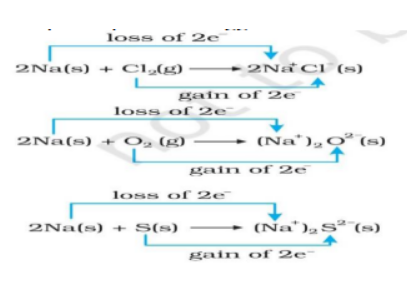
$2\text{Na}(\text{s})+\text{Cl2}\text{g}\rightarrow2\text{NaCl}(\text{s})$ $4\text{Na}(\text{s})+\text{O}_2\text{g}\rightarrow2\text{Na}_2\text{o}(\text{s})$ $2\text{Na}(\text{s})+\text{S}\text{(s)}\rightarrow2\text{Na}_2\text{S}(\text{s})$ are redox reactions because in each of these reactions sodium is oxidised due to the addition of either oxygen or more electronegative element to sodium. Simultaneously, chlorine, oxygen and sulphur are reduced because to each of these, the electropositive element sodium has been added. From our knowledge of chemical bonding we also know that sodium chloride, sodium oxide and sodium sulphide are ionic compounds and perhaps better written as $\mathrm{Na}+\mathrm{Cl}-(\mathrm{s}),\left(\mathrm{Na}^{+}\right)_2 \mathrm{O}^2-(\mathrm{s})$, and $\left(\mathrm{Na}^{+}\right)_2 \mathrm{~S}^{2-}(\mathrm{s})$. Development of charges on the species produced suggests us to rewrite the reactions in the following manner: For convenience, each of the above processes can be considered as two separate steps, one involving the loss of electrons and the other the gain of electrons. As an illustration, we may further elaborate one of these, say, the formation of sodium chloride. $2\text{Na}(\text{s})\rightarrow2\text{Na}^+\text{g}+2\bar{\text{e}}$ $\text{Cl}_2\text{g}+2\bar{\text{e}}\rightarrow2\text{C}\bar{\text{I}}\text{ (g)}$ Each of the above steps is called a half reaction, which explicitly shows involvement of electrons. Sum of the half reactions gives the overall reaction $2\text{Na}(\text{s})+\text{Cl}_2\text{(g)}\rightarrow2\text{Na}^+\text{CI}(\text{s})\text{ or } 2\text{NaCI}(\text{s})$ Above Reactions suggest that half reactions that involve loss of electrons are called oxidation reactions. Similarly, the half reactions that involve gain of electrons are called reduction reactions. To summarise, we may mention that Oxidation: Loss of electron(s) by any species. Reduction: Gain of electron(s) by any species. Oxidising agent: Acceptor of electron(s). Reducing agent: Donor of electron(s).
  1. Addition of electronegative element to a substance is known as..
  1. Oxidation
  2. Reduction
  3. Redox reaction
  4. All the above
  1. Removal of electronegative element to a substance is known as ..
  1. Oxidation
  2. Reduction
  3. Redox reaction
  4. All the above
  1. Acceptor of electrons is …
  1. Reducing Agent
  2. Catalytic Agent
  3. Oxidising Agent
  4. None of above
  1. Donor of electrons is…
  1. Organic Agent
  2. Catalytic Agent
  3. Oxidising Agent
  4. Reducing Agent
  1. Oxidation and Reduction occurs simultaneously is known as …
  1. Exothermic reaction
  2. Endothermic reaction
  3. Redox reaction
  4. Neutralization reaction