There are $n$ similar conductors each of resistance $R$. The resultant resistance comes out to be $x$ when connected in parallel. If they are connected in series, the resistance comes out to be
Medium


Download our appand get started for free
Experience the future of education. Simply download our apps or reach out to us for more information. Let's shape the future of learning together!No signup needed.*
Similar Questions
- 1$A$ constant voltage is applied between the two ends of a uniform metallic wire. Some heat is developed in it. The heat developed is doubled ifView Solution
- 2Two wires of same metal have the same length but their cross-sections are in the ratio $3:1$. They are joined in series. The resistance of the thicker wire is $10\,\Omega $. The total resistance of the combination will be ............. $\Omega$View Solution
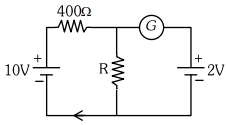
- 3If the galvanometer $G$ does not show any deflection in the circuit shown, the value of $R$ is given by $............\Omega$View Solution
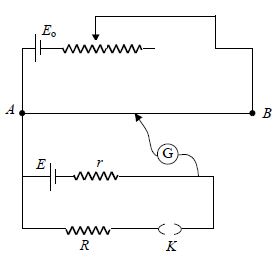
- 4The given figure represents an arrangement of potentiometer for the calculation of internal resistance $(r)$ of the unknown battery $(E)$. The balance length is $70.0\, cm$ with the key opened and $60.0\,cm$ with the key closed. $R$ is $132.40 \Omega $. The internal resistance $(r)$ of the unknown cell will be.......$\Omega$ (Given $E_o > E$) :-View Solution
- 5View SolutionIdentify the set in which all the three materials are good conductors of electricity
- 6A potentiometer is connected between $A$ and $B$ and the balance point is obtained at $203. 6\,cm$. When the end of the potentiometer connected to $B$ is shifted to $C$, then the balance point is obtained at $24.6\,cm$. If now the potentiometer be connected between $B$ and $C$, the balance point will be at ................. $cm$View Solution

- 7Two cells, having the same $e.m.f.$ are connected in series through an external resistance $R.$ Cells have internal resistances $r_1$ and $r_2\,\, (r_1 > r_2)$ respectively. When the circuit is closed, the potential difference across the first cell is zero. The value of $R$ isView Solution
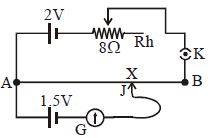
- 8In a potentiometer experiment shown here, for the position $X$ of the jockey $J,$ there occurs a null deflection in the galvanometer. Then the potential difference between points $A$ and $X$ is ................ $V$View Solution
- 9For a wire $\frac{R}{l}=\frac{1}{2}$ and length of wire is $l=5\, cm .$ If potential difference $1\, V$ is applied across it, current through wire will be: $( R =$ Resistance $)$ (in $A$)View Solution
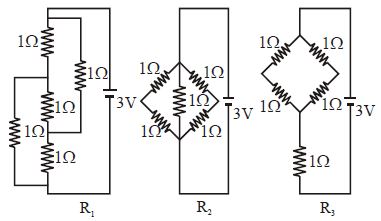
- 10Figure shows three resistor configurations $R_1,R_2$ and $R_3$ connected to $3\,V$ battery. If the power dissipated by the configuration $R_1, R_2$ and $R_3$ is $P_1, P_2$ and $P_3$ , respectively thenView Solution